



Abstract
This study investigates protective factors that may mitigate smartphone addiction from a positive psychology perspective, emphasizing the role of self-regulatory strengths. Exploratory sequential mixed design was used in the study. In the qualitative phase, 13 university students with high smartphone use (one standard deviation above the mean) were selected from a sample of 84 and interviewed using semi-structured formats. Content analysis identified self-control, social relationships, physical activities, hobbies, and responsibilities as key factors in reducing smartphone use. In the quantitative phase, data were collected from 612 students (427 females, 185 males) using the Smartphone Addiction Inventory, Multidimensional Self-Control Scale, Social Relationships Scale, and Responsibility Scale. Structural model analysis revealed that, unlike in the qualitative findings, social relationships did not significantly correlate with smartphone addiction. While responsibility was linked to addiction, this relationship overlapped considerably with self-control. Overall, self-control emerged as a robust protective factor, highlighting its central role in promoting healthier smartphone use behaviors.
Keywords: smartphone addiction, self-control, digital dependency, mixed methods, protective factors
Main Points
- This study investigates protective factors against smartphone addiction using a mixed-methods design.
- Qualitative findings indicated that self-control, social relationships, physical activities, hobbies, and responsibilities reduced smartphone use.
- Contrary to the qualitative findings, the quantitative analysis showed no significant association between social relationships and smartphone addiction.
- Responsibility was associated with smartphone addiction, but this relationship largely overlaps with self-control.
- Self-control emerged as the most robust protective factor against smartphone addiction
Introduction
Apart from communicating, smartphones enable individuals to engage in many activities such as health, exercise, navigation, social networking, listening to music, watching movies/videos, keeping schedules and reminders, managing emails, surfing the internet, playing video games, gambling, etc. without being limited by their environment (Billieux, 2012). Due to their functionality and portability, people’s desire for these phones has increased. As of 2023, 6.9 billion people worldwide are smartphone users. Since 2016, nearly 3 billion people have become smartphone users. Projections indicate that this number will be 7.8 billion in 2028 (Taylor, 2023). Smartphone use worldwide is increasing daily, and Türkiye is among the eight countries with the highest smartphone usage in the world, according to a meta-analysis study conducted across 24 countries. Researchers emphasize that this may be a reflection of psychological distress (Olson et al., 2022).
Smartphone use serves the function of increasing social interactions. Especially with the COVID-19 pandemic, which affected many economic, social, and political dimensions worldwide, smartphones became essential for individuals to maintain their psychological balance. Recent meta-analysis findings show that many behavioral addictions intensified with the COVID-19 pandemic, and the rate of smartphone addiction reached 30.7% (Alimoradi et al., 2022). Especially during the COVID-19 period, use of smartphones for educational, entertainment, and emotional purposes increased (de Freitas et al., 2022). Similarly, Hu et al. (2022) found in their longitudinal study that interpersonal alienation during the COVID-19 period increased smartphone addiction through decreased meaning of life, and that smartphone addiction decreased with the end of the pandemic.
One of the groups that use smartphones extensively is university students. Smartphones help university students share knowledge and experience (Aljomaa et al., 2016). In addition to these benefits, their prevalence and adverse effects among university students have attracted attention recently. Studies have shown that smartphone use is common among university students (Aljomaa et al., 2016). A significant portion of this group experiences health problems such as sleep disorders and fatigue (Matar Boumosleh & Jaalouk, 2017). Smartphones, which trigger negative psychological factors such as depression, anxiety, and stress (Okasha et al., 2022), can also be the precursor of many social problems (Enez Darcin et al., 2016). Smartphone addiction has also been associated with suicide risk in university students (Okasha et al., 2022). Therefore, university students are an essential risk group regarding smartphone use prevalence.
Smartphone Addiction
Smartphone addiction is considered a subcategory of technology addiction (Lin et al., 2014), which is defined by Griffiths (1996) as “non-chemical (behavioral) addictions which involve human-machine interaction.” Smartphone addiction is not structurally different from other types of addiction. The American Psychiatry Association (2023) defines addiction as the loss of control over a substance one uses, despite its harmful consequences. Although smartphone addiction has a similar structure to DSM-5 (Lin et al., 2014), the ease of access (Billieux, 2012) makes this type of addiction quite dangerous. Within the scope of this research, we adopted the conceptual framework developed by Lin et al. (2014), who discuss smartphone addiction under four components.
Compulsive behavior refers to an individual’s inability to control their behavior and their constant urge to engage with the smartphone; functional impairment means that the time spent with the smartphone negatively affects the functioning in daily life and causes psychological or physical problems; withdrawal means that the individual experiences unpleasant emotions and physical symptoms when they put down the smartphone; tolerance means that the time spent on the smartphone increases in order to get the same pleasure (Griffiths, 2005; Lin et al., 2014).
Since smartphone addiction parallels technology-related addictions in many ways, and Lin et al. (2014) grounded smartphone addiction in general addiction and internet addiction, the “object of addiction” in this study is referred to as the smartphone. In the literature, many studies on smartphone addiction focus on negative factors, such as depression and anxiety, which increase smartphone addiction or are increased by smartphone addiction (Matar Boumosleh & Jaalouk, 2017).
Smartphones have become such an integral part of everyday life that it is impossible to completely move away from them. There are conflicting results in the literature on whether digital detox, which involves quitting entirely or for a while to reduce the adverse effects of smartphones, is practical (Radtke et al., 2022). The literature indicates that self-control and a sense of security are protective factors in smartphone use (Cho et al., 2017). According to the study conducted by Sela et al. (2022), if individuals’ awareness of smartphone use is high, phones can affect individuals’ lives positively, rather than negatively. Various factors can reduce smartphone use. This study will examine these factors on the axis of positive psychology. In this direction, the study aims to determine the factors that reduce smartphone addiction in university students.
Protective Positive Factors in Smartphone Addiction
Positive psychology points out that the presence of positive states means more than the absence of negative emotions. Therefore, eliminating negativity may not necessarily mean a person is satisfied with life. Thus, positive psychology aims to develop strengths that can be protective factors against adverse events, rather than repairing negative aspects of an individual’s life (Seligman, 2002).
There are various studies examining positive psychology concepts and smartphone addiction. For example, variables such as well-being and resilience, mindfulness have been found to be protective factors (Choi & Kim, 2018; Horwood & Anglim, 2019). In addition, studies show that positive psychology-based practices are effective in smartphone addiction. Studies also show that psychological resilience (Choi & Kim, 2018), interpersonal and conscientiousness virtues (Lian, 2018), meaning of life and responsibility (Kaya et al., 2024) are effective in reducing smartphone use. Therefore, studies in the literature show that positive psychology practices and concepts have a protective effect against smartphone addiction.
Method
This study was conducted using the Exploratory Sequential Mixed Methods Design, one of the mixed research methods. In this research design, qualitative data are collected first, followed by quantitative data. It is possible to generalize the findings of qualitative analysis to a more extensive study group through quantitative data collection (Creswell, 2014). In this direction, qualitative interviews were conducted with a group with high smartphone usage. Then, quantitative research was conducted using measurement tools to examine the generalizability of the most frequently emerging themes from the qualitative interviews.
Participants
In Study 1, the Smartphone Addiction Inventory was administered to 84 university students, 15 males (17.9%) and 69 females (82.1%), aged between 18 and 33 years (x̄=58.46, Sd=12.23). Semi-structured interviews were conducted with 13 students with the highest scores (x̄=7.15, Sd =7.07), and one standard deviation above the mean. Twelve of the interviewed students were female (92.3%) and one was male (7.7%), and their ages ranged between 18 and 26 years. The participants stated that they used a smartphone for an average of 6.04 hours daily. Interviews were conducted in the spring semester of the 2022-2023 academic year.
In Study 2, data collection tools were determined based on the themes that emerged most frequently in the qualitative interviews. The application was carried out on a group of 612 university students, 427 females (70%) and 185 males (30%), aged 18 to 35 years, attending different departments across Gazi University during the fall semester of the 2023-2024 academic year. The mean age of the participants was 21.03 years, SD= 2.64. Convenience sampling was used to select the participants.
Procedure
Firstly, approval was obtained at the Gazi University Ethics Commission meeting numbered 18, with the research code number 2023-1336. Research data were collected through online interviews (Study 1) and face-to-face administration of paper-and-pencil tests (Study 2) between May and December 2023. Participants were informed verbally and in writing during the data collection phase. It was stated in the informed consent form that they could leave the study at any time without any explanation.
Data Collection Tools
In Study 1, the Personal Information Form, Smartphone Addiction Inventory and Interview Form were used. In Study 2, in addition to the Personal Information Form and Smartphone Addiction Inventory, Multidimensional Self-Control Scale, Social Relations Scale, and Responsibility Scale were used in line with the results of Study 1.
Personal Information Form: This form includes items to collect information about the participants’ gender and age.
Smartphone addiction inventory (S.P.A.I.): The measurement tool was adapted into Turkish by Arpaci and Esgi (2020). The inventory comprises 26 items and is scored on a 4-point Likert scale (1: not at all, 4: always). As a result of the confirmatory factor analysis conducted on the university sample for the validity study, it was found to have a 4-factor structure by its original form, including “compulsive behavior”, “withdrawal”, “tolerance”, and “functional impairment”. As a result of C.F.A., fit indices were found to be adequate [χ2 (156) = 328.26, χ2/DF = 2.10, GFI = .91, AGFI = .87, NFI = .86, TLI = .91, CFI = .92, IFI = .92, R.M.S.E.A.= .058]. The Cronbach’s alpha internal consistency coefficient calculated for reliability ranged between .71 and .84 for the sub-dimensions (Arpaci & Esgi, 2020). The Cronbach’s alpha coefficient calculated for this study was .91 in Study 1 and .92 in Study 2 for the whole scale.
Interview form: The interview form consists of 6 questions, 5 of which are open-ended and 1 of which is closed-ended. Four items in the interview form were based on the conceptual framework of the 4-component smartphone addiction model put forward by Lin et al. (2014). These questions focus on the positive psychology approach’s positive aspects and aim to reveal the life experiences in which people experience the situations in these components less. The questions in the interview form and the components to which they are related are presented in Table 1.
| * The questions were developed in line with Lin et al. (2014) | |
| Table 1. Interview form questions | |
| Questions | Component |
| Do you use a smartphone? How are you with a smartphone? | Perception of smartphone |
| How many hours a day do you spend on your smartphone, except when necessary? | Frequency of use |
| What do you do that gives you more control over your smartphone use? | Compulsive behavior* |
| What can you do more to reduce the negative impact of your smartphone on your life? | Functional impairment* |
| What makes you feel good emotionally and physically when you are not using a smartphone? | Withdrawal* |
| What do you do to reduce your smartphone cravings when they increase? | Tolerance* |
Multidimensional Self-Control Scale: The scale was adapted into Turkish by Gülüm and Tığrak (2022). Consisting of 25 items, the scale is a 5-point Likert type (1: Strongly disagree, 5: Strongly agree) with eight reverse-scored items. There are two dimensions in the measurement tool: “Inhibition” and “Initiation”. The validity study for the adaptation was conducted on university students. As a result of CFA for construct validity, it was found to have the goodness of fit values (χ2(263, N= 308) = 394.04, p < .001; CFI = .95; TLI = .95; R.M.S.E.A.= .04; 90% G.A. [.03, .05]; S.R.M.R. = .06). Cronbach’s alpha internal consistency coefficient was found to be .85. The Cronbach’s alpha coefficient calculated for this study was .88 for the whole scale.
Social Relations Scale: The scale developed by Köse et al. (2022) is a 5-point Likert scale (1= Very distant, 5= Very close) comprising ten items. The scale has three dimensions: family (3 items), relative/neighbor (3 items), and friend (4 items) relationships. These three dimensions were found to explain 62% of the total variance. As a result of the CFA conducted on the data collected from university students and young adults aged 25-29, adequate fit values (x2/sd=5.02; R.M.S.E.A.=.06; GFI=.97; CFI=.95; NFI=.94; x2/sd=5.09; RMSEA=.06; GFI=.98; CFI=.97; NFI=.96) were obtained for both groups. Cronbach’s alpha coefficient for the whole measurement tool for the two groups was .79 and .83. The Cronbach’s alpha coefficient calculated for this study was .69 for the whole scale.
Responsibility Scale: The scale developed by Topcu (2016) is a 5-point Likert type and consists of 24 items. There are five reverse-scored items. Validity and reliability studies were conducted on adult individuals. As a result of EFA for construct validity, three dimensions emerged: cognitive, emotional, and behavioral. The three factors explained 56% of the total variance. Cronbach’s alpha internal consistency coefficient was found to be .90. The Cronbach’s alpha coefficient calculated for this study was .83 for the whole scale.
Validity and Reliability Studies
Content analysis was conducted in the first part of the qualitative study. Also, the study used methods to ensure validity and reliability as specified in the literature for qualitative research. These methods are credibility, transferability, consistency, and confirmability (Lincoln et al. 1985). For credibility, expert opinions were obtained from three academics, the interviews were videotaped, and confirmation was obtained from the participants after transcription. For transferability, the interviewees in the qualitative research were selected using the criterion sampling method (1 standard deviation above the mean). In order to ensure consistency, an independent researcher coded the participants’ statements, and the discrepancies were discussed. In addition, the internal validity method proposed by Miles and Huberman (1994) (Reliability= Number of Agreements / (Number of Agreements+Disagreements)×100) was used. The internal validity coefficient obtained from this formula was calculated as 91.3%. In order to ensure confirmability, a pilot study was conducted with two people before the main application to determine the comprehensibility of the interview form and the appropriateness of the questions for the research. In addition, after the interviews, the participants’ statements were transcribed unchanged and shared with the participants. The codes were thought to be reflected in the statements and were used as study findings after receiving their confirmation. No qualitative data analysis software was used in the analysis of the data; the entire analysis process was conducted manually by the researcher.
Preliminary Analyses
The data were analyzed using IBM SPSS 25 and AMOS 18.0 package programs in the second part of the quantitative part of the study. Before the data were processed, they were analyzed for missing data and normal distribution. Within the scope of Study 2, two cases with more than 5% missing items were removed from the data set. Outliers were detected using Mahalanobis Distance, Cook’s distance values greater than 1, values whose z scores not within ±3, and box plot analysis. As a result of these methods, 44 outliers were identified and removed from the data set. Skewness and kurtosis values of the variables in the study were analyzed both in Study 1 (Skewness: .056, Kurtosis: .272) and Study 2 (Smartphone addiction: Skewness: .182, Kurtosis: .319; Self-control: Skewness: -.074, Kurtosis: .139; Responsibility: Skewness: -.385, Kurtosis: .061; Social relations: Skewness: -.113, Kurtosis: .365) and were found to be within ±1 range. It can be said that normal distribution regarding skewness and kurtosis values was achieved in this study.
Results
The categories and codes obtained in the qualitative part of the study are presented in Table 2.
| Table 2. Factors that reduce smartphone addiction | |||
| Category | Code |
|
|
| Self-Control | Restrict usage through apps |
|
|
| Turning off the phone/internet |
|
|
|
| Motivation for self-discipline |
|
|
|
| Making a daily plan |
|
|
|
| Keeping the phone away |
|
|
|
| Subtotal |
|
|
|
| Social Relations | Spending time with friends |
|
|
| Spending time with family |
|
|
|
| Chatting with people loves |
|
|
|
| Subtotal |
|
|
|
| Physical Activities | Light exercise (walking) |
|
|
| Doing sports |
|
|
|
| Subtotal |
|
|
|
| Hobbies | Reading a book |
|
|
| Cooking |
|
|
|
| Movie/T.V./Music |
|
|
|
| Playing games |
|
|
|
| Travel |
|
|
|
| Gardening |
|
|
|
| Painting/ Handicraft arts |
|
|
|
| Other events |
|
|
|
| Subtotal |
|
|
|
| Responsibilities | Academic issues |
|
|
| Housework |
|
|
|
| Subtotal |
|
|
|
A participant who tried to reduce his smartphone use to gain control over his behavior and spend time with his family shared the following:
“In the settings on my phone, there are reports of how many hours I use per day and week. When I see them, I think, 7 hours of my day, 9 hours of my day were spent with this. If I slept for 8 hours, I think I spent most of the day on my phone, and something inside me tells me to walk away. Moreover, I walk away. That is how I control myself.... How do I get away?... I put my phone in a different room and care for other things or chat with people around me.” (P8)
“I try to drain my battery and put it in a room away from me and not plug it in for a while.”
Another participant ironically stated that she tried to gain self-control over her smartphone through smartphone applications:
“I used time-limiting apps but could not adapt to them. I was constantly increasing the time. .... For example, when you hang out on Instagram for 2 hours, it locks Instagram. They were not very effective. However, there was an application called Forest. It was giving prizes. It was more like a game. It had motivational reminders like ‘Get away from your phone’ and ‘Look at your life.’ I was doing what they said.” (P1)
The following is the statement of a participant who stated that social relationships reduce the use of smartphones:
“When I am not at home or spend time with others, I use the smartphone in a controlled way.... When I do activities, go out, spend time with my friends, and sit with my family, my phone usage decreases so that I can control it.” (P3)
Below is a participant stating that she could reduce her desire to use her smartphone thanks to her hobbies:
“I try to take up new hobbies. My mother sometimes does handicrafts; I try to help her. Alternatively, sometimes I have a very close friend who is a farmer. I go to him; I take care of flowers, fields, etc. Anyway, meeting with the soil is something that elevates people both physically and mentally.” (P10)
Another participant emphasized that light exercise and socializing with friends are protective factors for smartphone use:
P: “When I go out, I reduce (the negative impact of the smartphone) a lot. When I am at home, (the negative impact of the smartphone) increases.”
I: “What do you do when you go out?”
P: “I can go for a coffee; I like to go for a walk; I go for a walk with my friends... We can do sightseeing or something cultural, like going to a museum. We also like to go on picnics.” (P12)
Another participant said they use smartphones less when they have responsibilities such as studying:
P: “For example, I have a routine job. I have to do it. However, I have not done it for a long time. Somehow, it stresses me out. I do not do it, I do not do it, I do not do it.... I need to do that job, but I increase my phone usage. Finally, my desire for that job has increased in the last two or three days, and my phone usage has decreased.....”
I: “What do you attribute your doing your work and putting down the phone for the last two or three days then?”
P: “Because I need to fulfill my responsibility.” (P11)
Findings
Descriptive analyses and correlation results for social relationships, self-control, responsibility, and smartphone addiction are given in Table 3.
| N = 612, **p <.01 | ||||||
| Table 3. Descriptive statistics and correlations for the variables | ||||||
| Variables | X̅ |
|
|
|
|
|
| Social relationships |
|
|
|
|||
| Self-control |
|
|
|
|
||
| Responsibility |
|
|
|
|
|
|
| Smartphone addiction |
|
|
|
|
|
|
As seen in Table 3, self-control and responsibility are significantly negatively related to smartphone addiction, while there is no significant relationship between social relationships and smartphone addiction. In this case, social relationships were not included in the model since they were unrelated to smartphone addiction.
Measurement Model
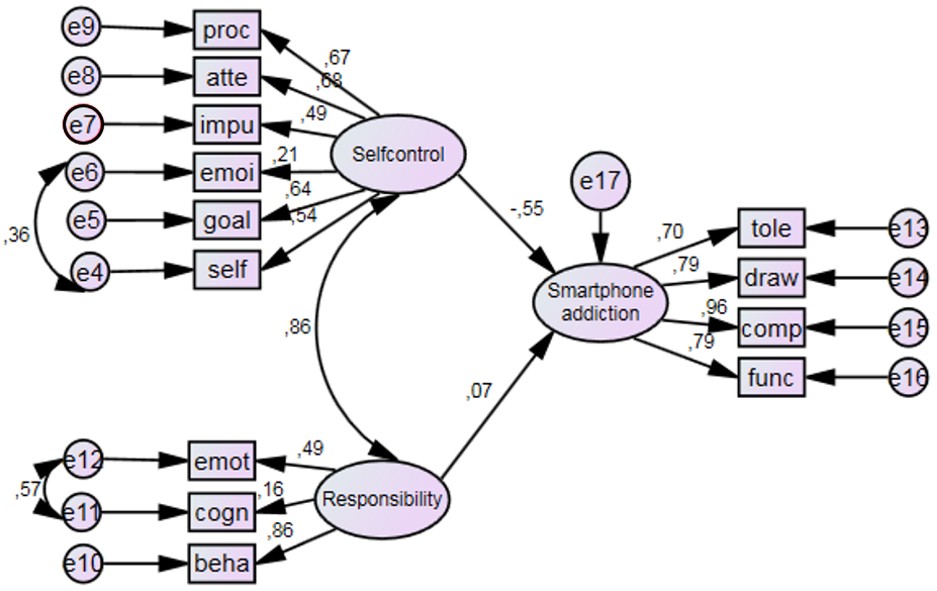
The measurement model includes three latent variables (Self-control, Responsibility, and Smartphone addiction) and 13 indicators. The fit values of the measurement model were not found to be sufficient in the first analysis. In line with the modification suggestions, goal orientation and emotion control were associated with self-control strategies, indicators of the self-control latent variable. Again, cognitive and emotional dimensions, the indicators of the responsibility latent variable, were associated. As a result of these modifications, the measurement model was found to have adequate fit values (χ2/df = 3.42, G.F.I. = .95, TLI = .94, CFI = .996, R.M.S.E.A. = .063). At the same time, the path coefficients from all indicators to the latent variables (between .15 and .96) were found to be significant at the .01 level.
Structural Model
First, the model for predicting phone addiction by two independent variables (self-control and responsibility) was tested. However, model fit values were not adequate (χ2/df = 11.17, G.F.I. = .86, TLI = .75, CFI = .80, R.M.S.E.A. = .129). Then, in line with the modification suggestions, responsibility and self-control were first associated. Although responsibility and self-control are different latent variables, their relationship is high. Therefore, their common variance is strong. Then, cognitive and emotional dimensions were associated under the latent variable of responsibility, and self-control strategies and emotion control were associated under the latent variable of self-control. In this case, the fit values of the model were found to be acceptable (χ2/df = 4.68, G.F.I. = .93, TLI = .91, CFI = .93, R.M.S.E.A. = .078). When the model in Figure 1 was analyzed, it was found that self-control predicted smartphone addiction (β = -.55, p < .01). Although responsibility was significantly negatively correlated with smartphone addiction in the correlation analysis, it was not significant in the structural model (.07 p> .05). This is because responsibility has a strong common variance with self-control.
Conclusion and Discussion
This study investigated protective factors that reduce smartphone addiction. In the qualitative research, self-control, social relationships, physical activities, hobbies, and responsibilities were categories that reduced smartphone use. Surprisingly, in the quantitative research findings, it was concluded that social relationships did not have a significant effect on smartphone addiction. In the literature, studies show that smartphone use is positively related to social relationships (Kim et al., 2016), but there are also studies showing that it is negatively related (Enez Darcin et al., 2016). Smartphones also increase social relationships (Troll et al., 2021). In addition, smartphones enable physically distant individuals to interact. Remondi et al. (2023) found that smartphone overuse had no significant relationship with friend relationships and had a low negative significant relationship with family relationships. Li and Lin (2019) found in their qualitative study that smartphone addicts are more extroverted and talkative. According to the researchers, the smartphone provides a platform for these people to socialize.
Similarly, Cho et al. (2017) found that extraversion predicted smartphone addiction at a low level and positively. These results can be understood by considering the prevalence of friend relationships on digital platforms today. Therefore, smartphone addiction and sociability have a complex relationship. In addition, research draws attention to the impact of the COVID-19 pandemic on the increase in smartphone use (Alimoradi et al., 2022; de Freitas et al., 2022). Therefore, while smartphones have been an essential tool for socialization during the pandemic, they may have turned into a risk factor after the pandemic. While smartphones mediate socialization on digital platforms, they may constitute a risk factor for face-to-face social relationships. Considering the year this study was conducted and the study group, the prolonged Covid-19 pandemic and the fact that some fields, including education, were conducted remotely as a result of the earthquake centered in Kahramanmaraş on February 6, which occurred in Türkiye, may have further complicated the relationship between smartphones and social relations.
On the other hand, the protective effect of self-control on smartphone use found in the qualitative findings was also supported in the quantitative findings. Addiction is behavioral by definition (Lin et al., 2014). For example, one study observed that smartphone-addicted university students were frequently interrupted while studying due to phone applications and did not have behavioral control (Lee et al., 2015). In another study, it was found that the smartphone-addicted and non-addicted groups felt similar feelings of distress and desire about smartphone use. However, the non-addicted group had more awareness and control over their behavior (Jameel et al., 2019). Similar to the results in this study, Troll et al. (2021) concluded that people who can put their phones away have more control over smartphone use. Different studies confirm the protective effect of self-control on smartphone addiction (Cho et al., 2017). Based on all this information, individuals with self-control are more successful in reducing their smartphone use.
Although responsibility is a variable negatively related to smartphone addiction, it is not a significant predictor in the structural model test because responsibility has a substantial common variance with self-control. In the literature, there are a limited number of studies investigating the relationship between responsibility and addiction. In these studies, responsibility was negatively related to smartphone addiction (Horwood & Anglim, 2019). The Interaction of the Person-Affect-Cognition-Execution (I-PACE) model proposed in the literature mentions that a low responsibility level is a risk factor for internet-use disorders (Brand et al., 2016).
On the other hand, the fact that responsibility was not a significant predictor of smartphone addiction in the model test in this study can be considered to indicate that self-control is a more critical protective factor for smartphone addiction than responsibility. Additionally, having self-control is a dominant protective factor for smartphone addiction regardless of individuals’ social relationships. In short, when the results of the study are considered as a whole, individuals with high self-control are more advantageous than others in terms of protection or recovery from smartphone addiction.
Limitations and Directions for Future Research
This study has certain limitations. First, the findings from this study were obtained from university students’ smartphone experiences. It may be worthwhile to conduct studies with different age groups. Also, the categories of physical activities and hobbies that emerged in the qualitative study could not be tested in the quantitative study due to the need for an appropriate measurement tool. In addition, in line with the findings of the study, psycho-educational practices and informative studies can be conducted to improve adults’ self-control skills. Mental health professionals can take into consideration that self-control is a significant predictor when intervening with individuals with high smartphone addiction. Also, the qualitative part of this study was conducted on the group with high smartphone addiction. In other studies, groups with low smartphone addiction can be studied. Thus, the experiences of these groups towards limiting smartphone use can be revealed. Another limitation was the gender imbalance in the study groups. In both Study 1 and Study 2, the number of women was much higher than the number of men. It may be beneficial to consider gender balance in future study groups. Furthermore, comparisons between genders may shed light on the field. For example, an exploratory study design could examine the areas in which women and men experience the most lack of self-control in smartphone addiction.
Ethical approval
This study was approved by the Gazi Üniversitesi Etik Komisyonu (Gazi University Ethics Committee) (Date: October 17, 2023, Decision/Protocol No: E-77082166-604.01.02-799722). Informed consent was obtained from all participants involved in this study.
Data availability statement
The data that support the findings of this study are available from the corresponding author upon reasonable request.
Conflict of interest
The authors declare that this study was conducted in the absence of any commercial or financial relationships that could be construed as a potential conflict of interest.
Funding
The authors declare that this study received no funding.
Generative AI statement
The authors declare that no generative AI or AI-assisted technologies were used in the writing or preparation of this study.
References
- Alimoradi, Z., Lotfi, A., Lin, C. Y., Griffiths, M. D., & Pakpour, A. H. (2022). Estimation of behavioral addiction prevalence during COVID-19 pandemic: A systematic review and meta-analysis. Current Addiction Reports, 9(4), 486-517. https://doi.org/10.1007/s40429-022-00435-6
- Aljomaa, S. S., Al.Qudah, M. F., Albursan, I. S., Bakhiet, S. F., & Abduljabbar, A. S. (2016). Smartphone addiction among university students in the light of some variables. Computers in Human Behavior, 61, 155-164. https://doi.org/10.1016/j.chb.2016.03.041
- American Psychiatry Association. (2023). What is addiction? https://www.psychiatry.org/patients-families/addiction/what-is-addiction
- Arpaci, I., & Esgi, N. (2020). Psychometric properties of the Turkish version of the smartphone addiction inventory (SPAI). Current Psychology, 39(6), 2246-2251. https://doi.org/10.1007/s12144-018-9913-8
- Billieux, J. (2012). Problematic use of the mobile phone: A literature review and a pathways model. Current Psychiatry Reviews, 8(4), 299-307. https://doi.org/10.2174/157340012803520522
- Brand, M., Young, K. S., Laier, C., Wölfling, K., & Potenza, M. N. (2016). Integrating psychological and neurobiological considerations regarding the development and maintenance of specific Internet-use disorders: An Interaction of Person-Affect-Cognition-Execution (I-PACE) model. Neuroscience & Biobehavioral Reviews, 71, 252-266. https://doi.org/10.1016/j.neubiorev.2016.08.033
- Cho, H. Y., Kim, D. J., & Park, J. W. (2017). Stress and adult smartphone addiction: Mediation by self‐control, neuroticism, and extraversion. Stress and Health, 33(5), 624-630. https://doi.org/10.1002/smi.2749
- Choi, W. S., & Kim, H. Y. (2018). The effects of smartphone addiction on subjective happiness in university students: Mediating effect of resilience. Journal of the Korea Academia-Industrial Cooperation Society, 19(1), 199-207. https://doi.org/10.5762/KAIS.2018.19.1.199
- Creswell, J. W. (2014). Research design: Qualitative, quantitative and mixed method approaches. SAGE Publications.
- de Freitas, B. H. B. M., Gaíva, M. A. M., Diogo, P. M. J., & Bortolini, J. (2022). Relationship between lifestyle and self-reported smartphone addiction in adolescents in the COVID-19 pandemic: A mixed-methods study. Journal of Pediatric Nursing, 65, 82-90. https://doi.org/10.1016/j.pedn.2022.03.001
- Enez Darcin, A., Kose, S., Noyan, C. O., Nurmedov, S., Yılmaz, O., & Dilbaz, N. (2016). Smartphone addiction and its relationship with social anxiety and loneliness. Behavior & Information Technology, 35(7), 520-525. https://doi.org/10.1080/0144929x.2016.1158319
- Griffiths, M. (1996). Gambling on the internet: A brief note. Journal of Gambling Studies, 12(4), 471-473. https://doi.org/10.1007/bf01539190
- Griffiths, M. (2005). A ‘components’ model of addiction within a biopsychosocial framework. Journal of Substance Use, 10(4), 191-197. https://doi.org/10.1080/14659890500114359
- Gülüm, İ. V., & Tığrak, A. (2022). Çok boyutlu özdenetim ölçeği Türkçe formunun psikometrik özellikleri. Nesne, 10(23), 89-104. https://doi.org/10.7816/nesne-10-23-06
- Horwood, S., & Anglim, J. (2019). Problematic smartphone usage and subjective and psychological well-being. Computers in Human Behavior, 97, 44-50. https://doi.org/10.1016/j.chb.2019.02.028
- Hu, Q., Liu, Q., & Wang, Z. (2022). Meaning in life as a mediator between interpersonal alienation and smartphone addiction in the context of Covid-19: A three-wave longitudinal study. Computers in Human Behavior, 127, 107058. https://doi.org/10.1016/j.chb.2021.107058
- Jameel, S., Shahnawaz, M. G., & Griffiths, M. D. (2019). Smartphone addiction in students: A qualitative examination of the components model of addiction using face-to-face interviews. Journal of Behavioral Addictions, 8(4), 780-793. https://doi.org/10.1556/2006.8.2019.57
- Kaya, A., Türk, N., Batmaz, H., & Griffiths, M. D. (2024). Online gaming addiction and basic psychological needs among adolescents: The mediating roles of meaning in life and responsibility. International Journal of Mental Health and Addiction, 22(4), 2413-2437. https://doi.org/10.1007/s11469-022-00994-9
- Kim, Y., Jeong, J.-E., Cho, H., Jung, D.-J., Kwak, M., Rho, M. J., Yu, H., Kim, D.-J., & Choi, I. Y. (2016). Personality factors predicting smartphone addiction predisposition: Behavioral inhibition and activation systems, impulsivity, and self-control. PLOS ONE, 11(8), e0159788. https://doi.org/10.1371/journal.pone.0159788
- Köse, M. F., Öztürk, M. A., & Acar, A (2022). Sosyal İlişkiler Ölçeği’nin geliştirilmesi ve psikometrik özellikleri. İstanbul Üniversitesi Sosyoloji Dergisi, 42(1), 1-20. https://doi.org/10.26650/SJ.2022.42.1.0071
- Lee, J., Cho, B., Kim, Y., & Noh, J. (2015). Smartphone addiction in university students and its implication for learning. In Y. Zhou & N.-S. Chen (Eds.), Emerging issues in smart learning. Lecture notes in educational technology (pp. 297-305). Springer. https://doi.org/10.1007/978-3-662-44188-6_40
- Lian, L. (2018). Alienation as mediator and moderator of the relationship between virtues and smartphone addiction among Chinese university students. International Journal of Mental Health and Addiction, 16, 1208-1218. https://doi.org/10.1016/j.chb.2016.08.027
- Li, L., & Lin, T. T. (2019). Over-connected? A qualitative exploration of smartphone addiction among working adults in China. BMC Psychiatry, 19, 186. https://doi.org/10.1186/s12888-019-2170-z
- Lin, Y. H., Chang, L. R., Lee, Y. H., Tseng, H. W., Kuo, T. B., & Chen, S. H. (2014). Development and validation of the Smartphone Addiction Inventory (SPAI). PloS one, 9(6), e98312. https://doi.org/10.1371/journal.pone.0098312
- Lincoln, Y. S., Guba, E. G., & Pilotta, J. J. (1985). Naturalistic inquiry. International Journal of Intercultural Relations, 9(4), 438-439. https://doi.org/10.1016/0147-1767(85)90062-8
- Matar Boumosleh, J., & Jaalouk, D. (2017). Depression, anxiety, and smartphone addiction in university students- A cross sectional study. PLOS ONE, 12(8), e0182239. https://doi.org/10.1371/journal.pone.0182239
- Miles, M. B., & Huberman, A. M. (1994). Qualitative data analysis: An expanded sourcebook. Sage Publication.
- Okasha, T., Saad, A., Ibrahim, I., Elhabiby, M., Khalil, S., & Morsy, M. (2022). Prevalence of smartphone addiction and its correlates in a sample of Egyptian University students. International Journal of Social Psychiatry, 68(8), 1580-1588. https://doi.org/10.1177/00207640211042917
- Olson, J. A., Sandra, D. A., Colucci, É. S., Al Bikaii, A., Chmoulevitch, D., Nahas, J., Raz, A., & Veissière, S. P. L. (2022). Smartphone addiction is increasing across the world: A meta-analysis of 24 countries. Computers in Human Behavior, 129, 107138. https://doi.org/10.1016/j.chb.2021.107138
- Radtke, T., Apel, T., Schenkel, K., Keller, J., & von Lindern, E. (2022). Digital detox: An effective solution in the smartphone era? A systematic literature review. Mobile Media & Communication, 10(2), 190-215. https://doi.org/10.1177/20501579211028647
- Remondi, C., La Tona, A., Schimmenti, A., Lo Coco, G., Compare, A., & Brugnera, A. (2023). Uncovering latent profiles of internet, smartphone and gaming use among young adults and their relationships with psychosocial risk factors. Behaviour & Information Technology, 43(16), 3955-3969. https://doi.org/10.1080/0144929x.2023.2295955
- Sela, A., Rozenboim, N., & Ben-Gal, H. C. (2022). Smartphone use behavior and quality of life: What is the role of awareness? PloS one, 17(3), https://doi.org/10.13114/MJH.2017.370
- Seligman, M. E. P. (2002). Positive psychology, positive prevention, and positive therapy. In C. R. Snyder & S. J. Lopez (Eds.), Handbook of positive psychology (pp. 3-12). Oxford University Press. https://doi.org/10.1093/oso/9780195135336.003.0001
- Taylor, P. (2023). Number of smartphone mobile network subscriptions worldwide from 2016 to 2022, with forecasts from 2023 to 2028. Statista. https://www.statista.com/statistics/330695/number-of-smartphone-users-worldwide/
- Topcu, M. (2016). The concept of gratitude and its relationship with posttraumatic growth: roles of early maladaptive schemata and schema coping styles, locus of control and responsibility (Publication No. 439244) [Doctoral dissertation, Middle East Technical University, Ankara]. Council of Higher Education National Thesis Center.
- Troll, E. S., Friese, M., & Loschelder, D. D. (2021). How students’ self-control and smartphone-use explain their academic performance. Computers in Human Behavior, 117, 106624. https://doi.org/10.1016/j.chb.2020.106624
License
Copyright (c) 2026 The Author(s). This is an open access article distributed under the Creative Commons Attribution License (CC BY), which permits unrestricted use, distribution, and reproduction in any medium or format, provided the original work is properly cited.