



Abstract
The symptomatic manifestations of Attention-Deficit Hyperactivity Disorder (ADHD) represent a risk factor for Internet Gaming Disorder (IGD). With the increasing prevalence of digital gaming, the coexistence of ADHD and IGD has emerged as a significant mental health concern. This systematic review aims to evaluate case-control and experimental studies investigating the associations between ADHD and IGD. Guided by a research question structured within the PICOS framework, a search was conducted in PubMed, ScienceDirect, Scopus, and Web of Science databases, yielding 15 studies that met the inclusion criteria. Most of the studies focused on adolescent and young adult samples, while five employed neuroimaging methods. Findings indicate that individuals diagnosed with ADHD demonstrate significantly higher prevalence and severity of IGD compared to healthy controls; similarly, individuals with IGD present more frequent and pronounced ADHD symptoms. Neuroimaging data reveal structural and functional alterations in prefrontal and temporal regions. Furthermore, factors such as impulsivity, sleep disturbances, negative parenting styles, and poor social adjustment appear to exacerbate the severity of this comorbidity. Intervention studies report lower treatment responsiveness among individuals with ADHD+IGD comorbidity. Overall, the findings highlight a strong bidirectional relationship between the two disorders, grounded in both neurobiological and psychosocial mechanisms, and underscore the importance of early diagnosis and comprehensive intervention strategies.
Keywords: attention-deficit hyperactivity disorder, internet gaming disorder, comorbidity, systematic review
Main Points
- ADHD represents a significant risk factor for IGD, and the relationship between childhood or adult ADHD symptoms and IGD in adults should be further investigated.
- Neuroimaging studies have shown that individuals with ADHD and ADHD+IGD exhibit functional and structural alterations in the brain.
- The literature has reported that the presence of emotionally supportive and autonomy-promoting parents may prevent the development of IGD in adolescents and children with ADHD.
- Individuals with IGD who present with comorbid ADHD tend to exhibit greater levels of insomnia, evening chronotype, and psychological difficulties.
Introduction
Recent advancements in digital gaming technologies and increased internet accessibility have led to the emergence of the concept of Internet Gaming Disorder (IGD), which is now recognized as a global mental health concern (Berloffa et al., 2022; Von Der Heiden et al., 2019). While traditional games require physical interaction and peer relationships, the technological transformation has shifted children’s play habits into digital environments (Şahin & Gözün Kahraman, 2021). This shift has resulted in excessive exposure of children to computer games, negatively impacting their cognitive, social, and emotional development and increasing the risk of behavioral addiction (Berloffa et al., 2022). In this context, the growing interest in digital games is considered a significant risk factor influencing the development of IGD, particularly among children and adolescents (Koncz et al., 2023).
The Diagnostic and Statistical Manual of Mental Disorders (DSM-5), published by the American Psychiatric Association (APA, 2013), classifies IGD as a diagnosis requiring further research. It defines IGD primarily by recurrent and uncontrolled online gaming behavior that results in significant impairment in personal, social, or academic functioning (American Psychiatric Association, 2013). Additionally, in the 11th revision of the International Classification of Diseases (ICD-11) published by the World Health Organization (WHO) in 2018, “Gaming Disorder” was officially classified under the category of addictive disorders (WHO, 2019).
Internet Gaming Disorder is addressed in the literature within two main theoretical frameworks (Berloffa et al., 2022; González-Bueso et al., 2018). The first approach views IGD as an independent addictive disorder, while the second considers it a reflection (epiphenomenon) of other psychiatric conditions (González-Bueso et al., 2018). Empirical studies have consistently shown that IGD is highly associated with Attention-Deficit/Hyperactivity Disorder (ADHD), as well as depression, anxiety, obsessive-compulsive disorder (OCD), and social anxiety disorder (APA, 2013; Kim et al., 2020).
Attention-Deficit Hyperactivity Disorder (ADHD) is a neurodevelopmental disorder characterized by impulsivity, inattentiveness, and hyperactivity (Koncz et al., 2023). The literature emphasizes that ADHD is a significant risk factor for substance use disorders and behavioral addictions (Dullur et al., 2021; Werling et al., 2022). Although IGD has been reported to exhibit high comorbidity with various psychiatric disorders, ADHD is suggested to be one of the most frequently co-diagnosed psychiatric conditions with IGD due to its high prevalence and conceptual similarity (Dullur et al., 2021; Yen et al., 2017).
Studies specifically examining the relationship between ADHD and IGD indicate that as the severity of ADHD symptoms increases, IGD symptoms tend to escalate as well (Cabelguen et al., 2021; Hawi & Samaha, 2024; Kim et al., 2020). A systematic review reported a strong association between ADHD and Gaming Disorder (Dullur et al., 2021). Moreover, Yen et al. (2017) emphasized that ADHD and IGD share common psychopathological features, particularly impulsivity and aggression. Furthermore, a systematic review and meta-analysis revealed that the severity of IGD is significantly higher in individuals with ADHD (Koncz et al., 2023). The same study also noted an increased prevalence of ADHD among individuals with IGD (Koncz et al., 2023).
The current literature reveals a multidimensional and complex relationship between IGD and ADHD, highlighting the need for more in-depth and targeted research to better understand the nature of this association (Cabelguen et al., 2021; Hawi & Samaha, 2024; Kim et al., 2020). In this context, assessing individuals diagnosed with IGD for ADHD and raising awareness about the risk of developing IGD among those diagnosed with ADHD emerge as important clinical necessities (Koncz et al., 2023). In contrast to previous systematic reviews, the present study aims to provide a more comprehensive synthesis by including studies published between 2016 and 2024, thereby covering both early and recent empirical evidence. Moreover, this review integrates neurobiological and psychopathological perspectives to offer an updated and multidimensional understanding of the relationship between Internet Gaming Disorder and Attention-Deficit/Hyperactivity Disorder. In light of all these considerations, the aim of our study is to systematically review case-control and experimental studies examining the relationship between IGD and ADHD, and to comprehensively analyze the data obtained from these studies.
Method
The research question was formulated within the PICOS framework (P: Population, I: Interventions, C: Comparisons, O: Outcomes, S: Study designs) (Table 1).
| ADHD: Attention-Deficit Hyperactivity Disorder; IGD: Internet Gaming Disorder | |
| Table 1. Components of the research question within the PICOS framework | |
| PICOS Element | Description |
| Population | Adults, adolescents, and children with ADHD and/or IGD |
| Interventions | Prevalence and severity of IGD/ADHD |
| Comparisons | Individuals without ADHD/IGD |
| Outcomes | Diagnosis and severity of IGD/ADHD |
| Study designs | Case-control studies |
Research Questions
- How do the prevalence and severity of IGD differ between adults, adolescents, and children with ADHD compared to those without ADHD?
- How do the prevalence and severity of ADHD differ between adults, adolescents, and children with IGD compared to those without IGD?
This systematic review was conducted in accordance with the “Centre for Reviews and Dissemination” guidelines. Prior to the literature search, databases, keywords, and their synonyms were identified. PubMed, ScienceDirect, Scopus, and Web of Science databases were searched between August 12–15, 2025, using the following keywords to identify relevant studies: (“Internet Gaming Disorder” [MeSH] or “gaming disorder” or “video game addiction” or “problematic gaming” or “pathological gaming”) and (“Attention Deficit Disorder with Hyperactivity” [MeSH] or “attention deficit hyperactivity disorder” or “ADHD” or “attention deficit disorder”). A total of 1,250 studies published between 2008 and 2025 were screened. 15 publications that met the inclusion criteria were included in the review and evaluated in terms of their findings.
Inclusion and Exclusion Criteria
The inclusion criteria for the study were as follows: publications written in English; studies evaluating IGD and ADHD together (i.e., investigating GD/IGD in individuals with ADHD or examining ADHD in individuals with IGD/GD); case-control or experimental studies (including randomized controlled trials, case-control, and quasi-experimental designs); and studies published in peer-reviewed journals with full-text access available online. The exclusion criteria included studies assessing ADHD and IGD independently, studies focusing on digital addictions other than IGD, non-experimental studies, case reports, scale development studies, reviews, meta-analyses, book chapters, publications not in English, and studies without full-text availability online.
Data Analysis
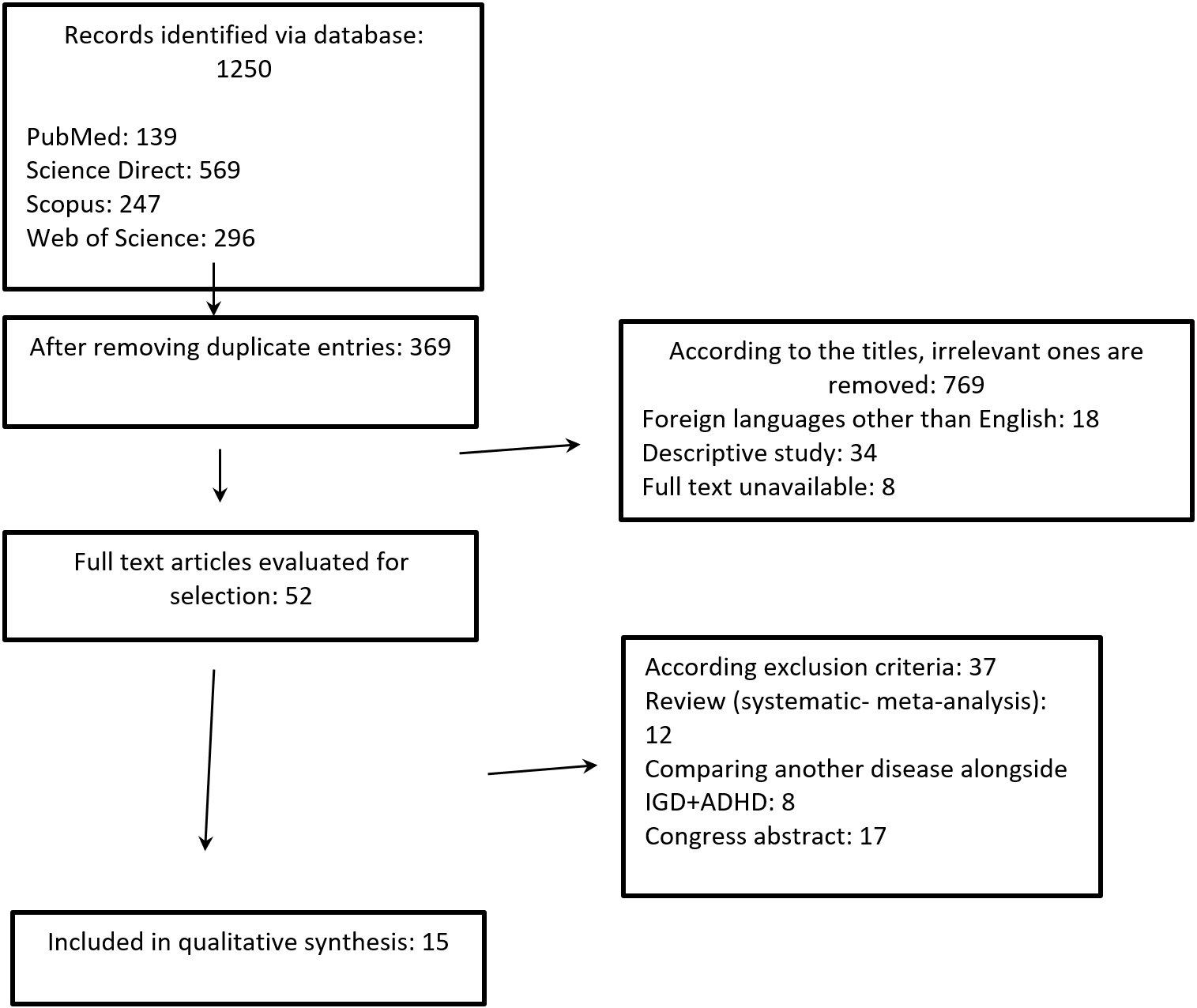
The literature search initially identified a total of 1,250 studies (PubMed: 139, ScienceDirect: 568, Scopus: 247, Web of Science: 296). After removing 369 duplicates, the titles of the remaining 881 studies were independently screened by both researchers, resulting in the exclusion of 769 studies that were irrelevant based on their titles. Among the remaining 112 studies, 34 were descriptive studies, 12 were reviews (systematic or meta-analyses), eight compared IGD+ADHD with another disorder, 17 were conference abstracts, 18 were published in languages other than English, and eight were unavailable in full text. Consequently, 15 studies met the inclusion criteria and were included in the review.
Studies included in the systematic review were uploaded to RAYYAN, a web-based literature screening platform (Qatar Computing Research Institute, Ar-Rayyan, Qatar), and independently screened by two researchers to remove duplicates based on titles and abstracts. Subsequently, the titles and abstracts of the remaining studies were further examined. Each researcher created a data extraction form, and these forms were independently evaluated by both researchers. To achieve consensus, the forms were merged, and studies were assessed according to the inclusion and exclusion criteria. The form included information on the authors, year of publication, country, study objectives, sample characteristics (experimental and control groups, mean ages), research methodology, measurement instruments, and study findings.
The Preferred Reporting Items for Systematic Reviews and Meta-Analyses (PRISMA) checklist was used to evaluate the characteristics of the included studies, and the review was registered in the PROSPERO database (Registration ID: CRD420251162321). The PRISMA flow diagram of the study is presented in Figure 1.
Methodological Quality
The articles were assessed using the Newcastle–Ottawa Quality Assessment Scale for Case-Control and Cohort Studies (Wells et al., 2020), which consists of a 9-item checklist, and the results are presented in Table 2. According to this assessment, one study (Menéndez-García et al., 2022) was rated as moderate quality (score 4–6), while the remaining 14 studies (Bae et al., 2016; Başgül et al., 2020; Berloffa et al., 2022; Chung et al., 2023; Hong et al., 2023; Kietglaiwansiri & Chonchaiya, 2018; Kim et al., 2020; Lee et al., 2017; Lee et al., 2019; Lee et al., 2021; Lin et al., 2023; Masi et al., 2021; Park et al., 2017; Yen et al., 2017) were evaluated as high quality (score ≥7).
| ^: Evaluated according to the Newcastle–Ottawa Quality Assessment Scale-Cohort Studies. | |||||||||
| Table 2. Methodological quality according to Newcastle–Ottawa Quality Assessment Scale (Case-Control/Cohort Studies) | |||||||||
| Author |
|
|
|
|
|||||
|
|
|
|
|
|
|
|
|
||
| Bae et al. (2016) |
|
|
|
|
|
|
|
|
|
| Lee et al. (2017) |
|
|
|
|
|
|
|
|
|
| Park et al. (2017) |
|
|
|
|
|
|
|
|
|
| Yen et al. (2017) |
|
|
|
|
|
|
|
|
|
| Kietglaiwansiri and Chonchaiya (2018) |
|
|
|
|
|
|
|
|
|
| Lee, et al. (2019) |
|
|
|
|
|
|
|
|
|
| Başgül et al. (2020) |
|
|
|
|
|
|
|
|
|
| Kim et al. (2020) |
|
|
|
|
|
|
|
|
|
| Masi et al. (2021) |
|
|
|
|
|
|
|
|
|
| Berloffa et al. (2022) |
|
|
|
|
|
|
|
|
|
| Menéndez-García et al. (2022) |
|
|
|
|
|
|
|
|
|
| Chung et al. (2023) |
|
|
|
|
|
|
|
|
|
| Hong et al. (2023) |
|
|
|
|
|
|
|
|
|
| Lin et al. (2023) |
|
|
|
|
|
|
|
|
|
|
|
|
|
|
|
|
|
|
||
| Lee et al. (2021)^ |
|
|
|
|
|
|
|
|
|
Results
The 15 studies included in this systematic review were conducted between 2016 and 2023. Eight of the studies were carried out in South Korea, two in Taiwan, and the others in Thailand, Türkiye, Canada, Italy, and Spain, respectively. A detailed overview of the included studies is presented in Table 3.
| NI: No information; ADHD: Attention-Deficit Hyperactivity Disorder; IGD: Internet Gaming Disorder; HC: Health Control; IAD: Internet Addiction Disorder; MPA: Mobile Phone Addiction | |||||||||
| Table 3. Characteristics of the studies reviewed | |||||||||
| No | Author | Country | Objective | Sample Group Characteristic | ADHD_scale/filled by | IGD_scale/filled by | Another scales | Conclusion | |
| 1. | Bae et al. (2016) | South Korea | To evaluate the impact of chronic internet gaming in children with ADHD. |
74 adolescents (age: NI) 28 IGD+ADHD (mean age 15.7 ± 1.7)
27 ADHD (mean age 15.3±1.4) 47 HC (mean age 16.4±2.0) |
Case control Brain imaging study (proton magnetic resonance spectroscopy (MRS) study) |
Korean Kiddie Schedule for Affective Disorders and Schizophrenia-Present and Life time version (K-SADS-PL)/ Professional report Korean ADHD rating scale (K-ARS)/ Professional rating |
Young Internet Addiction Scale (YIAS) /self report |
Beck Depressive Inventory (BDI)
Beck Anxiety Inventory (BAI) |
Both participants with ADHD and those with IGD are characterized by hypofrontality reduced NAA (n-acetylaspartate) levels in the frontal lobe. The decrease in Glu+Gln levels may solely reflect the clinical symptom differences between the ADHD and IGD+ADHD groups. |
| 2. | Lee et al. (2017) | South Korea | To examine the influence of childhood ADHD on the neural network characteristics of IGD. |
63 male adult (age: NI) 24 IGD (mean age 24.3 ± 2.7) 20 IGD+ADHD (mean age 23.6 ± 2.5) 19 HC (mean age 23.6 ± 2.0) |
Case control Brain imaging study (functional magnetic resonance imaging (fMRI) |
Wender Utah rating scale (WURS) /self report Conners' adult ADHD rating scales (CAARS) /self report |
Young Internet Addiction Scale (YIAS) / self report |
Diagnostic and Statistical Manual of Mental Disorders, Fourth Edition (SCID), Korean version of the Wechsler adult intelligence scale III (WAIS-III) Alcohol Use Disorders identification test (AUDIT) Beck Depression Inventory (BDI) Beck Anxiety Inventory (BAI) Barratt Impulsiveness Scale-Version 11 (BIS-11) |
A distinct alteration in PCC (posterior singulat korteks )based functional connectivity was observed in individuals with IGD, and these characteristics are thought to be attributable to a history of childhood ADHD. |
| 3. | Park et al. (2017) | South Korea | To compare the neurobiological differences between ADHD+IGD group and ADHD by analyzing quantitative electroencephalogram (QEEG) findings. |
46 male adolescent (age: 10-19) 16 ADHD+IGD (mean age: 14.6 ± 1.9) 15 ADHD (mean age: 13.7 ± 0.8) 15 HC (mean age: 14.4 ± 1.7) |
Case control Brain imaging study (QEEG) |
Structured Clinical Interview for DSM-5, Patient Edition, Clinician version (SCID-5-CV)/ Professional rating Korean ADHD Rating Scale (K-ARS)/ Self report |
Young's Internet Addiction Scale (YIAS) / self report | Adolescents with both ADHD and IGD showed higher neuronal connectivity and relative beta power but lower delta power in the parieto-occipital and temporal regions compared to those with only ADHD, while the ADHD-only group displayed higher frontal theta power and interhemispheric theta coherence than HC. | |
| 4. | Yen et al. (2017) | Taiwan | To evaluate the associations among ADHD, impulsivity, hostility, and IGD |
174 adults (age: 20-30) 87 IGD (mean age 23.38 ± 2.40) 87 HC (mean age 23.29 ± 2.34) |
Scale-based comparative case–control study |
A diagnostic interview based on the DSM-IV-TR ADHD/ Professional-rating Korean Kiddie-Schedule for Affective Disorders and Schizophrenia-Present and Lifetime Version/ Professional-rating |
DSM-5 IGD criteria–based interview/professional rating |
Mini International Neuropsychiatric Interview (MINI) Clinical Global Impressions (CGI)/ Professional-rating Dickman's Impulsivity Inventory (DII) Buss–Durkee Hostility Inventory-Chinese version-short form (BDHIC-SF) |
Young adults with ADHD exhibited greater IGD severity, impulsivity, and hostility, with impulsivity and hostility mediating the relationship between ADHD and IGD. |
| 5. | Kietglaiwansiri and Chonchaiya (2018) | Thailand | To compare the pattern of video game use and game addiction between Thai children with ADHD and healthy controls. |
182 adolescents (age: 6-19) 80 ADHD (mean age: 9,5) 102 HC (mean age: 10,0) |
Scale-based comparative case–control study | The diagnosis of ADHD was made by the evaluation made by the pediatrician according to DSM-5./Professional rating | Game Addiction Screening Test (GAST)/parent report | Children with ADHD showed a higher prevalence of problematic gaming behavior compared to their typically developing peers. | |
| 6. | Lee, et al. (2019) | South Korea | To investigate whether young adults with IGD and a history of childhood ADHD symptoms exhibit gray matter volume (GMV) alterations distinct from those without such a history.” |
65 right-handed male adult (age: 19-29) 20 ADHD+IGD (mean age:24.5 ± 2.5) 20 IGD (mean age: 23.9 ± 2.5) HC (mean age: 22.7 ± 2.4) |
Case control Brain imaging study (MRI) |
Wender Utah rating scale (WURS)/ Self report Conners’ adult ADHD rating scales (CAARS)/ Self report |
Young Internet Addiction test Scale (YIAST) )/ Self report |
Wechsler adult intelligence scale IV (WAIS-IV) Beck depression inventory (BDI) Beck anxiety inventory (BAI) Barratt impulsiveness scale-version 11 (BIS-11) |
Y oung adults with IGD who have a history of childhood ADHD exhibit marked differences in GMV, which may be associated with the developmental effects of ADHD. |
| 7. | Başgül et al. (2020) | Türkiye |
To investigate whether there is a significant difference between the levels of computer game addiction in children with and without the diagnosis of ADHD. |
200 adolescents (age: 10-13) 100 ADHD (mean age: 11.53 ±1.03) 100 HC (mean age: 11.83± 0.98) |
Scale-based comparative case–control study | ADHD diagnosis according to DSM-5/ Professional rating | Computer Game Addiction Scale for Children (CGASC)/Self report | Children with ADHD had significantly higher levels of video game addiction than healthy children | |
| 8. | Kim et al. (2020) | South Korea | To determine whether an ADHD-related structural brain network exists in IGD patients with comorbid ADHD by comparing them with those without comorbid ADHD and to elucidate how this sub-network relates to addiction severity. |
128 right-handed male adult (age: NI) 46 ADHD+IGD (mean age: 19,4 ± 3,9) 48 ADHD (mean age: 21,1 ± 5,1) 34 HC (mean age: 20,6 ± 4,1) |
Case control Brain imaging study (Diffusion tensor imaging) |
Korean Kiddie Schedule for Affective Disorders and Schizophrenia – Present and Lifetime version (K-SADS-PL-K)/Professional-rating the Dupaul's ADHD scale-Korean version (K-ARS-P)/Ebeveyn report |
Young’s Internet Addiction Scale (YIAS) /Self report |
Korean Kiddie Schedule for Affective Disorders and Schizophrenia – Present and Lifetime version | ADHD-related brain sub-network in IGD + ADHD patients, whose structural alterations partly explained their gaming addiction severity through links with impaired inhibition, visual–spatial integration, and motor processing. |
| 9. | Lee et al. (2021) | South Korea | To investigate whether ADHD comorbidity in IGD patients influences recovery, recurrence rates, and the trajectories of IGD symptoms, and to examine the relationship between changes in IGD and ADHD symptoms. |
255 adults (age: 11-42) 127 ADHD+IGD (mean age: 20.1 ± 5.7) 128 IGD (mean age: 22.3 ± 6.5) |
semi-experimental 3-year clinical cohort study 8 weeks of cognitive behavioral therapy and medication Follow-ups at 1, 2, and 3 years post-treatment |
Diagnosis of ADHD in adults was made by psychiatrists according to DSM-5/Professional-rating Korean Kiddie-Schedule for Affective Disorders and Schizophrenia for School-Age Children-Present and Lifetime Version (K-SADS-PL)/Professional-rating A parent-rated Korean ADHD rating scale (ADHDRS)/Parent report |
Structured Clinical Interview for Internet Gaming Disorder (SCI-IGD/Professional-rating) Young Internet Addiction Scale (YIAS) /Self report |
Beck’s Depression Inventory (BDI) Social Avoidance and Distress Scale (SADS) Family Environment Scale (FES) |
GDI patients with comorbid ADHD exhibit lower recovery rates and higher relapse rates compared to IGD patients without comorbidity |
| 10. | Masi et al. (2021) | Canada | To understand the relationship between video game use/addiction and ADHD in preschool/school children |
280 adolescents (age: 4-12) 98 ADHD (mean age: NI) 37 one or more mental health diagnoses other than ADHD (mean age: NI) 145 HC (mean age: NI) |
Scale-based comparative case–control study | QUATTORD (Questionnaire de l'attention et de l'ordinateur)/Parent report |
QUATTORD (Questionnaire de l'attention et de l'ordinateur)/Parent report SDQ (Strengths and Difficulties Questionnaire)/Parent report |
It was found that children with ADHD, starting from preschool age, have a higher tendency to develop addictive behaviors toward video games compared to their peers without ADHD | |
| 11. | Berloffa et al. (2022) | Italy |
To investigate the prevalence of IGD in a sample of youth with ADHD compared with a normal control group. To assess selected psychopathological and cognitive features in ADHD patients with and without IGD. |
255 (age: 8-18) adolescents 108 (ADHD) no medical (mean age: 11,7 ± 2,6) 147 HC (mean age: 13,9 ± 3,0) |
Scale-based comparative case–control study | Conners’ Parent Rating Scale—Revised: Short Form (CPRS—R:S)/parent report |
Young Internet Addiction Scale (YIAS)/self-professional report Internet Gaming Disorder Scale-Short Form (IGDS9-SF) /self report Use, Abuse, Dependence to Internet (UADI)/self report |
Clinical Global Impression-Severity score (CGI-S) Children Global Assessment Scales (C-GAS) The Child Behavior Checklist (CBCL) Wechsler Intelligence Scale for Children—Fourth Edition (WISC-IV) |
Among adolescents, 44% of those with ADHD scored above the IGD cut-off, compared to 9.5% of controls; furthermore, ADHD participants with IGD exhibited greater symptom severity and functional impairment. |
| 12. | Spain | To explore the relationship between ADHD and IAD, IGD, and MPA in children and adolescents. |
112 adolescents (7-17 ages) 51 ADHD (mean age: NI) 61 HC (mean age: NI) |
Scale-based comparative case–control study | TEA questionnaire (ATENTO)/parent report and child interview) | Assessment and Prevention of Internet, Mobile and Video Game (ADITEC) /parent report and child interview) | ADHD constitutes a risk factor for IGD; however, adequate social adjustment mitigates this association. | ||
| 13. | Chung et al. (2023) | South Korea | To examine whether ADHD and parenting style are associated with IGD in adolescents and the effect of parenting styles on IGD |
467 adolescents (age: 13-18) 256 IGD (mean age: 15,7 ± 2,0 ) and mom (mean age: NI) 211 HC (mean age: 15,5 ± 1,9) and mom (mean age: NI) |
Scale-based comparative case–control study | Korean ADHD rating scale (K-ARS)/ Professional rating | Young Internet Addiction Scale (YIAS) /self report |
Beck Depression Inventory II (BDI-II) Beck Anxiety Inventory (BAI) Korean Wechsler Intelligence Scale for Children IV (K-WISC-IV) Behavioral Inhibitory System/Behavioral Activation System (BIS/BAS) Scale Maternal Behavior Research Instrument (MBRI-K) (Korean version) |
Elevated ADHD symptoms, together with low levels of emotionally and autonomy-supportive parenting, are significant predictors of IGD |
| 14. | Hong et al. (2023) | South Korea | To compare gaming patterns, comorbid psychopathology, and comorbid psychiatric disorders, particularly ADHD, between IGD and general gamer samples |
301 adults (age: 17-29) IGD 136 (mean age: 21.56±4.63) 165 general gamer group (mean age: 21.9±2.51) |
Scale-based comparative case–control study |
Adult ADHD Self-Report Scale (ASRS) |
Gaming Diagnostic Interview/professional evulation Young Internet Addiction Scale (YIAS)/self report |
Demographic Questionnaire, Including Gaming Habits and Patterns Mini International Neuropsychiatric Interview (MINI) Patient Health Questionnaire–9 (PHQ–9) Patient Health Questionnaire–15 (PHQ–15) Obsessive-Compulsive Inventory–Revised (OCI–R) Aggression Questionnaire (AQ) Generalized Anxiety Disorder 7-Item Scale (GAD–7) Social Interaction Anxiety Scale (SIAS) Social Phobia Scale (SPS) |
The IGD group showed a higher prevalence of ADHD compared to the general gaming group. Conversely, the ADHD group exhibited a higher incidence of IGD relative to the non-ADHD group |
| 15. | Lin et al. (2023) | Taiwan | To assess the relationships between circadian typologies, insomnia, and IGD and how ADHD influences this relationship |
207 adults (age: 20-38) 69 IGD (mean age: 25.32 ± 4.20) 69 regular gamer group (mean age: 24,59 ± 3,41) 69 HC (mean age: 26,87 ± 3,82) |
Scale-based comparative case–control study |
Diagnosis of ADHD in adults was made by psychiatrists according to DSM-5/Professional-rating |
Chen Internet Addiction Scale (CIAS) /self report |
Composite Scale of Morningness (CSM) Pittsburg Insomnia Rating Scale (PIRS-20) |
Eveningness (a late sleep chronotype) and greater insomnia severity were observed in individuals with co-occurring IGD and ADHD.” |
Psychosocial and Behavioral Dimension
An examination of the 15 studies included according to the eligibility criteria shows that their objectives addressed the psychosocial, behavioral, and neurobiological dimensions of the association between ADHD and IGD. In studies investigating the psychosocial and behavioral aspects of this relationship (Başgül et al., 2020; Berloffa et al., 2022; Chung et al., 2023; Hong et al., 2023; Kietglaiwansiri & Chonchaiya, 2018; Lin et al., 2023; Masi et al., 2021; Menéndez-García et al., 2022; Yen et al., 2017), researchers examined how the ADHD–IGD association is related to environmental, behavioral, and interpersonal factors. Specifically, by comparing IGD and gaming patterns among individuals with and without ADHD, these studies highlighted mediating factors such as impulsivity, hostility, peer relationships, environmental influences, early developmental exposure, and socialization (Başgül et al., 2020; Kietglaiwansiri & Chonchaiya, 2018; Masi et al., 2021; Yen et al., 2017).
Berloffa et al. (2022) focused on the prevalence of IGD among adolescents with ADHD and the psychopathological and cognitive features associated with IGD comorbidity in ADHD, while Hong et al. (2023) examined psychopathological characteristics and ADHD comorbidity between IGD and general gaming groups. Menéndez-García et al. (2022) investigated the association between ADHD and Internet Addiction Disorder (IAD), IGD, and Mobile Phone Addiction (MPA) in children and adolescents, and whether adequate social adjustment could be linked to reductions in such addictive behaviors. Chung et al. (2023) emphasized parenting styles, aiming to explore the impact of ADHD and parenting approaches relate to IGD comorbidity in adolescents, with a particular focus on how emotionally and autonomy-supportive parenting is associated with IGD severity. Lin et al. (2023) extended the psychosocial scope by evaluating the influence of insomnia and circadian typology—key daily life behaviors—on individuals with IGD, as well as the moderating role of ADHD comorbidity. Finally, Lee et al. (2021), in a 3-year cohort study, investigated whether an 8-week cognitive-behavioral therapy (CBT) program and pharmacological treatment influenced recovery, relapse rates, and the trajectories of IGD symptoms in patients with comorbid ADHD.
When evaluating the findings of psychosocial and behavioral studies, it was observed that young adults with ADHD exhibited greater IGD severity, impulsivity, and hostility (Yen et al., 2017). In children with ADHD, higher levels of IGD/problematic gaming behavior were reported compared to healthy controls (Başgül et al., 2020; Kietglaiwansiri & Chonchaiya, 2018; Masi et al., 2021). Supporting these findings, Berloffa et al. (2022) reported that 44% of adolescents with ADHD scored above the IGD cutoff compared to only 9.5% of healthy controls, further noting that ADHD+IGD was associated with increased symptom severity and impaired functioning. Similarly, Hong et al. (2023) found that adults with IGD had a higher prevalence of ADHD compared to general gaming groups, and that adults with ADHD demonstrated a higher prevalence of IGD than those without ADHD. Menéndez-García et al. (2022) argued that ADHD may represent a risk correlate for IGD, while adequate social adjustment may mitigate this risk. In contrast, Chung et al. (2023) emphasized that reduced emotional and autonomy-supportive parenting, alongside ADHD symptoms, represents a significant risk factor for IGD. Lee et al. (2021) reported that eight weeks of CBT combined with psychopharmacological treatment resulted in lower recovery rates among patients with ADHD+IGD compared to those with IGD alone. Finally, Lin et al. (2023) observed a late sleep chronotype and severe insomnia in individuals with ADHD+IGD.
Neuroimaging Dimension
Five neuroimaging-based studies (Bae et al., 2016; Kim et al., 2020; Lee et al., 2017; Lee et al., 2019; Park et al., 2017) aimed to identify functional and structural brain differences underlying the relationship between ADHD and IGD. Specifically, Bae et al. (2016) investigated metabolic alterations in adolescents with ADHD who engaged in chronic internet gaming, using proton magnetic resonance spectroscopy (MRS). Lee et al. (2017) examined, through functional magnetic resonance imaging (fMRI), how a childhood history of ADHD relates to the neural network characteristics of IGD in adults. Park et al. (2017) compared neurobiological differences between adolescents with ADHD with and without IGD by analyzing quantitative electroencephalogram (QEEG) findings. Lee et al. (2019) explored gray matter volume (GMV) changes using magnetic resonance imaging (MRI) in adolescents with IGD, both with and without a childhood history of ADHD. Finally, Kim et al. (2020) employed diffusion tensor imaging (DTI) to determine whether adults with IGD, with and without ADHD comorbidity, exhibited an ADHD-specific structural subnetwork, and whether this network was associated with IGD. Collectively, these neuroimaging studies suggest that ADHD and IGD are linked to not only behavioral manifestations but also to alterations in brain structure and function.
When evaluating the findings of neuroimaging studies, Bae et al. (2016) reported that individuals with ADHD+IGD exhibited hypofrontality alongside reduced frontal lobe NAA (N-acetylaspartate) levels. Moreover, decreased Glu+Gln concentrations in this group were associated with clinical symptom differences among individuals with ADHD. Supporting these findings, Lee et al. (2017) observed that IGD individuals without a childhood history of ADHD displayed extended functional connectivity between the anterior insula and orbitofrontal cortex. Park et al. (2017) found that adolescents with ADHD+IGD, compared to those with ADHD alone, demonstrated greater neuronal connectivity and relative beta power in parieto-occipital and temporal regions, but lower delta power. Similarly, Lee et al. (2019) identified significant GMV alterations in IGD individuals with a childhood history of ADHD. Finally, Kim et al. (2020) reported that in adults with ADHD+IGD, an ADHD-specific structural subnetwork was linked to gaming addiction severity, partially explained by impaired inhibition, visuospatial integration, and motor processing.
Sample Characteristics and Intervention Methods
The sample sizes of the 15 studies included in this systematic review ranged from 46 (Park et al., 2017) to 467 (Chung et al., 2023), with participants aged between 4 and 42 years. The mean ages ranged from 11 to 16 years for children and adolescents and from 20 to 26 years for adults. Four studies, all of which were neuroimaging investigations, included only male participants (Kim et al., 2020; Lee et al., 2017; Lee et al., 2019; Park et al., 2017). Although nearly half of the studies were conducted with adults, the overall scope also encompassed preschoolers, school-aged children, and adolescents, thereby broadening the developmental spectrum.
The sample groups varied: some studies compared individuals with ADHD+IGD comorbidity to IGD groups (Lee et al., 2017; Lee et al., 2019; Lee et al., 2021), while others compared ADHD groups with and without IGD to healthy controls (Bae et al., 2016; Kim et al., 2020; Park et al., 2017). Five studies compared ADHD patients to healthy controls (Başgül et al., 2020; Berloffa et al., 2022; Kietglaiwansiri & Chonchaiya, 2018; Masi et al., 2021; Menéndez-García et al., 2022), whereas four studies compared IGD patients to healthy controls (Chung et al., 2023; Hong et al., 2023; Lin et al., 2023; Yen et al., 2017). Some studies also included additional groups, such as general gamer samples (Hong et al., 2023) or small subgroups with other psychiatric diagnoses (Masi et al., 2021). Participants were typically right-handed (e.g., Kim et al., 2020; Lee et al., 2019) and without neurological disorders.
In terms of research methods, 14 of the included studies employed a case-control design, while only Lee et al. (2021) conducted a three-year cohort study with a quasi-experimental design, assessing the effects of an 8-week CBT program and psychopharmacological treatment. Five studies were neuroimaging-based, utilizing MRS, fMRI, MRI, QEEG, and DTI to obtain measurements (Bae et al., 2016; Kim et al., 2020; Lee et al., 2017; Lee et al., 2019; Park et al., 2017).
Assessment Tools
In the 15 studies included in this systematic review, several scales were used to determine ADHD diagnosis and symptom severity. The following instruments were applied for ADHD diagnosis: The Korean Kiddie Schedule for Affective Disorders and Schizophrenia – Present and Lifetime Version (K-SADS-PL) was administered in four studies by psychiatrists through patient interviews with children, adolescents, and adults (Bae et al., 2016; Kim et al., 2020; Lee et al., 2021; Yen et al., 2017). Semi-structured interviews conducted by psychiatrists or pediatricians according to DSM-IV/5 diagnostic criteria were used in five studies (Başgül et al., 2020; Kietglaiwansiri & Chonchaiya, 2018; Lee et al., 2021; Lin et al., 2023; Yen et al., 2017). In the study by Park et al. (2017), the Structured Clinical Interview for DSM-5, Patient Edition, Clinical Version (SCID-5-CV) was administered to adolescents by a psychiatrist.
To assess ADHD symptom severity, the Korean ADHD Rating Scale (K-ARS) was most frequently used, typically administered to adolescents either as a professional report or self-report (Bae et al., 2016; Chung et al., 2023; Park et al., 2017). Among adult ADHD assessment tools, the Wender Utah Rating Scale (WURS) was applied in two studies to retrospectively assess childhood ADHD symptoms through self-report (Lee et al., 2017; Lee et al., 2019). The Conners’ Adult ADHD Rating Scales (CAARS), a self-report instrument evaluating ADHD subdimensions, was used in two studies (Lee et al., 2017; Lee et al., 2019). The Adult ADHD Self-Report Scale (ASRS) was applied by Hong et al. (2023) to adults in IGD and general gamer groups through self-report in order to determine ADHD prevalence.
Among parent-report scales and tools based on early childhood experiences, the Dupaul’s ADHD Scale Korea version (K-ARS-P) (Kim et al., 2020) and the Korean ADHD Rating Scale (ADHDRS) (Lee et al., 2021) were administered to the parents of adults with ADHD+IGD and ADHD. The QUATTORD (Questionnaire de l’attention et de l’ordinateur) was used by Masi et al. (2021) with parents to assess attention in preschool and school-aged children. The TEA Questionnaire (ATENTO) was administered by Menéndez-García et al. (2022) both as parent reports and child interviews, while the Conners’ Parent Rating Scale—Revised: Short Form (CPRS-R:S) was administered in parent-report form by Berloffa et al. (2022).
In the studies included in this systematic review, the most frequently used instrument for assessing IGD and problematic gaming behavior was the Young Internet Addiction Scale (YIAS) (Bae et al., 2016; Berloffa et al., 2022; Chung et al., 2023; Hong et al., 2023; Kim et al., 2020; Lee et al., 2017; Lee et al., 2019; Lee et al., 2021; Park et al., 2017). Yen et al. (2017) conducted a DSM-5 IGD criteria–based interview to assess IGD, while Hong et al. (2023) evaluated adults with the semi-structured Gaming Diagnostic Interview, administered by psychiatrists. Likewise, Lee et al. (2021) applied the Structured Clinical Interview for Internet Gaming Disorder (SCI-IGD) to confirm IGD diagnosis in adults.
To evaluate IGD in children or adolescents, parents were asked to complete the Game Addiction Screening Test (GAST) (Kietglaiwansiri & Chonchaiya, 2018), QUATTORD, Strengths and Difficulties Questionnaire (SDQ) (Masi et al., 2021), and Assessment and Prevention of Internet, Mobile and Video Game (ADITEC) (Menéndez-García et al., 2022). In addition to YIAS, Berloffa et al. (2022) also used the Internet Gaming Disorder Scale–Short Form (IGDS9-SF) and Use, Abuse, Dependence to Internet (UADI) as self-report tools in adolescents. Başgül et al. (2020) administered the Computer Game Addiction Scale for Children (CGASC) to adolescents, while Lin et al. (2023) applied the Chen Internet Addiction Scale (CIAS) to adults.
To better understand the relationship between ADHD and IGD, additional instruments were employed to assess mood, anxiety, impulsivity, aggression, family environment, sleep, and cognitive functioning. Across the 15 studies included in this review, measures assessing mood and anxiety were the most frequently used instruments. These included the Beck Depression Inventory (BDI/BDI-II) (Bae et al., 2016; Chung et al., 2023; Lee et al., 2017; Lee et al., 2019; Lee et al., 2021) and the Beck Anxiety Inventory (BAI) (Bae et al., 2016; Chung et al., 2023; Lee et al., 2017; Lee et al., 2019). Additionally, Hong et al. (2023) employed the Generalized Anxiety Disorder–7 (GAD-7). Social anxiety in individuals with IGD was assessed using the Social Avoidance and Distress Scale (SADS) (Lee et al., 2021), Social Interaction Anxiety Scale (SIAS), and Social Phobia Scale (SPS) (Hong et al., 2023).
Impulsivity in individuals with ADHD and IGD was measured with the Barratt Impulsiveness Scale – Version 11 (BIS-11) (Lee et al., 2017; Lee et al., 2019) and Dickman’s Impulsivity Inventory (DII) (Yen et al., 2017). Aggression was assessed with the Buss–Durkee Hostility Inventory – Chinese version – Short Form (BDHIC-SF) (Yen et al., 2017) and the Aggression Questionnaire (AQ) (Hong et al., 2023). The influence of family environment and parenting styles on ADHD and IGD was examined with the Family Environment Scale (FES) (Lee et al., 2021) and the Maternal Behavior Research Instrument – Korean version (MBRI-K) (Chung et al., 2023).
Lin et al. (2023) assessed sleep and circadian rhythm with the Composite Scale of Morningness (CSM) and the Pittsburgh Insomnia Rating Scale (PIRS-20). Cognitive functioning was evaluated using the Wechsler Adult Intelligence Scale III/IV (WAIS-III/IV) (Lee et al., 2017; Lee et al., 2019), Wechsler Intelligence Scale for Children IV (WISC-IV) (Berloffa et al., 2022), and Korean WISC-IV (K-WISC-IV) (Chung et al., 2023). For the assessment of additional psychiatric disorders, the Diagnostic and Statistical Manual of Mental Disorders, Fourth Edition (SCID) (Lee et al., 2017), Mini International Neuropsychiatric Interview (MINI) (Hong et al., 2023; Yen et al., 2017), Clinical Global Impressions (CGI) (Yen et al., 2017), Korean Kiddie Schedule for Affective Disorders and Schizophrenia – Present and Lifetime version (Kim et al., 2020), and Obsessive-Compulsive Inventory–Revised (OCI-R) (Hong et al., 2023) were used.
Discussion
This systematic review was conducted to evaluate the relationship between IGD and ADHD. Within this scope, 15 studies meeting the inclusion criteria were identified, conducted between 2016 and 2023, most of them in South Korea, followed by Taiwan, Thailand, Türkiye, Canada, Italy, and Spain, indicating that similar issues have been examined across different cultural contexts.
Several studies included in this systematic review emphasized mediating factors such as impulsivity, hostility, peer relationships, environmental influences, early developmental exposure, parenting styles, and socialization in relation to IGD and problematic gaming behaviors among individuals with and without ADHD (Başgül et al., 2020; Berloffa et al., 2022; Chung et al., 2023; Hong et al., 2023; Kietglaiwansiri & Chonchaiya, 2018; Lin et al., 2023; Masi et al., 2021; Menéndez-García et al., 2022; Yen et al., 2017). Certain neuropsychological traits, such as impulsivity and hostility, are associated with ADHD–IGD comorbidity (Yen et al., 2017). Additionally, individuals with ADHD often experience peer rejection and consequent social isolation, which may be related to an increased likelihood of seeking online connections (Dekkers & Van Hoorn, 2022). Early developmental exposure and parenting styles also emerge as significant risk factors for IGD (Chung et al., 2023). Adolescents raised in dysfunctional families characterized by poor communication, high conflict, and inconsistent parenting have been reported to be more prone to IGD (Bussone et al., 2020; Dekkers & Van Hoorn, 2022). Conversely, balanced parenting styles and active involvement have been highlighted as protective, reducing adolescents’ tendency to engage in video games as a means of escaping negative emotions (Commodari et al., 2024). Overall, the findings of the included studies highlight the bidirectional nature of the association between IGD and ADHD. While ADHD-related traits such as impulsivity, emotion dysregulation, and reward sensitivity may increase vulnerability to excessive gaming, prolonged engagement in gaming environments may further reinforce attentional difficulties and impair executive functioning.
Lin et al. (2023) noted insomnia and circadian typology patterns in individuals with IGD and ADHD comorbidity, while Coogan and McGowan (2017) reported that approximately 30% of individuals with ADHD exhibit a delayed chronotype and delayed sleep–wake phase disorder. Wong et al. (2020) further demonstrated a positive correlation between IGD severity and poor sleep quality (including insomnia, daytime sleepiness, and evening chronotype). Literature also suggests that social connectedness and stable sleep patterns may improve the prognosis of both ADHD and IGD (Algedik & Kocaman, 2025).
Lee et al. (2021) found that CBT and pharmacological treatment led to improvement in IGD patients, whereas comorbid ADHD was associated with higher relapse rates and reduced recovery. These findings were supported by Marmet et al. (2018), who reported similar outcomes.
Neuroimaging studies included in the review (Bae et al., 2016; Kim et al., 2020; Lee et al., 2017; Lee et al., 2019; Park et al., 2017) revealed that ADHD–IGD comorbidity is associated with both functional and structural alterations in the brain. Bae et al. (2016) interpreted decreased NAA levels in ADHD and reductions in both NAA and Glu+Gln in ADHD+IGD as potentially reflecting hypofrontality, rather than establishing a direct causal mechanism. In the context of ADHD, hypofrontality has been linked to impaired behaviors such as inattention, poor impulse control, and executive dysfunction (Cao et al., 2014). Lee et al. (2017) observed that individuals with IGD without a childhood history of ADHD exhibited greater functional connectivity between the anterior insula and orbitofrontal cortex compared to those with such a history. The orbitofrontal cortex is involved in monitoring reward value and decision-making (Dom et al., 2005), whereas the anterior insula is a central hub of the salience network, responsible for directing attention (Menon & Uddin, 2010). These findings suggest possible associations between ADHD comorbidity in IGD and alterations in reward and control mechanisms. The increased neuronal connectivity in parieto-occipital and temporal regions among individuals with ADHD+IGD may result from repeated stimulation of brain reward and working memory systems (Park et al., 2017). Lee et al. (2019) found significant differences in gray matter volume in IGD individuals with a childhood history of ADHD, while Kim et al. (2020) identified a brain subnetwork specific to ADHD that was structurally altered in ADHD+IGD adults. These findings indicate that the neurobiological traces of ADHD may be closely associated with the pathophysiology and clinical features of IGD (Kim et al., 2020; Lee et al., 2019).
Taken together, psychosocial and neurobiological findings appear to converge on shared mechanisms—particularly impulsivity, reward-processing abnormalities, and executive dysfunction. These overlapping pathways suggest that the clinical presentation of IGD in individuals with ADHD may reflect a combination of behavioral and neural vulnerabilities, underscoring the importance of integrative assessment, and treatment approaches.
When examining the age range of studies included in the systematic review, participants ranged from 4 to 42 years, with the majority being male children, adolescents, or adults. This observation aligns with literature findings indicating that IGD tends to be more prevalent among males (Hawi & Samaha, 2024; Kuss & Griffiths, 2012).
In the studies included in the systematic review, it is noteworthy that ADHD and IGD diagnoses and symptom severity were assessed using validated and reliable measurement tools, which is critical for the robustness of the results. Specifically, ADHD diagnoses were primarily established using semi-structured interviews based on DSM-IV/V criteria administered by psychiatrists (Başgül et al., 2020; Kietglaiwansiri & Chonchaiya, 2018; Lee et al., 2021; Lin et al., 2023; Yen et al., 2017) and K-SADS-PL (Bae et al., 2016; Kim et al., 2020; Lee et al., 2021; Yen et al., 2017).
For the diagnosis and assessment of IGD, the majority of studies relied on self-report via the YIAS (Bae et al., 2016; Berloffa et al., 2022; Chung et al., 2023; Hong et al., 2023; Kim et al., 2020; Lee et al., 2017; Lee et al., 2019; Lee et al., 2021; Park et al., 2017), demonstrating its reliability as a measurement instrument in the field. Additionally, Yen et al. (2017) employed DSM-5 IGD criteria-based interviews, Hong et al. (2023) utilized the Gaming Diagnostic Interview, and Lee et al. (2021) applied the SCI-IGD to reinforce diagnostic validity through clinical assessment.
Moreover, most studies evaluated ADHD and IGD not only using diagnostic criteria but also alongside psychosocial variables such as mood, anxiety, impulsivity, aggression, family environment, sleep, and cognitive functioning. In this context, the use of BDI/BDI-II (Bae et al., 2016; Chung et al., 2023; Lee et al., 2017; Lee et al., 2019; Lee et al., 2021) and BAI (Bae et al., 2016; Chung et al., 2023; Lee et al., 2017; Lee et al., 2019) to assess mood and anxiety supports the literature suggesting that anxiety and depression are commonly observed in the comorbidity of ADHD and IGD (Kim et al., 2020; Masklavanou et al., 2023).
Other frequently used scales targeted impulsivity and aggression, including BIS-11 (Lee et al., 2017; Lee et al., 2019) and DII (Yen et al., 2017) for impulsivity, and BDHIC-SF (Yen et al., 2017) and AQ (Hong et al., 2023) for aggression. These findings indicate that impulsivity, a core symptom of ADHD, may be linked to IGD symptomatology (Kim et al., 2020). Furthermore, ADHD-related difficulties in anger regulation (Connor et al., 2003) and the potential for online gaming to trigger aggressive behaviors in IGD (Anderson et al., 2010) provide additional explanatory mechanisms for the co-occurrence of these disorders.
Limitations
This systematic review has several limitations. First, it is limited to 15 studies that met the inclusion criteria and were identified through searches in PubMed, Science Direct, Scopus, and Web of Science within a defined time frame using the specified keywords. Additionally, since the included studies are case-control and experimental in design, they prevent the determination of the direction of causality between the variables. Moreover, most samples were predominantly male, and the majority of studies were conducted in East Asian countries, which may limit the generalizability of the findings to different genders and cultural contexts. The exclusion of non-English publications may also have introduced language bias.
Conclusion
This systematic review highlights that the link between ADHD and IGD is bidirectional, substantial, and multidimensional. ADHD represents a significant risk factor for IGD, and the relationship between childhood or adult ADHD symptoms and IGD in adults should be further investigated. It is crucial not to overlook the potential association of psychiatric problems, such as depression, anxiety, impulsivity, and hostility in individuals with ADHD with IGD. Neuroimaging studies have demonstrated both functional and structural brain alterations in individuals with ADHD and ADHD+IGD. Furthermore, individuals with ADHD+IGD exhibit more severe psychiatric symptoms, greater symptom intensity, and a higher prevalence of adverse life events; however, supportive and engaged parenting, as well as adequate social adaptation, appear to mitigate these challenges. Accordingly, the comorbidity of ADHD and IGD should be addressed holistically, considering behavioral, neurobiological, and environmental dimensions. Clinically, it is recommended that specialists systematically screen for IGD during the ADHD diagnostic process and for ADHD during the IGD assessment. Additionally, future research should employ longitudinal designs and cross-cultural comparisons to examine the impact of ADHD on IGD and the reciprocal effects of IGD on ADHD symptomatology.
Data availability statement
Data sharing is not applicable to this article as no new datasets were generated or analyzed during this study.
Conflict of interest
The authors declare that this study was conducted in the absence of any commercial or financial relationships that could be construed as a potential conflict of interest.
Funding
The authors declare that this study received no funding.
Generative AI statement
The authors declare that no generative AI or AI-assisted technologies were used in the writing or preparation of this study.
References
- Algedik, P., & Kocaman, O. (2025). Sleep quality and its associations with adhd symptoms, smartphone use, and social support in university students. European Journal of Therapeutics, 31(3), 185-193. https://doi.org/10.58600/eurjther2697
- American Psychiatric Association. (2013). Diagnostic and statistical manual of mental disorders (DSM-5) (5th ed.). https://doi.org/10.1176/appi.books.9780890425596
- Anderson, C. A., Shibuya, A., Ihori, N., Swing, E. L., Bushman, B. J., Sakamoto, A., Rothstein, H. R., & Saleem, M. (2010). Violent video game effects on aggression, empathy, and prosocial behavior in eastern and western countries: A meta-analytic review. Psychological Bulletin, 136(2), 151-173. https://doi.org/10.1037/a0018251
- Bae, S., Han, D. H., Kim, S. M., Shi, X., & Renshaw, P. F. (2016). Neurochemical correlates of internet game play in adolescents with attention deficit hyperactivity disorder: A proton magnetic resonance spectroscopy (MRS) study. Psychiatry Research. Neuroimaging, 254, 10-17. https://doi.org/10.1016/j.pscychresns.2016.05.006
- Başgül, Ş. S., Bekar, B., & Luş, M. G. (2020). Associations between computer game addiction and attention deficit and hyperactivity disorder - An emprical study. Addicta: The Turkish Journal on Addictions, 7(2), 122-128. https://doi.org/10.5152/ADDICTA.2020.20142
- Berloffa, S., Salvati, A., D’Acunto, G., Fantozzi, P., Inguaggiato, E., Lenzi, F., Milone, A., Muratori, P., Pfanner, C., Ricci, F., Ruglioni, L., Tacchi, A., Tessa, C., Villafranca, A., & Masi, G. (2022). Internet gaming disorder in children and adolescents with attention deficit hyperactivity disorder. Children, 9(3), 428. https://doi.org/10.3390/children9030428
- Bussone, S., Trentini, C., Tambelli, R., & Carola, V. (2020). Early-life interpersonal and affective risk factors for pathological gaming. Frontiers in Psychiatry, 11, 423. https://doi.org/10.3389/fpsyt.2020.00423
- Cabelguen, C., Rocher, B., Leboucher, J., Schreck, B., Challet-Bouju, G., Hardouin, J. B., & Grall-Bronnec, M. (2021). Attention deficit hyperactivity disorder and gaming disorder: Frequency and associated factors in a clinical sample of patients with gaming disorder. Journal of Behavioral Addictions, 10(4), 1061-1067. https://doi.org/10.1556/2006.2021.00074
- Cao, M., Shu, N., Cao, Q., Wang, Y., & He, Y. (2014). Imaging functional and structural brain connectomics in attention-deficit/hyperactivity disorder. Molecular Neurobiology, 50(3), 1111-1123. https://doi.org/10.1007/s12035-014-8685-x
- Chung, S. A., Bae, S., Kim, H. J., Lee, J. W., Hwang, H., & Han, D. H. (2023). Mediating effects of attention problems on the link between parenting style and internet gaming disorder in adolescents. Frontiers in Psychiatry, 14, 1211889. https://doi.org/10.3389/fpsyt.2023.1211889
- Commodari, E., Consiglio, A., Cannata, M., & La Rosa, V. L. (2024). Influence of parental mediation and social skills on adolescents’ use of online video games for escapism: A cross-sectional study. Journal of Research on Adolescence : The Official Journal of the Society for Research on Adolescence, 34(4), 1668-1678. https://doi.org/10.1111/jora.13034
- Connor, D. F., Steingard, R. J., Anderson, J. J., & Melloni, R. H., Jr. (2003). Gender differences in reactive and proactive aggression. Child Psychiatry and Human Development, 33(4), 279-294. https://doi.org/10.1023/a
- Coogan, A. N., & McGowan, N. M. (2017). A systematic review of circadian function, chronotype and chronotherapy in attention deficit hyperactivity disorder. Attention Deficit and Hyperactivity Disorders, 9(3), 129-147. https://doi.org/10.1007/s12402-016-0214-5
- Dekkers, T. J., & van Hoorn, J. (2022). Understanding problematic social media use in adolescents with attention-deficit/hyperactivity disorder (adhd): A narrative review and clinical recommendations. Brain Sciences, 12(12), 1625. https://doi.org/10.3390/brainsci12121625
- Dom, G., Sabbe, B., Hulstijn, W., & van den Brink, W. (2005). Substance use disorders and the orbitofrontal cortex: Systematic review of behavioural decision-making and neuroimaging studies. The British Journal of Psychiatry: The Journal of Mental Science, 187(3), 209-220. https://doi.org/10.1192/bjp.187.3.209
- Dullur, P., Krishnan, V., & Diaz, A. M. (2021). A systematic review on the intersection of attention-deficit hyperactivity disorder and gaming disorder. Journal of Psychiatric Research, 133, 212-222. https://doi.org/10.1016/j.jpsychires.2020.12.026
- González-Bueso, V., Santamaría, J. J., Fernández, D., Merino, L., Montero, E., & Ribas, J. (2018). Association between internet gaming disorder or pathological video-game use and comorbid psychopathology: A comprehensive review. International Journal of Environmental Research and Public Health, 15(4), 668. https://doi.org/10.3390/ijerph15040668
- Hawi, N., & Samaha, M. (2024). Relationships of gaming disorder, ADHD, and academic performance in university students: A mediation analysis. PloS One, 19(4), e0300680. https://doi.org/10.1371/journal.pone.0300680
- Hong, J. S., Bae, S., Starcervic, V., & Han, D. H. (2023). Correlation between attention deficit hyperactivity disorder, internet gaming disorder or gaming disorder. Journal of Attention Disorders, 27(11), 1252-1262. https://doi.org/10.1177/10870547231176861
- Kietglaiwansiri, T., & Chonchaiya, W. (2018). Pattern of video game use in children with attention-deficit-hyperactivity disorder and typical development. Pediatrics International: Official Journal of the Japan Pediatric Society, 60(6), 523-528. https://doi.org/10.1111/ped.13564
- Kim, M., Kim, D., Bae, S., Han, D. H., & Jeong, B. (2020). Aberrant structural network of comorbid attention deficit/hyperactivity disorder is associated with addiction severity in internet gaming disorder. Neuroimage. Clinical, 27, 102263. https://doi.org/10.1016/j.nicl.2020.102263
- Koncz, P., Demetrovics, Z., Takacs, Z. K., Griffiths, M. D., Nagy, T., & Király, O. (2023). The emerging evidence on the association between symptoms of ADHD and gaming disorder: A systematic review and meta-analysis. Clinical Psychology Review, 106, 102343. https://doi.org/10.1016/j.cpr.2023.102343
- Kuss, D. J., & Griffiths, M. D. (2012). Online gaming addiction in children and adolescents: A review of empirical research. Journal of Behavioral Addictions, 1(1), 3-22. https://doi.org/10.1556/JBA.1.2012.1.1
- Lee, D., Lee, J., Lee, J. E., & Jung, Y. C. (2017). Altered functional connectivity in default mode network in Internet gaming disorder: Influence of childhood ADHD. Progress in Neuro-Psychopharmacology & Biological Psychiatry, 75, 135-141. https://doi.org/10.1016/j.pnpbp.2017.02.005
- Lee, D., Namkoong, K., Lee, J., & Jung, Y. C. (2019). Preliminary evidence of altered gray matter volume in subjects with internet gaming disorder: Associations with history of childhood attention-deficit/hyperactivity disorder symptoms. Brain Imaging and Behavior, 13(3), 660-668. https://doi.org/10.1007/s11682-018-9872-6
- Lee, J., Bae, S., Kim, B. N., & Han, D. H. (2021). Impact of attention-deficit/hyperactivity disorder comorbidity on longitudinal course in Internet gaming disorder: A 3-year clinical cohort study. Journal of Child Psychology and Psychiatry and Allied Disciplines, 62(9), 1110-1119. https://doi.org/10.1111/jcpp.13380
- Lin, Y. J., Yen, J. Y., Lin, P. C., Liao, H. Y., & Ko, C. H. (2023). Circadian typologies and insomnia in individuals with internet gaming disorder comorbid with attention deficit/hyperactivity disorder. Scientific Reports, 13(1), 12764. https://doi.org/10.1038/s41598-023-39462-2
- Marmet, S., Studer, J., Grazioli, V. S., & Gmel, G. (2018). Bidirectional associations between self-reported gaming disorder and adult attention deficit hyperactivity disorder: Evidence from a sample of young swiss men. Frontiers in Psychiatry, 9, 649. https://doi.org/10.3389/fpsyt.2018.00649
- Masi, L., Abadie, P., Herba, C., Emond, M., Gingras, M. P., & Amor, L. B. (2021). Video games in adhd and non-adhd children: Modalities of use and association with adhd symptoms. Frontiers in Pediatrics, 9, 632272. https://doi.org/10.3389/fped.2021.632272
- Masklavanou, C., Triantafyllou, K., Paparrigopoulos, T., Sypsa, V., & Pehlivanidis, A. (2023). Internet gaming disorder, exercise and attention deficit hyperactivity disorder: The role of symptoms of depression, anxiety and stress. Psychiatrike, 34(1), 13-20. https://doi.org/10.22365/jpsych.2022.098
- Menéndez-García, A., Jiménez-Arroyo, A., Rodrigo-Yanguas, M., Marin-Vila, M., Sánchez-Sánchez, F., Roman-Riechmann, E., & Blasco-Fontecilla, H. (2022). Internet, video game and mobile phone addiction in children and adolescents diagnosed with ADHD: A case-control study. Adicción a internet, videojuegos y teléfonos móviles en niños y adolescentes: Un estudio de casos y controles. Adicciones, 34(3), 208-217. https://doi.org/10.20882/adicciones.1469
- Menon, V., & Uddin, L. Q. (2010). Saliency, switching, attention and control: A network model of insula function. Brain Structure & Function, 214(5-6), 655-667. https://doi.org/10.1007/s00429-010-0262-0
- Park, J. H., Hong, J. S., Han, D. H., Min, K. J., Lee, Y. S., Kee, B. S., & Kim, S. M. (2017). Comparison of qeeg findings between adolescents with attention deficit hyperactivity disorder (ADHD) without comorbidity and ADHD comorbid with internet gaming disorder. Journal of Korean Medical Science, 32(3), 514-521. https://doi.org/10.3346/jkms.2017.32.3.514
- Şahin, D., & Gözün Kahraman, Ö. (2021). Okul dönemi çocuklarının bilgisayar oyun bağımlılığı ile davranış problemleri arasındaki ilişkinin incelenmesi. Journal of National Education, 50(230), 13-28. https://doi.org/10.37669/milliegitim.682086
- Von Der Heiden, J. M., Braun, B., Müller, K. W., & Egloff, B. (2019). The association between video gaming and psychological functioning. Frontiers in Psychology, 10, 1731. https://doi.org/10.3389/fpsyg.2019.01731
- Wells, G. A., Shea, B., O’Connell, D., Peterson, J., Welch, V., Losos, M. ve Tugwell, P. (2020). The newcastle-ottawa scale (NOS) for assessing the quality of nonrandomised studies in meta-analyses. https://ohri.ca/en/who-we-are/core-facilities-and-platforms/ottawa-methods-centre/newcastle-ottawa-scale
- Werling, A. M., Kuzhippallil, S., Emery, S., Walitza, S., & Drechsler, R. (2022). Problematic use of digital media in children and adolescents with a diagnosis of attention-deficit/hyperactivity disorder compared to controls. A meta-analysis. Journal of Behavioral Addictions, 11(2), 305-325. https://doi.org/10.1556/2006.2022.00007
- Wong, H. Y., Mo, H. Y., Potenza, M. N., Chan, M. N. M., Lau, W. M., Chui, T. K., Pakpour, A. H., & Lin, C. Y. (2020). Relationships between severity of internet gaming disorder, severity of problematic social media use, sleep quality and psychological distress. International Journal of Environmental Research and Public Health, 17(6), 1879. https://doi.org/10.3390/ijerph17061879
- World Health Organization. (2019). The 11th revision of the international classification of diseases.
- Yen, J. Y., Liu, T. L., Wang, P. W., Chen, C. S., Yen, C. F., & Ko, C. H. (2017). Association between internet gaming disorder and adult attention deficit and hyperactivity disorder and their correlates: Impulsivity and hostility. Addictive Behaviors, 64, 308-313. https://doi.org/10.1016/j.addbeh.2016.04.024
License
Copyright (c) 2026 The Author(s). This is an open access article distributed under the Creative Commons Attribution License (CC BY), which permits unrestricted use, distribution, and reproduction in any medium or format, provided the original work is properly cited.