



Abstract
Night eating syndrome (NES) is characterized by symptoms such as insomnia, inappetence in the morning, increased energy intake after dinner, and nocturnal awakenings with the motivation to eat. Certain behavioral addictions, such as internet addiction (IA) and social media addiction (SMA), may contribute to the onset of NES by leading to changes in sleep patterns and eating habits. This cross-sectional study investigates the association between IA, SMA, and NES among university students. Six hundred and eighty-six university students, aged between 19 and 24 years, were questioned regarding their habits that may be associated with NES, IA, and SMA using validated tools in a web-based questionnaire. The relationships between the targeted variables were tested using logistic regression models. After controlling for confounding factors, a high score above the cut-off for IA (OR [95% CI]:2.92 [1.75 - 4.86]) and a high score above the cut-off for SMA (OR [95% CI]:1.69 [1.06 - 2.68]), were identified as potential risk factors associated with having NES. Prevention efforts targeting IA- and SMA-related NES may attenuate NES-related long-term health issues among university students.
Keywords: night eating syndrome, internet addiction, social media addiction, young adult
Main Points
- The prevalence of night eating syndrome is 13.6% among Turkish university students.
- Internet addiction is associated with night eating syndrome.
- Social media addiction is associated with night eating syndrome.
Introduction
Black et al. (1999) define internet addiction (IA) as “compulsive computer use that had contributed to personal distress, or social, occupational, financial, or legal consequences”. The most apparent symptom of internet addiction is extended “non-essential” time spent on web surfing, chat rooms, email, games, webpage design, pornography, newsgroups, and shopping (Shaw & Black, 2012). Young people born in the internet era are considered particularly susceptible to IA because they are raised in an environment where smartphones and other internet-connected devices are largely available (Morrison & Gore, 2010). Numerous cross-sectional studies have shown that IA is associated with factors related to lifestyle such as irregular eating habits, physical inactivity, shortened sleep duration, and increased alcohol and tobacco use in teenagers (Kim et al., 2010; Tsitsika et al., 2011). Despite IA being considered for inclusion in diagnostic manuals, it is not yet listed in the Diagnostic and Statistical Manual of Mental Disorders, 5th edition (DSM-5) (American Psychiatric Association, 2013) or the International Classification of Diseases, 11th edition (ICD-11) (World Health Organization, 2019).
Compared to the extensive research on IA, social media addiction (SMA) has only recently received attention from researchers. In a review study published in 2014, it was concluded that SMA is associated with negative psychological consequences such as anxiety, preoccupation, and introversion (Griffiths et al., 2014). Studies among university students also reported impairments in mental health, a decrease in academic performance, strain on the eyes, anger, and sleep disturbances in young adults with SMA (Hou et al., 2019; Masthi et al., 2018). Although there is an increase in the number of studies on SMA, it is also yet to be listed in DSM-5 (American Psychiatric Association, 2013) or ICD-11 (World Health Organization, 2019). Currently, social media platforms such as Facebook, Instagram, X, YouTube, LinkedIn, WeChat, Weibo, Douyin, ShareChat, and Koo have 5.31 billion users worldwide, which represents about 64.7% of the global population (DataReportal, 2025). Considering the vast number of users, the prevalence of SMA is predicted to be high, especially in young adults who spend much of their time on online activities. Although no clear evidence exists on the long-term consequences, SMA could be associated with extended screen time and physical inactivity, similar to IA.
Sleep disorders are the most commonly reported health problems associated with IA and SMA (Bulut & Tuncay, 2020; Cheung & Wong, 2011; Masthi et al., 2018; Wolniczak et al., 2013). In particular, adolescents who postpone their sleep times to use the internet are more likely to experience difficulty falling asleep as well as an increased number of nocturnal awakenings (Singh, 2018). It is believed that the atypical sleeping patterns manifested with IA and SMA may be associated with some disordered eating behaviors. Night eating syndrome (NES) is among the disordered eating behaviors in which the effect of disturbed sleep patterns on feeding is more apparent. NES was first studied by Stunkard et al. in 1955 to address the eating disorder characterized by morning anorexia, evening hyperphagia, and insomnia (Stunkard et al., 1955). It is listed in DSM-5 under “Other Specified Feeding or Eating Disorders” (American Psychiatric Association, 2013). The six major definitive symptoms (A-F) for NES are: (A1) night hyperphagia characterized by consuming 25% of daily energy intake after the evening meal and/or (A2) night eating episodes occuring at least two times a week; (B) awareness and recall of the presence of the night eating episodes; (C) manifestation of at least three of the following signs and symptoms: (C1) loss of appetite in the morning and skipping breakfast four or more times a week, (C2) a severe desire to eat between dinner and sleep initiation and/or throughout the night, (C3) insomnia associated with the onset and maintenance of sleep four or more times a week, (C4) presence of a belief that eating is a necessity to fall asleep or to maintain sleep, (C5) depressed mood or low mood especially at night; (D) distress or impairment in functioning; (E) the persistence of the night eating episodes for the last three months; and (F) manifestation of the symptoms separately from substance use, mental illness, drug therapy, and other psychiatric diseases (Allison et al., 2010). This study’s hypothesis is that there is a significant association between NES and IA as well as NES and SMA.
Methods
Participants and Procedures
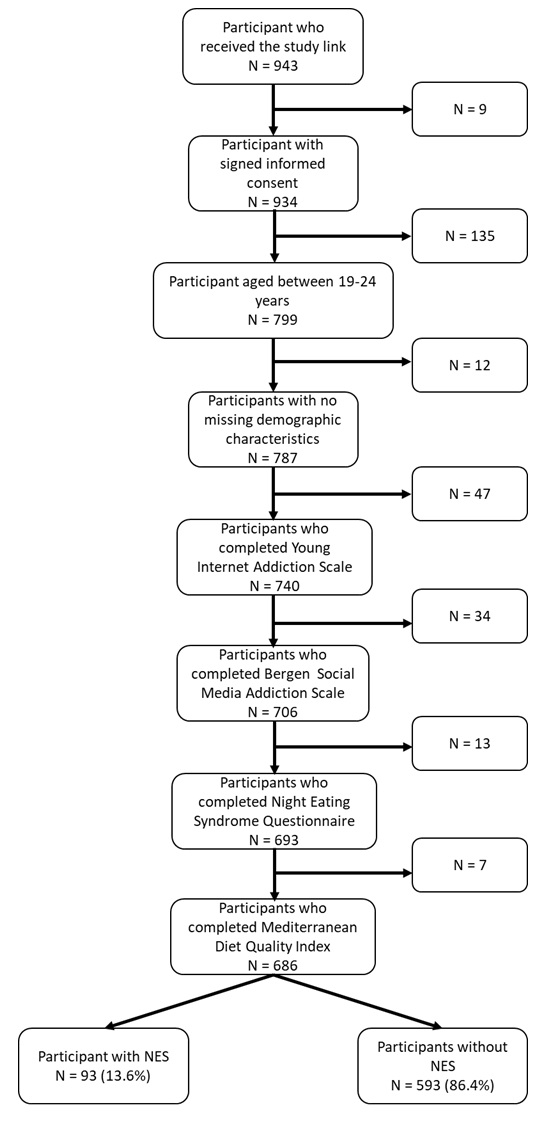
Based on Alpaslan et al.’s study (2015), the minimum expected participant number was calculated as 109, (95% confidence interval [1-α], 95% test power [1-β] and OR= 2.81 effect size) using the G-power package program. Six hundred and eighty-six female and male Turkish university students aged 19-24 years were included in this study. Information on general characteristics, IA, SMA, NES, and compliance with the Mediterranean Diet was collected via a web-based survey. Snowball sampling was used for recruitment. The link to the study was shared on social media platforms, and volunteer participants were asked to share the link to the study with an eligible peer. The questionnaires detailed in the “Measures” section were presented in the same order to everyone as follows: General Characteristics, Internet Addiction Scale, Social Media Addiction Scale, Night Eating Questionnaire, and Mediterranean Diet Quality Index. The ethical considerations of the study were approved by the Atılım University’s Human Research Ethics Committee (decision number E-59394181-604.01.02-7678). Informed consent was obtained from all participants before the survey. Statistical analyses were conducted on the 686 individuals (73% of total participants) who completed all questions in the survey (Figure 1).
Measures
General Characteristics
Self-reported data on age, sex, smoking status, the department students are registered in, grade, physical activity status, and average sleep time were assessed in the first part of the survey. Participants who exercised at least three times a week for at least 30 minutes per exercise session were categorized as the “regular physical activity” group, in line with a prior sleep study demonstrating health benefits at this threshold (Baron et al., 2013). The departments that students were registered in were divided into two groups, namely “departments related to health sciences” and “other departments”, to control the effect of health literacy. The departments affiliated with the Health Sciences, Faculty of Dentistry, Faculty of Pharmacy, and Faculty of Medicine were categorized as “departments related to health sciences.”
Night Eating Syndrome
NES was assessed using the Night Eating Questionnaire (NEQ) (Allison et al., 2008), which was translated into Turkish by Atasoy et al. (2014). The cut-off point for individuals with and without NES was set at 25 in this study to increase sensitivity and decrease false negative rates (Allison et al., 2008). Cronbach’s α of the NEQ for the current sample was 0.60.
Internet Addiction
IA was assessed using the Internet Addiction Scale – Short Form (Pawlikowski et al., 2013), which was translated into Turkish by Kutlu et al. (2016). The cut-off point for individuals with and without IA was set at 36 in this study, as recommended by Tran et al. (2017). Cronbach’s α of the scale for the current sample was 0.82.
Social Media Addiction
SMA was assessed using the Bergen Social Media Addiction Scale (Andreassen et al., 2016), which was translated into Turkish by Demirci (2019). The cut-off point for individuals with and without SMA was set at 19 in this study, as recommended by Bányai et al. (2017). Cronbach’s α of the scale for the current sample was 0.82.
Body Mass Index
BMI values were calculated from self-reported height and weight data.
Adherence to the Mediterranean Diet
The validated “Mediterranean Diet Quality Index (KIDMED)” (Serra-Majem et al., 2004) was used to assess the participants’ adherence to the Mediterranean diet. The total KIDMED score is classified as follows: ≥8 “optimal diet”; 4-7 “dietary intervention is required”, and ≤3 “very low diet quality” (Serra-Majem et al., 2004).
Statistical Analysis
The demographic characteristics of participants with and without NES are presented in percentages (%) and median (minimum - maximum) values. For categorical variables, the differences between NES groups were assessed using the chi-square test. Normality was tested using the Kolmogorov-Smirnov test for continuous variables. Since all continuous variables were non-normally distributed, the differences between NES groups were assessed using the Mann-Whitney U test.
The binary logistic regression model was used to determine the potential risk factors for NES, and the odds ratios were calculated using univariate and multivariate analyses. Univariate analyses were used to define the individual effect of each variable, while the multivariate analysis assessed the combined effect of the variables. In the multivariate analysis, the effects of sex, smoking, age, average sleep duration, the departments that the students are registered in, and BMI were controlled. Smoking was defined as a confounding factor in the relationship between NES, IA, and SMA in light of the following evidence: NES was shown to be associated with substance abuse (Rempfer & Murphy, 2012). Secondly, departments emerged as a confounding factor in the relationships of NES with both IA and SMA, because it was found that students with higher health literacy tend to have a healthier lifestyle (Kazak et al., 2021).
Cronbach’s α value of the tools was calculated to ensure statistical reliability of participant responses. All statistical analyses were performed using the IBM SPSS (v25, IBM Corp, Armonk, NY, USA) package program. A p-value <0.05 was considered significant in all statistical analyses.
Results
Demographic Characteristics of the Participants with and without NES
The demographic characteristics of the participants with (n=93; 13.6%) and without NES (n= 593; 86.4%) are shown in Table 1. The majority of the participants in this study are female (79.3%). The proportion of male students with NES (29%) is higher than that of those without NES (19.4%; p = 0.033).
|
Chi-Square test was used for categorical variables; Mann Whitney U Test was used for continuous variables. *Presented as median (min - max) a-b: There is no significant difference between groups with the same letter. |
||||
| Table 1. The demographic characteristics of participants with and without night eating syndrome | ||||
|
|
|
|
|
|
| Sex n (%) | ||||
| Female |
|
|
|
|
| Male |
|
|
|
|
| Age* |
|
|
|
|
| Smoking status n (%) | ||||
| Yes |
|
|
|
|
| No |
|
|
|
|
| Department n (%) | ||||
| Departments related to health sciences |
|
|
|
|
| Other departments |
|
|
|
|
| Regular physical activity n (%) | ||||
| Yes |
|
|
|
|
| No |
|
|
|
|
| Average sleep duration* |
|
|
|
|
| Body Mass Index (BMI)* |
|
|
|
|
| BMI (categorical) n (%) | ||||
| Underweight |
|
|
|
|
| Normal |
|
|
|
|
| Overweight |
|
|
|
|
| Obese |
|
|
|
|
| Internet addiction scale total score* |
|
|
|
|
| İnternet addiction (categorical) n (%) | ||||
| (+) |
|
|
|
|
| (-) |
|
|
|
|
| Social media addiction scale total score* |
|
|
|
|
| Social media addiction (categorical) n (%) | ||||
| (+) |
|
|
|
|
| (-) |
|
|
|
|
| KIDMED total score* |
|
|
|
|
| KIDMED (categorical) n (%) | ||||
| Very low diet quality |
|
|
|
|
| Dietary intervention is required |
|
|
|
|
| Optimal diet |
|
|
|
|
Significant differences exist in the IA and SMA test scores among students with and without NES (p <0.001 and p = 0.008, respectively). The total scores on both tests are higher in students with NES than in students without NES. Similarly, the proportion of students with IA in the NES (+) group (31.2%) is higher compared to the NES (-) group (14%) when a cut-off value of 36 is used to define IA (p <0.001). However, no significant difference is found in the proportion of students with SMA among the two NES groups when a cut-off value of 19 is used to define SMA (p = 0.075). Nevertheless, the SMA rate in participants with NES (43%) is higher than in those without NES (33.6%). The mean KIDMED scores of students with and without NES are 3.9 ± 2.8 and 5.1 ± 2.6, respectively (p <0.001). When cut-offs for the KIDMED score are used to define diet quality, the rate of those with very low diet quality in the NES (+) group (45.2%) is higher than that in the NES (-) group (26.6%; p = 0.001).
Results of the Binary Logistic Regression Analysis for Defining the Factors Associated with NES
Table 2 depicts the potential risk factors associated with NES in university students. In the univariate analysis, being male (OR [95% CI]: 1.7 [1.04 - 2.78]), smoking (OR [95% CI]: 1.93 [1.23 - 3.05]), studying in departments other than health-related ones (OR [95% CI]: 1.73 [1.05 - 2.85]), and having IA (OR [95% CI]: 2.78 [1.7 – 4.57]) have been identified as potential risk factors related to having NES. In the multivariate analysis, both having IA and SMA were found to be associated with NES (OR [95% CI]: 2.92 [1.75 - 4.86] and OR [95% CI]: 1.69 [1.06 - 2.68], respectively) after controlling for sex, smoking status, age, average sleep duration, department, and BMI.
| *Sex, smoking, age, average sleep duration, department and BMI were controlled in multivariate analysis assessing the relationship between IA-NES and SMA-NES. Sex, smoking, age, average sleep duration and department were controlled in multivariate analysis assessing the relationship between BMI and NES. | ||||
| Table 2. The factors associated with night eating syndrome in university students (n=93) | ||||
|
|
|
|||
|
|
|
|
|
|
| Sex | ||||
| Female |
|
|||
| Male |
|
|
||
| Smoking status | ||||
| No |
|
|||
| Yes |
|
|
||
| Age |
|
|
||
| Average sleep duration |
|
|
||
| Department | ||||
| Departments related to health sciences |
|
|||
| Other departments |
|
|
||
| Body Mass Index (BMI) |
|
|
|
|
| Internet addiction | ||||
| (+) |
|
|||
| (-) |
|
|
|
|
| Social media addiction | ||||
| (+) |
|
|||
| (-) |
|
|
|
|
Discussion
The current study reported a rate of 13.6% for NES among university students. Moreover, sex, smoking status, department, and IA were found to be associated with NES through the univariate analysis. After checking for confounding factors, both having a high score above the cut-off for IA and having a high score above the cut-off for SMA were found to be potential risk factors associated with having NES.
In previous studies, the frequency of NES appeared to vary between different age and nationality groups. In earlier research, the prevalence of NES in the general adult population was estimated at approximately 1.5% (Rand et al., 1997). More recent studies continue to support a low (but non-negligible) base rate — population estimates typically range around 0.5 – 1.5% (Sayed Ahmed et al., 2024). In contrast, NES appears substantially more common among individuals with obesity and those undergoing bariatric surgery: clinical samples have reported rates between ~ 3% and ~ 15% in obese patients (Kaur et al., 2022), while a recent post-surgical cohort was found to have a NES prevalence as high as 33.8% (Almuammar et al., 2024). In two cross-sectional studies conducted among American and Brazilian university students, the prevalence was found to be 4.2% and 15%, respectively (Borges et al., 2017; Runfola et al., 2014). A prior study among Turkish university students, however, reported the NES prevalence of 9.5% (Sevincer et al., 2016). Cultural differences (regular timing of meals, breakfast habits), anthropometric measurements, social environment and the lifestyle habits of the population of interest, as well as the preference of different measurement instruments for detecting NES, may be effective in modifying the rates of NES in different groups. When compared with the study among Turkish university students, the prevalence seems to increase (from 9.5% to 13.6%). One possible reason for the increased prevalence of NES may be related to lifestyle changes, especially after the COVID-19 pandemic. Rodgers et al. (2020) hypothesized that, during the COVID-19 pandemic, the risk and symptoms of eating disorders may have increased due to the interruption of daily habits, social isolation, changes in sleep and physical activity patterns, and emotional regulation. Nevertheless, there is a need for studies assessing the validity of this hypothesis among people with NES.
In the current literature, no specific study comparing NES with IA and/or SMA is available. However, the relationship between other eating disorders (especially anorexia nervosa, bulimia nervosa and binge eating) and problematic internet use has been examined before (Gündüz et al., 2019; Hinojo-Lucena et al., 2019). In a prior study conducted on Turkish university students, no significant correlation was found between IA and EAT-26 scores (Gündüz et al., 2019). On the other hand, similar to the current study, a meta-analysis examining the relationship between problematic internet use and eating disorders in the student population, reported a 2.03-times increased risk for having eating disorders in students with problematic internet use (Hinojo-Lucena et al., 2019). Problematic internet use, defined as the users’ desire to be constantly connected to the internet, can lead to a sedentary lifestyle. It can also promote a preference for fast food due to its easy preparation and consumption properties (Hinojo-Lucena et al., 2019). This explanation is often used for defining the causal relationship between internet use and eating disorders. However, there is no literature-based explanation for the causal relationship between NES and IA and/or SMA.
The relationship between NES and IA and/or SMA among university students may be related to the fact that the time spent on the internet and social media is concentrated in the evening time because young adults are mostly in school during the day. Tekinarslan and Gurer (2011) reported that 66.6% of university students studied used the internet in the evening and nighttime (20:00 - 07:59). Moreover, the rate of students using the internet late at night (00:00 - 07:59) was reported to be 12.1% (Tekinarslan & Gurer, 2011). By delaying sleep times for internet use and staying awake during the nighttime, sleep disruption (Li et al., 2007) and circadian rhythm misalignments (Touitou et al., 2016) may occur, which may cause further health problems. Adolescents who use social media for more than three hours a day experience problems related to sleeping late and falling asleep again after waking up at night (Scott et al., 2019). Such problems overlap with some NES symptoms. Furthermore, young adults who delay their bedtime due to internet or social media use may also tend to increase their food consumption during the period they are awake. Kamran et al. (2018) found that eating snacks while using the internet was common (61.3%) among university students with severe IA. In the same study, it was reported that high-caloric foods and beverages, such as fast food, fried foods, and carbonated drinks, were among the common snacks preferred by the students with IA (Kamran et al., 2018). Based on these previous findings, it can be speculated that, in young adults with IA, disruptions in sleep patterns and consumption of high-caloric foods while using the internet may increase the risk of nocturnal hyperphagia and insomnia by disrupting the circadian activity of orexigenic and anorexigenic hormones and lead to symptoms that are defined in the diagnosis of NES.
On the other hand, there is also a possibility that NES has a triggering effect on IA and/or SMA. In a meta-analysis study, it was revealed that sleep problems are 2.2 times higher in people with IA (Alimoradi et al., 2019). In another study, social media use was reported to be high among high school students having poor sleep quality and moderate to severe sleep disorders (Bulut & Tuncay, 2020). NES-related sleep disturbances, such as difficulties in sleep initiation, nocturnal awakenings, and sleep onset and maintenance insomnia, may predispose young adults to IA and/or SMA.
Another possible reason for the high incidence of NES with IA and/or SMA could be explained by the three of them (NES, IA and SMA) sharing similarities with various dimensions of psychopathology (Rempfer & Murphy, 2012; Saikia et al., 2019; Sun & Zhang, 2021). The results of a 12-month follow-up study indicated that both depression and anxiety are predictors of the severity of internet use disorders (Leo et al., 2021). Besides, a vast amount of evidence indicates a positive correlation between NES and depression, anxiety, and substance use (Rempfer & Murphy, 2012). Stunkard et al. emphasized that NES is more frequent during periods of emotional distress (Stunkard et al., 1955). Hence, young adults may become emotionally more prone to IA and SMA if NES is present.
Limitations
This is the first study, to the authors’ knowledge, to define the possible relationship between NES, IA, and SMA in a wide-scale population. However, this study has certain limitations. First, since it is a cross-sectional study, it is not possible to demonstrate a causal relationship between variables. Further studies should be conducted to clarify the relationships in a robust way. Secondly, the questionnaires used for detecting IA, SMA, and NES were all screening tools. Despite being widely used, clinical examination is still the gold standard for diagnostic purposes. Thirdly, snowball sampling, which was used to reach a large-scale sample, is a non-probability method and it can introduce bias that can limit the generalizability and reliability of findings. Finally, no validated tool was used for defining depression or anxiety in this study. Assessing these variables could widen the perspective of the study in a way that could enhance the understanding of whether anxiety and/or depression are possible confounding factors in the relationship between NES, IA, and SMA.
Directions/Suggestions for Future Research
In conclusion, this study reveals that IA and SMA may be associated with NES in university students. Since the long-term effects of both NES and problematic internet or social media use are not clearly defined, future studies are needed to improve on these findings. However, as a preventive step in healthcare services, it is recommended to develop strategies to detect and manage IA, SMA, and NES in university students. From a clinical perspective, healthcare providers, particularly dietitians and psychologists, should consider screening for internet addiction when adolescents present with symptoms of eating or sleep disorders. Interventions could include psychoeducation for both parents and adolescents about the risks of excessive internet use, the development of healthy digital habits, and the incorporation of behavioral therapies aimed at reducing screen time. Additionally, universities and community programs could implement awareness campaigns and workshops to educate young people about the interconnectedness of internet use, eating behaviors, and sleep patterns.
Ethical approval
This study was approved by the Atilim University’s Human Research Ethics Committee (Date: November 24, 2020, Decision/Protocol No: E-59394181-604.01.02-7678). Informed consent was obtained from all participants involved in this study.
Data availability statement
The data that support the findings of this study are available from the corresponding author upon reasonable request.
Conflict of interest
The authors declare that this study was conducted in the absence of any commercial or financial relationships that could be construed as a potential conflict of interest.
Funding
The authors declare that this study received no funding.
Generative AI statement
The authors declare that no generative AI or AI-assisted technologies were used in the writing or preparation of this study.
References
- Alimoradi, Z., Lin, C. Y., Broström, A., Bülow, P. H., Bajalan, Z., Griffiths, M. D., Ohayon, M. M., & Pakpour, A. H. (2019). Internet addiction and sleep problems: A systematic review and meta-analysis. Sleep Medicine Reviews, 47, 51-61. https://doi.org/10.1016/j.smrv.2019.06.004
- Allison, K. C., Lundgren, J. D., O’Reardon, J. P., Geliebter, A., Gluck, M. E., Vinai, P., Mitchell, J. E., Schenck, C. H., Howell, M. J., Crow, S. J., Engel, S., Latzer, Y., Tzischinsky, O., Mahowald, M. W., & Stunkard, A. J. (2010). Proposed diagnostic criteria for night eating syndrome. International Journal of Eating Disorders, 43(3), 241-247. https://doi.org/10.1002/eat.20693
- Allison, K. C., Lundgren, J. D., O’Reardon, J. P., Martino, N. S., Sarwer, D. B., Wadden, T. A., Crosby, R. D., Engel, S. G., & Stunkard, A. J. (2008). The Night Eating Questionnaire (NEQ): Psychometric properties of a measure of severity of the Night Eating Syndrome. Eating Behaviors, 9(1), 62-72. https://doi.org/10.1016/j.eatbeh.2007.03.007
- Almuammar, S., Aljaaly, E., Alqarni, L., Alazwari, H., Alsubhi, R., & Alatawi, N. (2024). Evaluating Night-Eating Syndrome in bariatric surgery patients: A cross-sectional study. BMC Research Notes, 17(1), 118. https://doi.org/10.1186/S13104-024-06774-Z
- Alpaslan, A. H., Koçak, U., Avci, K., & Uzel Taş, H. (2015). The association between internet addiction and disordered eating attitudes among Turkish high school students. Eating and Weight Disorders, 20(4), 441-448. https://doi.org/10.1007/s40519-015-0197-9
- American Psychiatric Association. (2013). Diagnostic and statistical manuel of mental disorders - DSM V TR. American Psychiatric Association.
- Andreassen, C. S., Billieux, J., Griffiths, M. D., Kuss, D. J., Demetrovics, Z., Mazzoni, E., & Pallesen, S. (2016). The relationship between addictive use of social media and video games and symptoms of psychiatric disorders: A large-scale cross-sectional study. Psychology of Addictive Behaviors, 30(2), 252-262. https://doi.org/10.1037/adb0000160
- Atasoy, N., Saraçli, Ö., Konuk, N., Ankarali, H., Güriz, S. O., Akdemir, A., Sevinçer, G. M., & Atik, L. (2014). Gece Yeme Anketi-Türkçe formunun psikiyatrik ayaktan hasta popülasyonunda geçerlilik ve güvenilirlik çalışması. Anadolu Psikiyatri Dergisi, 15(3), 238-247.
- Bányai, F., Zsila, Á., Király, O., Maraz, A., Elekes, Z., Griffiths, M. D., Andreassen, C. S., & Demetrovics, Z. (2017). Problematic social media use: Results from a large-scale nationally representative adolescent sample. PLOS ONE, 12(1), e0169839. https://doi.org/10.1371/journal.pone.0169839
- Baron, K. G., Reid, K. J., & Zee, P. C. (2013). Exercise to improve sleep in insomnia: Exploration of the bidirectional effects. Journal of Clinical Sleep Medicine : Official Publication of the American Academy of Sleep Medicine, 9(8), 819. https://doi.org/10.5664/JCSM.2930
- Black, D. W., Belsare, G., & Schlosser, S. (1999). Clinical features, psychiatric comorbidity, and health-related quality of life in persons reporting compulsive computer use behavior. The Journal of Clinical Psychiatry, 60(12), 839-844. https://doi.org/10.4088/JCP.v60n1206
- Borges, K. M., Figueiredo, F. W. dos S., & do Souto, R. P. (2017). Night eating syndrome and emotional states in university students. Journal of Human Growth and Development, 27(3), 332-341. https://doi.org/10.7322/jhgd.141277
- Bulut, A., & Tuncay, N. (2020). Social media addiction and sleep problem: A structural equation modelling. In The 16 th International Scientific Conference eLearning and Software for Education (pp. 461-469).
- Cheung, L. M., & Wong, W. S. (2011). The effects of insomnia and internet addiction on depression in Hong Kong Chinese adolescents: An exploratory cross-sectional analysis. Journal of Sleep Research, 20(2), 311-317. https://doi.org/10.1111/j.1365-2869.2010.00883.x
- DataReportal. (2025). Global social media statistics - Datareportal - Global digital insights. https://datareportal.com/social-media-users
- Demirci, I. (2019). The adaptation of the bergen social media addiction scale to Turkish and its evaluation of relationship with depression and anxiety symptoms. Anadolu Psikiyatri Dergisi, 21, 15-22. https://doi.org/10.5455/apd.41585
- Griffiths, M. D., Kuss, D. J., & Demetrovics, Z. (2014). Social networking addiction: An overview of preliminary findings. In Behavioral Addictions: Criteria, Evidence, and Treatment (pp. 119-141). Elsevier Inc. https://doi.org/10.1016/B978-0-12-407724-9.00006-9
- Gündüz, N., Gökçen, O., Eren, F., Erzincan, E., & Turan, H. (2019). The relationship between internet addiction and eating attitudes and obesity related problems among university students. Journal of Clinical Psychiatry, 22, 266-275. https://doi.org/10.5505/kpd.2019.14622
- Hinojo-Lucena, F.-J., Aznar-Díaz, I., Cáceres-Reche, M.-P., Trujillo-Torres, J.-M., & Romero-Rodríguez, J.-M. (2019). Problematic internet use as a predictor of eating disorders in students: A systematic review and meta-analysis study. Nutrients, 11(9), 2151. https://doi.org/10.3390/nu11092151
- Hou, Y., Xiong, D., Jiang, T., Song, L., & Wang, Q. (2019). Social media addiction: Its impact, mediation, and intervention. Cyberpsychology: Journal of Psychosocial Research on Cyberspace, 13(1), 1-4. https://doi.org/10.5817/CP2019-1-4
- Kamran, H., Afreen, A., & Ahmed, Z. (2018). Effect of internet addiction on dietary behavior and lifestyle characteristics among university students. Annals of King Edward Medical University, 24(S), 836-841. https://doi.org/10.21649/akemu.v24is.2518
- Kaur, J., Dang, A. B., Gan, J., An, Z., & Krug, I. (2022). Night eating syndrome in patients with obesity and binge eating disorder: A systematic review. Frontiers in Psychology, 12, 766827. https://doi.org/10.3389/FPSYG.2021.766827/BIBTEX
- Kazak, A., Başaran, F., Coşkun, N., & Karakullukçu, S. (2021). Evaluatıon of health literacy and healthy lifestyle behaviors of unıversıty students that study in health-related department. Kocaeli Medical Journal, 10(3), 273-283. https://doi.org/10.5505/KTD.2021.22438
- Kim, Y., Park, J. Y., Kim, S. B., Jung, I. K., Lim, Y. S., & Kim, J. H. (2010). The effects of internet addiction on the lifestyle and dietary behavior of Korean adolescents. Nutrition Research and Practice, 4(1), 51-57. https://doi.org/10.4162/nrp.2010.4.1.51
- Kutlu, M., Savci, M., Demir, Y., & Aysan, F. (2016). Young internet bağımlılığı testi kısa formunun türkçe uyarlaması: Üniversite öğrencileri ve ergenlerde geçerlilik ve güvenilirlik çalışması. Anadolu Psikiyatri Dergisi, 17, 69-76. https://www.guvenliweb.org.tr/dosya/1QN49.pdf
- Leo, K., Kewitz, S., Wartberg, L., & Lindenberg, K. (2021). Depression and social anxiety predict internet use disorder symptoms in children and adolescents at 12-month follow-up: Results from a longitudinal study. Frontiers in Psychology, 12, 5827. https://doi.org/10.3389/FPSYG.2021.787162/BIBTEX
- Li, S., Jin, X., Wu, S., Jiang, F., Yan, C., & Shen, X. (2007). The impact of media use on sleep patterns and sleep disorders among school-aged children in China. Sleep, 30(3), 361-367. https://doi.org/10.1093/sleep/30.3.361
- Masthi, N. R. R., Pruthvi, S., & Phaneendra, M. S. (2018). A comparative study on social media usage and health status among students studying in PRE-UNIVersity Colleges of Urban Bengaluru. Indian Journal of Community Medicine : Official Publication of Indian Association of Preventive & Social Medicine, 43(3), 180-184. https://doi.org/10.4103/IJCM.IJCM_285_17
- Morrison, C. M., & Gore, H. (2010). The relationship between excessive internet use and depression: A questionnaire-based study of 1,319 young people and adults. Psychopathology, 43(2), 121-126. https://doi.org/10.1159/000277001
- Pawlikowski, M., Altstötter-Gleich, C., & Brand, M. (2013). Validation and psychometric properties of a short version of Young’s Internet Addiction Test. Computers in Human Behavior, 29(3), 1212-1223. https://doi.org/10.1016/j.chb.2012.10.014
- Rand, C. S. W., Macgregor, A. M. C., & Stunkard, A. J. (1997). The night eating syndrome in the general population and among postoperative obesity surgery patients. International Journal of Eating Disorders, 22(1), 65-69. https://doi.org/10.1002/(SICI)1098-108X(199707)22
- Rempfer, M. V, & Murphy, M. E. (2012). Night eating syndrome and other psychiatric disorders. In Night eating syndrome: Research, assessment, and treatment. BT - Night eating syndrome: Research, assessment, and treatment. (pp. 127-150). https://psycnet.apa.org/record/2012-17298-008
- Rodgers, R. F., Lombardo, C., Cerolini, S., Franko, D. L., Omori, M., Fuller-Tyszkiewicz, M., Linardon, J., Courtet, P., & Guillaume, S. (2020). The impact of the COVID-19 pandemic on eating disorder risk and symptoms. International Journal of Eating Disorders, 53(7), 1166-1170. https://doi.org/10.1002/eat.23318
- Runfola, C. D., Allison, K. C., Hardy, K. K., Lock, J., & Peebles, R. (2014). Prevalence and clinical significance of night eating syndrome in university students. Journal of Adolescent Health, 55(1), 41-48. https://doi.org/10.1016/j.jadohealth.2013.11.012
- Saikia, A. M., Das, J., Barman, P., & Bharali, M. D. (2019). Internet addiction and its relationships with depression, anxiety, and stress in urban adolescents of Kamrup District, Assam. Journal of Family & Community Medicine, 26(2), 108. https://doi.org/10.4103/JFCM.JFCM_93_18
- Sayed Ahmed, H. A., Abo El-Ela, S. G., Joudeh, A. I., Moawd, S. M., El Hayek, S., Shah, J., & Eldahshan, N. A. (2024). Prevalence and correlates of night eating syndrome, Insomnia, and psychological distress in primary care patients with obesity: A cross-sectional study. Obesity Facts, 17(3), 274-285. https://doi.org/10.1159/000538341
- Scott, H., Biello, S. M., & Woods, H. C. (2019). Social media use and adolescent sleep patterns: cross-sectional findings from the UK millennium cohort study. BMJ Open, 9(9), e031161. https://doi.org/10.1136/bmjopen-2019-031161
- Serra-Majem, L., Ribas, L., Ngo, J., Ortega, R. M., García, A., Pérez-Rodrigo, C., & Aranceta, J. (2004). Food, youth and the Mediterranean diet in Spain. Development of KIDMED, Mediterranean Diet quality ındex in children and adolescents. Public Health Nutrition, 7(7), 931-935. https://doi.org/10.1079/phn2004556
- Sevincer, G. M., Ince, E., Taymur, I., & Konuk, N. (2016). Night eating syndrome frequency in university students: Association with impulsivity, depression, and anxiety. Klinik Psikofarmakoloji Bulteni, 26(3), 238-247. https://doi.org/10.5455/bcp.20160322093750
- Shaw, M., & Black, D. W. (2012). Internet addiction. CNS Drugs, 22(5), 353-365. https://doi.org/10.2165/00023210-200822050-00001
- Singh, A. (2018). Ever-increasing trend of internet usage and its impact on school aged children and adolescents. International Journal of Education & Management © 2018 Indian Association of Health, 8(1), 119-122. https://www.proquest.com/openview/2879e1585bc1dc2e46c9e7b91914d5c3/1?pq-origsite=gscholar&cbl=2032132
- Stunkard, A. J., Grace, W., & Wolff, H. (1955). The night-eating syndrome; A pattern of food intake among certain obese patients. The American Journal of Medicine, 19(1), 78-86. https://doi.org/10.1016/0002-9343(55)90276-x
- Sun, Y., & Zhang, Y. (2021). A review of theories and models applied in studies of social media addiction and implications for future research. Addictive Behaviors, 114, 106699. https://doi.org/10.1016/J.ADDBEH.2020.106699
- Tekinarslan, E., & Gurer, M. (2011). Problematic internet use among Turkish university students : A multidimensional investigation based on demographics and Internet activities. International Journal of Human Sciences, 8(1), 1028-1051.
- Touitou, Y., Touitou, D., & Reinberg, A. (2016). Disruption of adolescents’ circadian clock: The vicious circle of media use, exposure to light at night, sleep loss and risk behaviors. Journal of Physiology-Paris, 110(4), 467-479. https://doi.org/10.1016/j.jphysparis.2017.05.001
- Tran, B. X., Mai, H. T., Nguyen, L. H., Nguyen, C. T., Latkin, C. A., Zhang, M. W. B., & Ho, R. C. M. (2017). Vietnamese validation of the short version of Internet Addiction Test. Addictive Behaviors Reports, 6, 45-50. https://doi.org/10.1016/j.abrep.2017.07.001
- Tsitsika, A., Critselis, E., Janikian, M., Kormas, G., & Kafetzis, D. A. (2011). Association between ınternet gambling and problematic ınternet use among adolescents. Journal of Gambling Studies, 27(3), 389-400. https://doi.org/10.1007/s10899-010-9223-z
- Wolniczak, I., Cáceres-DelAguila, J. A., Palma-Ardiles, G., Arroyo, K. J., Solís-Visscher, R., Paredes-Yauri, S., Mego-Aquije, K., & Bernabe-Ortiz, A. (2013). Association between facebook dependence and poor sleep quality: A study in a sample of undergraduate students in Peru. PLoS ONE, 8(3), e59087. https://doi.org/10.1371/journal.pone.0059087
- World Health Organization. (2019). ICD-11. https://icd.who.int/en
License
Copyright (c) 2026 The Author(s). This is an open access article distributed under the Creative Commons Attribution License (CC BY), which permits unrestricted use, distribution, and reproduction in any medium or format, provided the original work is properly cited.