



Abstract
This study investigated the relationships between sociodemographic factors, family resilience, and religious coping among Turkish university students, a population vulnerable to sports betting addiction. The research, conducted with 587 students (ages 17–27), found that 30.5% of the participants had engaged in sports betting. Analyses showed that sports betting addiction differed significantly by gender, with men scoring higher than women. Other significant factors included having betting acquaintances, the importance of religion, betting frequency, and motivations. Both family resilience (r=−.136, p<.001) and positive religious coping (r=−0.154, p<.001) were negatively associated with addiction. Mediation analysis was a key finding, revealing that positive religious coping indirectly reduces addiction by increasing family resilience. Furthermore, multiple regression analysis identified betting frequency and motivations like making money and seeking excitement as the strongest predictors. These findings emphasize the importance of strong family bonds and positive religious beliefs as crucial protective factors against addiction. The results have important implications for prevention strategies that focus on strengthening family resilience and promoting religious coping methods among young people.
Keywords: sports betting addiction, university students, religious coping, family resilience
Main Points
- Family resilience and positive religious coping may serve as significant protective factors against the development of sports betting addiction among university students.
- Positive religious coping appears to indirectly mitigate problematic sports betting behaviors, not through a direct effect, but rather by enhancing levels of family resilience.
- Sociodemographic factors such as being male and having an acquaintance who bets, alongside the primary motivation of financial gain, are significantly associated with and serve as robust predictors for heightened sports betting addiction levels among university students.
Introduction
In recent years, behavioral addictions have come to be recognized as a growing public health concern. Among these, sports betting addiction has emerged as a serious behavioral problem marked by persistent and uncontrolled gambling behavior (Calado & Griffiths, 2016). This condition is officially classified as a psychiatric disorder defined as Gambling Disorder in the DSM-5 and Gambling Control Disorder in the ICD-11 because its symptoms closely resemble those of substance use disorders. Research consistently shows that problem gambling is almost four times more common among adolescents than among adults (Pisarska & Ostaszewski, 2020). University students constitute a vulnerable group due to factors such as academic stress, risk-taking tendencies, peer influence, and the desire for financial independence (Calado & Griffiths, 2016; Derevensky & Gupta, 2019). Ultimately, sports betting addiction has been shown to have damaging effects on individuals’ social relationships, psychological health, and academic performance (Griffiths & Wood, 2007; Williams et al., 2012).
In the field of mental health, risk, and protective factors are often examined through the tripartite framework of predisposing, triggering, and perpetuating factors (Barlow, 2022; Reichert et al., 2025). Predisposing factors refer to individual or contextual vulnerabilities that increase susceptibility to mental or behavioral disorders. Triggering factors are acute life stressors or events that precipitate the onset of symptoms, whereas perpetuating factors contribute to the continuation of the problem over time. Within this framework, coping strategies and family support are seen as key protective mechanisms that can buffer against the effects of risk factors.
In Türkiye, despite the legal prohibition of gambling, online sports betting has become increasingly widespread due to technological advancements and easy internet access (Köksoy Vayısoğlu et al., 2019). National studies have revealed a growing risk among university students: Duran et al. (2024) found a 4.8% prevalence of gambling addiction, while Elmas et al. (2017) identified that 34.55% of students were at risk of pathological gambling. These findings underline the need to explore factors that can protect young adults from such risky behaviors. Family support and effective coping strategies have repeatedly been shown to play a vital role in reducing these risks (Molinaro et al., 2014).
One of the central protective mechanisms is Family Resilience, defined by Walsh (2016) as a family’s ability to maintain balance and emerge stronger in the face of adversity. Strong communication, shared meaning systems, and emotional connectedness within the family are known to protect individuals from developing addictive behaviors (Liese et al., 2020).
Another important construct is religious coping, described by Pargament (1997) as turning to one’s faith system to manage stress or crisis. Positive religious coping involves finding meaning, hope, and comfort in spirituality, whereas negative religious coping reflects guilt or conflict in one’s beliefs. Prior research suggests that religious beliefs may act as a deterrent against gambling, as many religions view such behavior as unethical (Beyerlein & Sallaz, 2017; Kanabar et al., 2024; Lam, 2006).
Drawing on these perspectives, the present study explores how family resilience and religious coping operate together as protective factors against sports betting addiction. Religious coping may strengthen family resilience by fostering shared belief systems that enhance unity, communication, and problem-solving (Pargament, 1997; Walsh, 2016). Families that utilize positive religious coping are more likely to demonstrate stronger resilience when faced with stress or financial strain (Prasetyo et al., 2023). Thus, Positive Religious Coping and Family Resilience can be viewed as complementary protective mechanisms that help disrupt the progression of sports betting addiction (Barlow, 2022).
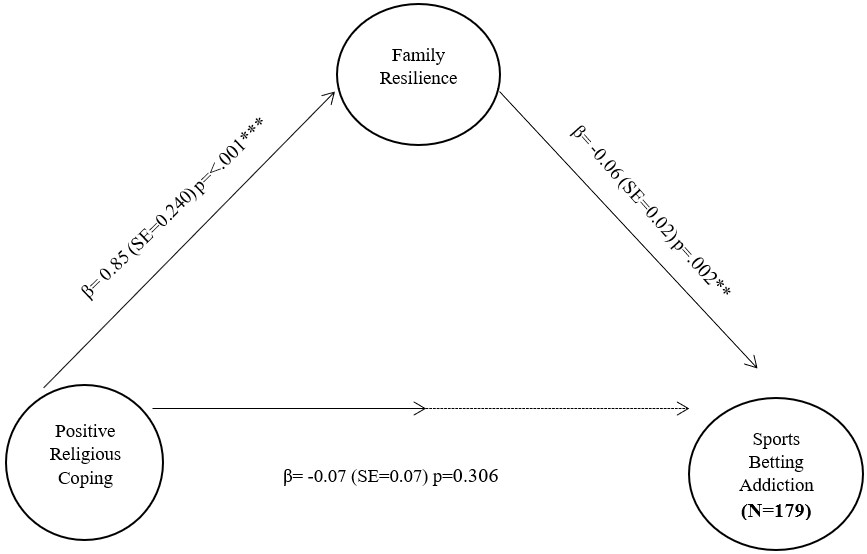
Considering the theoretical background and previous research, the present study aims to gain a deeper understanding of how family resilience and religious coping function as protective mechanisms within the context of behavioral addictions among university students. More specifically, it seeks to examine both the direct and indirect influences of these variables on sports betting addiction, clarifying how they interact to shape students’ vulnerability or resistance to such behaviors. The conceptual model developed for this purpose is illustrated in Figure 1.
To Address This Objective, the Study is Guided by the Following Research Questions (RQ)
RQ1. Does family resilience significantly predict the level of sports betting addiction among university students?
RQ2. Do religious coping strategies have an indirect effect on sports betting addiction through the mediating role of family resilience?
Methods
This study used a cross-sectional design to examine variable relationships, in accordance with the STROBE guidelines (Von Elm et al., 2007).
Population and Sample of the Study
The determination of the minimum required sample size was based on statistical principles designed for estimating a single population proportion in cross-sectional studies (Naing et al., 2006). Since reliable prevalence data for the outcome variable in the target population were unavailable, a conservative estimate of 50% prevalence was selected to maximize the required sample size and ensure adequate statistical power (Arcan & Karanci, 2013; Suresh & Chandrashekara, 2012). The calculation, executed using Epi Info software (Centers for Disease Control and Prevention, 2024), incorporated a 5% margin of error (d=.05), a 95% confidence level (Z=1.96), and a design effect of 1.0. This process yielded a minimum required sample size of N=371.
Data were collected via face-to-face surveys at a university in Türkiye over a four-month period, spanning from March 2025 to July 2025, following institutional ethical approval. The inclusion criteria for the study were strictly defined: Participants had to be currently enrolled students at the university, at least 18 years old, and provide voluntary, informed consent to participate.
A total of 32 participants were excluded from the final sample due to missing data (n=12) or incorrect responses on a control item (n=20). The final study sample thus comprised 587 participants who met all inclusion criteria and completed the questionnaires in their entirety. This final sample size exceeded the minimum statistical requirement (N=371). Participants’ sociodemographic characteristics are fully detailed in Table 1. Descriptive and correlational analyses were conducted on the entire sample (N=587). However, the mediation and regression analyses, which addressed the study’s primary hypotheses, were performed exclusively on the subsample (n=179) of participants who explicitly reported engaging in sports betting.
| ¹ Participants could select multiple responses for this item; therefore, the total percentage exceeds 100%. x̄ = mean; SD = standard deviation; Min = minimum; Max = maximum | ||
| Table 1. Sociodemographic characteristics of participants (N=587) | ||
| Sociodemographic Characteristics |
|
|
| Gender | ||
| Female |
|
|
| Male |
|
|
| Age (x̄±sd) |
|
|
| Department | ||
| Nursing |
|
|
| Vocational school |
|
|
| Art and Design |
|
|
| Economic and administrative sciences |
|
|
| Faculty of Sciences |
|
|
| Engineering |
|
|
| Grade | ||
| 1st year |
|
|
| 2nd year |
|
|
| 3rd year |
|
|
| 4th year |
|
|
| Religious Belief Status | ||
| Muslim |
|
|
| Christian |
|
|
| Jew |
|
|
| Atheist |
|
|
| Agnostic |
|
|
| Deist |
|
|
| Non-believers |
|
|
| The Importance of Religion | ||
| Not important at all |
|
|
| Somewhat unimportant |
|
|
| Slightly important |
|
|
| Very important |
|
|
| The situation of having an acquaintance who bets | ||
| Yes |
|
|
| No |
|
|
| Betting Situation | ||
| Yes |
|
|
| No |
|
|
| Betting Frequency | ||
| Non-gamblers |
|
|
| Most days |
|
|
| At least once a week |
|
|
| Once or twice a month |
|
|
| Less than once a month |
|
|
| Reason For Betting1 | ||
| Non-gamblers |
|
|
| Entertainment |
|
|
| Earning money |
|
|
| Social circle effect |
|
|
| Thinking you are lucky |
|
|
| Excitement |
|
|
Measurements
The survey instrument was comprised of four sections: (1) Participant Information Form (participants’ gender, religious beliefs, importance of religion, sports betting status, frequency of sports betting, reasons for sports betting, presence of an acquaintance who bets on sports), (2) Sports Betting Addiction Index, (3) Walsh Family Resilience Scale, and (4) Religious Coping Scale.
Sports Betting Addiction Index
The Problem Gambling Severity Index (PGSI), developed by Ferris and Wyne (2001), was adapted into Turkish for sports betting as the Sports Betting Addiction Index by Gökce Yüce (2020). The scale contains 9 items designed to measure the level of sports betting addiction. A 4-point Likert-type scale was used to evaluate the scale items (0 = rarely/never - 3 = almost always/always). The total score range that can be obtained from the index is between 0 and 27. A score of 0 on the scale indicates that the person does not have a sports betting addiction problem, a score between 1 and 2 indicates a low risk of sports betting addiction, a score between 3 and 7 indicates a moderate risk of sports betting addiction, and a score of 8+ indicates a sports betting addiction problem. The Turkish version of the scale demonstrated good internal consistency (α = .88) (Gökce Yüce, 2020). In the current study, we utilized only the total scores, and the scale demonstrated excellent internal consistency (α = .93).
Walsh Family Resilience Scale
The Walsh Family Resilience Scale, developed by Walsh (2015), was adapted into Turkish by Arslan and Hatipoğlu (2025). The scale was created to assess families’ resilience levels and consists of 32 items. The scale items are rated using a 5-point Likert-type scale (0=strongly disagree, 5=strongly agree). The total score range that can be obtained from the scale is between 0 and 160. A higher score on the scale indicates high family resilience, while a lower score indicates low family resilience. Participants’ levels of attachment, support, and problem-solving within the family are assessed using this scale. It has been stated that the internal consistency coefficients of the Turkish version of the scale are above .70 in all subscales and provide a high level of reliability (Arslan & Hatipoğlu, 2025). In the current study, we utilized only the total scores, and the scale demonstrated excellent internal consistency (α = .95).
Religious Coping Scale
The “Religious Coping Scale” developed by Pargament et al. (1998) was adapted into Turkish by Ekşi and Sayın (2016) as part of their research. The scale consists of 10 items and was created to measure the extent to which individuals use religious coping strategies in response to stressful life events. Seven of these items assess positive religious coping, while three assess negative religious coping. It consists of two subscales that evaluate individuals’ religious coping strategies as positive and negative. Positive coping is explained by themes such as forgiveness, hope, and spirituality, while negative coping includes religious conflict and feelings of guilt. The scale is assessed using a 4-point Likert scale (1=never, 4=always). The possible score range for the positive subscale is 7–28, while the possible score range for the negative subscale is 3–12. A high score indicates that the relevant religious coping style is used more intensely. Ekşi and Sayın (2016) reported Cronbach’s alpha coefficients of .64 for positive religious coping and .63 for negative religious coping. In our study, the scale showed significantly higher internal consistency for both the negative (α = .91) and positive (α = .96).
Statistical Analysis
All statistical analyses were conducted using the Jamovi statistical software (Version 2.6). Descriptive statistics (mean, standard deviation, skewness, and kurtosis) were calculated for all variables. The assumption of normality was assessed by examining skewness and kurtosis coefficients, with values between ±1 considered acceptable (Hair et al., 2014). The internal consistency reliability of the scales was determined using Cronbach’s alpha coefficient. Pearson’s correlation coefficients were computed to assess the bivariate relationships among the study variables.
Correlation coefficients (r) were interpreted based on established general guidelines (Cohen, 1988), categorized as weak (0.10–0.29), moderate (0.30–0.49), or strong (≥0.50). Initially, in alignment with the study’s main research question, all subscales of the Religious Coping Scale (Positive and Negative Religious Coping) were planned for inclusion in the correlation analysis. However, given that the Negative Religious Coping sub-dimension did not exhibit a statistically significant relationship with the Family Resilience variable (as detailed in the Findings section), a methodological decision was made to include only the Positive Religious Coping variable in the subsequent indirect effect modelling. This deliberate elimination aimed to enhance the parsimony and statistical power of the final model.
Mediation Analysis
A mediation analysis was subsequently performed to test the hypothesized indirect effect, utilizing the internal modules of the Jamovi program and adhering to the statistical approach consistent with Hayes (2018), which extends the traditional framework of Baron and Kenny (1986). In this structural model, Positive Religious Coping was defined as the independent variable (X), Family Resilience as the mediating variable (M), and Sports Betting Addiction as the dependent variable (Y). The analysis was explicitly designed to test the mediation structure summarized in Figure 1: Positive Religious Coping → Family Resilience → Sports Betting Addiction.
Ethical Issues
Prior to data collection, ethical approval was obtained from a university’s Non-Interventional Ethics Committee (decision number: E-42435178-050.04-79173, date: 18/03/2025) in accordance with the principles of the Declaration of Helsinki, and permission was obtained from the institution where the study was conducted. Written consent was obtained from the participating students after informing them about the study.
Results
The study included 587 participants, with 51.8% being female and 48.2% male. The mean age was 20.2 years, with a range from 17 to 27. Most of the participants (55.4%) were engineering students. A large portion of the sample identified as Muslim (86.7%), while 3.4% were atheist and 2.2% were agnostic. Approximately half of the participants (49.1%) considered religion ‘very important’ in their lives. Regarding sports betting, 55.7% of students reported having an acquaintance who bets. Of the 30.5% of participants who reported betting, the most common reasons were entertainment (14.1%), making money (6.8%), and seeking excitement (5.8%) (Table 1)
As shown in Table 2, men’s sports betting addiction scores are significantly higher than women’s (p<.001). The average score for men is 5.37, while the average for women is 1.55. Having an acquaintance who gambles significantly increases addiction scores (p<.001). The average score for those with a friend who gambles is 5.57, while the average score for those without is 0.65. There is no significant difference in sports betting addiction scores between different religious belief groups (p >.05). The importance of religion has a significant effect on sports betting addiction (p<.001). The addiction levels of individuals who consider religion very important are higher than those who consider religion unimportant or less important. The frequency of betting significantly differentiates addiction scores (p<.001). The scores of those who bet frequently, such as every day or once a week, are much higher than those who do not bet. The reason for gambling significantly affects addiction levels (p<.001). Scores are higher among those who gamble for reasons such as to make money or for excitement.
The mean score of the participants on the Family Resilience scale was 118.0 (SD = 25.2). The mean score for the Positive Religious Coping scale was 19.9 (SD = 8.06), and the mean score for the Negative Religious Coping scale was 7.29 (SD = 3.70). The mean score on the Sports Betting Addiction scale was 3.27 (SD = 6.68). Cronbach’s Alpha values, which show the internal consistency reliability of all scales, ranged from .91 to .96 (Table 3).
| M = mean; SD = standard deviation; Min = minimum; Max = maximum. | |||||
| Table 3. Descriptive statistics and internal consistency reliability | |||||
| Variables |
|
|
|
|
|
| Family Resilience |
|
|
|
|
|
| Positive Religious Coping |
|
|
|
|
|
| Negative Religious Coping |
|
|
|
|
|
| Sports Betting Addiction |
|
|
|
|
|
A positive, moderate, and significant relationship was found between family resilience and positive religious coping (r=.246, p<.001). The relationship between negative religious coping and family resilience was weaker (r=.126, p=.002). There is a negative, weak but significant relationship between positive religious coping and sports betting addiction (r=−.154, p<.001). A negative, weak but significant relationship was also found between family resilience and sports betting addiction (r=−.136, p<.001). This finding supports the notion that sports betting addiction decreases as family resilience increases. A very strong relationship was found between positive and negative religious coping (r=.760, p<.001). However, no statistically significant relationship was found between negative religious coping and sports betting addiction (p >.05). This outcome necessitated the exclusion of the Negative Religious Coping variable from further analysis (i.e., the mediation model), as it failed to meet the requisite precondition of demonstrating a significant effect on Sports Betting Addiction (Baron & Kenny, 1986) as shown in Table 4.
| r: Pearson's Correlation value.; **p < .01; *** p < .001 | ||||
| Table 4. Pearson's correlation matrix for study variables (N=587) | ||||
| Variables |
|
|
|
|
| Family Resilience |
|
|
|
|
| Positive Religious Coping |
|
|
|
|
| Negative Religious Coping |
|
|
||
| Sports Betting Addiction |
|
|||
As shown in Table 5, family resilience plays a significant mediating role in the relationship between positive religious coping and sports betting addiction (β = -.0584, p=.018). This indicates that positive religious coping strategies reduce sports betting addiction indirectly by increasing family resilience, rather than directly. Direct Effect: Positive religious coping has no direct effect on sports betting addiction (β = -.0739, p=.306). Total Effect: Although the total effect of positive religious coping on sports betting addiction is not statistically significant, it shows a negative trend (β = -.1322, p=.065).
| The analysis was performed using a bootstrapping approach consistent with Hayes (2018), with positive religious coping as the independent variable (X), family resilience as the mediating variable (M), and Sports Betting Addiction as the dependent variable (Y). β represents the unstandardized regression coefficient, and SE represents the standard error of the estimate. Z is the Z-score for the test statistic. The mediation model was run only on participants who reported engaging in sports betting (N = 179).; **p < .01, *** p < .001 | ||||
| Table 5. Mediation analysis of family resilience in the relationship between positive religious coping and sports betting addiction (N=179) | ||||
| Effect Type |
|
|
|
|
| Indirect Effect |
|
|
|
|
| Direct Effect |
|
|
|
|
| Total Effect |
|
|
|
|
| Path | ||||
| Positive Religious Coping → Family Resilience |
|
|
|
|
| Family Resilience → Sports Betting Addiction |
|
|
|
|
| Positive Religious Coping → Sports Betting Addiction |
|
|
|
|
Positive religious coping significantly predicts family resilience (β = .8568, p<.001). Family resilience significantly predicts sports betting addiction in a negative direction (β = -.0681, p=.002). These findings support the hypothesis that family resilience acts as a mediating mechanism between positive religious coping and sports betting addiction. That is, individuals who cope positively with religious beliefs have increased family resilience, which in turn reduces the risk of sports betting addiction.
As presented in Table 6, positive religious coping scores have a significant and negative effect on sports betting addiction (B=−.195, p=.031). This finding indicates that as positive religious coping strategies increase, addiction levels decrease. In the model, the total score for family resilience was not found to be a statistically significant predictor of sports betting addiction (B=−.030, p=.158). This indicates that family resilience does not have a significant direct effect on addiction when other variables are controlled. This result is consistent with the findings of the previous mediation analysis; that is, family resilience affects addiction indirectly. Betting frequency and reasons for betting emerge as the strongest predictors of sports betting addiction (p<.001). Those who gamble very often have significantly higher addiction scores than those who gamble less frequently. Similarly, those who gamble for reasons such as making money or seeking excitement also have significantly higher levels of addiction. Other sociodemographic variables, such as gender, religious belief status, and having a friend who gambles, were not found to be significant predictors of sports betting addiction in this multiple regression model (p>.05).
| The multiple regression analysis was conducted using the enter method. B represents the unstandardized regression coefficient, indicating the change in the dependent variable (Sports Betting Addiction) for a one-unit increase in the predictor variable, with all other variables held constant. SE is the standard error of the B coefficient, representing its precision. t is the t-statistic, used to test the statistical significance of the coefficient. p is the p-value. 95% CI shows the 95% confidence interval for the coefficient.; *p < .05, **p < .01, ***p < .001. | |||||
| Table 6. Multiple regression analysis predicting sports betting addiction (N=179) | |||||
| Predictor |
|
|
|
|
|
| Model (R² = 0.370) | |||||
| Intercept |
|
|
|
|
|
| Gender (Female vs Male) |
|
|
|
|
|
| Religious Belief Status |
|
||||
| Christian vs. Muslim |
|
|
|
|
|
| Jew vs. Muslim |
|
|
|
|
|
| Atheist vs. Muslim |
|
|
|
|
|
| Agnostic vs. Muslim |
|
|
|
|
|
| Deist vs. Muslim |
|
|
|
|
|
| Non-believers vs. Muslim |
|
|
|
|
|
| Known Person Betting (Yes vs No) |
|
|
|
|
|
| Betting Frequency |
|
||||
| Most days vs. non-gamblers |
|
|
|
|
|
| At least once a week vs. non-gamblers |
|
|
|
|
|
| Once or twice a month vs. non-gamblers |
|
|
|
|
|
| Less than once a month vs. non-gamblers |
|
|
|
|
|
| Betting Reason |
|
||||
| Entertainment vs. non-gamblers |
|
|
|
|
|
| Earning money vs. non-gamblers |
|
|
|
|
|
| Positive Religious Coping |
|
|
|
|
|
| Family Resilience Total |
|
|
|
|
|
Discussion
Sports betting addiction has emerged as a significant public health concern, with increasing participation observed across both adolescent and adult populations. This study systematically examined the key determinants of sports betting addiction within a specific sample of university students in Türkiye. The resulting empirical findings illuminate critical factors associated with gambling behavior among this young adult demographic, spanning both male and female participants.
Demographic and Behavioral Predictors
Within the sample, 30% of the students reported having placed a sports bet, and more than half indicated they had an acquaintance who gambled. While comparing these figures across different studies is challenging due to variations in methodology and time periods, these results are consistent with the noticeable increase in both legal and illegal gambling activities observed in Türkiye in recent years (Altıntaş et al., 2024; Duran et al., 2024; Yığman et al., 2023). Furthermore, this local trend aligns with international estimates, which suggest that 1.9% to 15% of adolescents gamble, with approximately 28% of these individuals potentially at risk of developing problematic gambling behavior (Bozzato et al., 2020). In terms of demographic findings, the observation that male participants exhibited significantly higher addiction scores than female participants are consistent with prior research indicating the greater prevalence of sports betting within the male population (Seal et al., 2022; Valenciano-Mendoza et al., 2023; Waitt et al., 2020). Multiple regression analysis identified betting frequency and specific motivations as the strongest predictors of addiction. Motivations such as “making money” and “seeking excitement” significantly increased addiction levels. This outcome corroborates previous findings, which establish financial motivation and impulsivity as key determinants in the etiology of sports betting addiction (Lelonek-Kuleta & Bartczuk, 2021; Russell et al., 2019; Su Topbaş & Uzdil, 2025; Yüce et al., 2021).
The Protective Role of Family Resilience and Mediation
The first research question (RQ1) of this study investigated whether family resilience significantly predicts the level of sports betting addiction among university students. Our findings confirmed this question, revealing a weak but statistically significant negative correlation (r = -.136, p<.001) between family resilience and addiction scores. The observation that Family Resilience negatively influences sports betting addiction suggests that it functions as a protective maintenance factor. As a protective perpetuating factor (Barlow, 2022), high family resilience, by ensuring strong familial bonds and effective communication, can mitigate the effects of life stressors (triggers), thus preventing the transition from occasional betting to problematic gambling. This outcome is consistent with prior research indicating that strong familial bonds can protect individuals from risky behaviors (Doblignon et al., 2024; Sevinç, 2024; Smith et al., 2025; Zhang et al., 2023).
The second research question (RQ2) tested whether religious coping methods exhibit a significant indirect effect on sports betting addiction through the mediating role of family resilience. The results of the mediation analysis support this conceptual model, demonstrating that Positive Religious Coping significantly enhances family resilience, which, in turn, reduces the risk of sports betting addiction. Positive Religious Coping strategies (e.g., forgiveness, hope, and spirituality) strengthen family communication and support levels by enabling individuals to mobilize their inner resources during stressful situations (Bormann et al., 2019). This mechanism suggests that Positive Religious Coping increases the family’s collective coping capacity (family resilience) by providing the individual with internal resources (hope, meaning), thereby effectively disrupting the perpetuating cycle of addictive behavior. This outcome indicates that the protective effect of religion operates not directly on the individual, but through indirect mechanisms that strengthen familial bonds (Calado et al., 2024; Dowling et al., 2021).
Religious Coping: Contradictory and Indirect Findings
Our findings indicate that the Negative Religious Coping variable does not exhibit a statistically significant direct relationship with sports betting addiction. Consequently, this sub-dimension was necessarily excluded from advanced analyses, as it failed to meet the precondition for mediation analysis of showing a significant effect on the outcome variable (Baron & Kenny, 1986). Nevertheless, the potential role of these variable warrants in-depth discussion. In the literature, Negative Religious Coping (e.g., considering hardships as divine punishment) is frequently associated with greater psychological adjustment difficulties, anxiety, and depression (Casey et al., 2011). Within Barlow’s (2022) psychopathology framework, the resulting internal conflict and negative emotional state may function not as a direct triggering factor for addiction, but rather as a perpetuating factor that sustains the individual’s overall psychological vulnerability over time. In this context, sports betting may emerge as a dysfunctional coping strategy aimed at temporarily alleviating the stress perpetuated by Negative Religious Coping. Thus, the absence of a direct significant relationship between Negative Religious Coping and addiction suggests that its risk may be demonstrated indirectly, mediated by a variable such as Psychological Adjustment Difficulties (Calado et al., 2024). This potential indirect effect mechanism warrants more in-depth investigation in future research.
In the correlation analysis, Positive Religious Coping showed a weak but statistically significant negative relationship (r= -.154, p <.001) with sports betting addiction, which is consistent with previous findings indicating that spiritual support can protect individuals from risky behaviors (Casey et al., 2011; Uecker & Stokes, 2016). However, the findings regarding the role of religion do not present a homogenous picture. Most participants (%86.7) identified as Muslim, and nearly half (%49.1) stated that religion was “very important” to them. It is noteworthy that participants who rated religion as “very important” exhibited both high family resilience and higher addiction scores. This contradictory finding suggests that the effect of religion is not merely a deterrent but can manifest in different ways depending on how the individual internalizes their belief system. Indeed, the literature suggests that some individuals viewing religious symbols or prayers as good luck charms can reinforce cognitive distortions such as the “illusion of control” (Browne et al., 2019; Williams et al., 2022). These illusions function as perpetuating factors that rationalize the risky behavior’s potential negative consequences. Supporting this, Dahiru and Nasidi’s (2025) study found that although many Muslim individuals are aware that gambling is religiously prohibited, they lacked sufficient knowledge regarding specific religious teachings on the matter. Therefore, it can be argued that the protective effect of religiosity is closely linked to the level of religious knowledge and the way faith is internalized.
Limitations
The findings of this study, by their nature, contain several important limitations that must be carefully considered during evaluation. Foremost among these is the study’s reliance on a cross-sectional research design, which prevents the definitive establishment of cause-and-effect relationships between the variables examined. This limitation on causality must be borne in mind when interpreting our mediation findings; for instance, we cannot conclusively determine whether low family resilience predisposes individuals to addiction, or whether engagement in sports betting addiction diminishes family resilience over time. Future longitudinal studies are needed to clarify the directionality of these complex relationships. Another significant limitation concerns sample generalizability. Since the sample was restricted to students attending a single university, the findings have limited scope for generalization to the entire university student population in Türkiye. Furthermore, given that most participants (%86.7) identified themselves as Muslim, it remains uncertain whether the observed findings are specific to this religious group. The disproportionately small size of the other religious groups in the sample constrained our ability to perform comparisons with adequate statistical power. Finally, the use of self-report measures for data collection carries the inherent risk that participants’ true thoughts and behaviors may not be fully reflected. This is particularly relevant for sensitive topics like gambling behavior, where factors such as social desirability concerns or memory inaccuracies may influence the accuracy of the responses provided.
Conclusion and Practical Implications
In summary, our study demonstrates that the relationship among religion, family resilience, and behavioral addiction possesses a complex, multidimensional structure. Our core finding is that family resilience assumes a critical mediating role in the protective effect offered by positive religious coping strategies. This suggests that religious beliefs do not merely serve as a direct deterrent to addiction; rather, they establish an indirect protective shield by actively strengthening familial relationships and solidarity. Furthermore, multiple regression analyses confirmed that betting frequency and motivations such as “making money” and “seeking excitement” are the strongest predictors of sports betting addiction. The protective potential of religion is closely linked to how the individual internalizes their faith, the supportive nature of the family environment, and the encompassing cultural context. Consequently, addiction intervention programs should move beyond solely aiming for individual behavior change. Instead, they must adopt holistic approaches that center on strengthening family resilience, ensuring the accurate and conscious transmission of religious knowledge, and cultivating healthy coping skills aligned with the youth’s cultural values. To establish causal relationships on solid ground, future research should utilize longitudinal designs; simultaneously, qualitative methods should be employed to more deeply explore the complex interactions among addiction, family dynamics, and religious coping processes.
Acknowledgements
The authors would like to thank the university students for their contributions to the data collection process.
Ethical approval
This study was approved by the Doğuş University Ethics Committee (Date: 18.03.2025, Decision/Protocol No: E-42435178-050.04-79173). Informed consent was obtained from all participants involved in this study.
Data availability statement
The data that support the findings of this study are available from the corresponding author upon reasonable request.
Conflict of interest
The authors declare that this study was conducted in the absence of any commercial or financial relationships that could be construed as a potential conflict of interest.
Funding
The authors declare that this study received no funding.
Generative AI statement
The authors declare that no generative AI or AI-assisted technologies were used in the writing or preparation of this study.
References
- Altıntaş, M., Başgül, Ş. S., Avcu, A., Macit, R., Büyüköztürk, Ş, Dinçer, D., Özdenler, M., & Öztürk, M. (2024). A study on gambling behavior in Türkiye: Perceptions, attitudes, thoughts, and behaviors toward gambling. Psychiatry and Clinical Psychopharmacology, 34(4), 311-319. https://doi.org/10.5152/pcp.2024.24907
- Arslan, A. S., & Hatipoğlu, H. H. (2025). Reliability and Validity of the Turkish Version of the Walsh Family Resilience Questionnaire. Journal of Social Service Research, 51(2), 604-615. https://doi.org/10.1080/01488376.2024.2363930
- Arcan, K., & Karanci, A. N. (2013). Adaptation Study of the Turkish Version of the Gambling-Related Cognitions Scale (GRCS-T). Journal of Gambling Studies, 31(1), 211-224. https://doi.org/10.1007/s10899-013-9414-5
- Barlow, D. H. (2022). Manual clínico dos transtornos psicológicos. Artmed.
- Baron, R. M., & Kenny, D. A. (1986). The moderator–mediator variable distinction in social psychological research: Conceptual, strategic, and statistical considerations. Journal of Personality and Social Psychology, 51(6), 1173-1182. https://doi.org/10.1037/0022-3514.51.6.1173
- Beyerlein, K., & Sallaz, J. J. (2017). The wager: How religion prevents gambling. Social Science Research, 62, 204-218. https://doi.org/10.1016/j.ssresearch.2016.07.007
- Bormann, N. L., Allen, J., Shaw, M., Smith, J., & Browne, M. (2019). Religiosity and luck beliefs among DSM-IV pathological gamblers participating in a longitudinal follow-up study. Journal of Gambling Studies, 35(3), 849-860. https://doi.org/10.1007/s10899-019-09857-w
- Bozzato, P., Longobardi, C., & Fabris, M. A. (2020). Problematic gambling behaviour in adolescents: Prevalence and its relation to social, self-regulatory, and academic self-efficacy. International Journal of Adolescence and Youth, 25(1), 907-919. https://doi.org/10.1080/02673843.2020.1772842
- Browne, M., Hing, N., Rockloff, M., Russell, A. M. T., Greer, N., Nicoll, F., & Smith, G. (2019). A Multivariate Evaluation of 25 Proximal and Distal Risk-Factors for Gambling-Related Harm. Journal of Clinical Medicine, 8(4), 509. https://doi.org/10.3390/jcm8040509
- Calado, F., & Griffiths, M. D. (2016). Problem gambling worldwide: an update and systematic review of empirical research (2000–2015). Journal of Behavioral Addictions, 5(4), 592-613. https://doi.org/10.1556/2006.5.2016.073
- Calado, F., Vernon, M., & Nuyens, F. (2024). How does religiosity affect gambling? A cross-cultural study among Portuguese and British youth. Journal of Gambling Studies, 40, 1005-1019. https://doi.org/10.1007/s10899-023-10269-0
- Casey, D. M., Williams, R. J., Mossière, A. M., Schopflocher, D. P., El-Guebaly, N., Hodgins, D. C., & Wood, R. T. (2011). The role of family, religiosity, and behavior in adolescent gambling. Journal of Adolescence, 34, 841-851. https://doi.org/10.1016/j.adolescence.2011.02.002
- Centers for Disease Control and Prevention. (2024). Epi Info (Version 7.2.6) [Computer software]. https://www.cdc.gov/epiinfo/
- Cohen, J. (1988). Statistical power analysis for the behavioral sciences (2nd ed.). Lawrence Erlbaum Associates.
- Dahiru, I. S., & Nasidi, S. M. (2025). Islam and its teachings: A vital means to the problem and perception of gambling among Muslims of Nasarawa North Senatorial District Nigeria. Solo Universal Journal of Islamic Education and Multiculturalism, 3(1), 81-92. https://doi.org/10.61455/sujiem.v3i01.260
- Derevensky, J. L., & Gupta, R. (2019). Preventing adolescent gambling problems. In A. Heinz, N. Romanczuk-Seiferth, & M. N. Potenza (Eds.), Gambling disorder (pp. 297-311). Springer International Publishing. https://doi.org/10.1007/978-3-030-03060-5_14
- Doblignon, G. B., Aka, E. F., & N’Dri, Y. E. (2024). Taille de la famille, statut de scolarisation et niveau d’addiction aux paris sportifs chez des Abidjanais, Côte d’Ivoire. European Journal of Social Sciences Studies, 9(3), 143-157.
- Dowling, N. A., Youssef, G. J., Greenwood, C., Merkouris, S. S., Suomi, A., & Room, R. (2021). The development of empirically derived Australian low-risk gambling limits. Journal of Clinical Medicine, 10(2), 167. https://doi.org/10.3390/jcm10020167
- Duran, S., Demirci, Ö., & Akgenç, F. (2024). An investigation of university students’ gambling behaviors, self-confidence, and psychological resilience levels. Journal of Gambling Studies, 40(4), 1937-1949.
- Ekşi, H., & Sayın, M. (2016). Adaptation of the Religious Coping Scale into Turkish: A bilingual equivalence, validity, and reliability study. Paper presented at the AGP Humanities and Social Sciences Conference, BAU International Berlin University, Berlin, Germany.
- Elmas, H. G., Cesur, G., & Oral, E. T. (2017). Alexithymia and pathological gambling: The mediating role of difficulties in emotion regulation. Turkish Journal of Psychiatry, 28(1), 17-24.
- Ferris, J. A., & Wynne, H. J. (2001). The Canadian problem gambling index: Final report. http://jogoremoto.pt/docs/extra/TECb6h.pdf
- Gökce Yüce, S. (2020). Effects of sports betting motivations on sports betting addiction (Thesis No. 635439) [Doctoral dissertation, Anadolu University]. Council of Higher Education National Thesis Center.
- Griffiths, M. D., & Wood, R. T. A. (2007). Adolescent internet gambling: Preliminary results of a national survey. Education and for Health, 25(2), 23-27.
- Hair, J. F., Black, W. C., Babin, B. J., & Anderson, R. E. (2014). Multivariate data analysis (7th ed.). Pearson Education.
- Hayes, A. F. (2018). Introduction to mediation, moderation, and conditional process analysis: A regression-based approach (2nd ed.). Guilford Press.
- Kanabar, M., Kathiresan, P., Elkholy, H., Zonoozi, A. K., Orsolini, L., Long, J., Farokhnia, M., Bhad, R., Butner, J. L., Fonseca, F., Phan, V., Achab, S., & Potenza, M. N. (2024). Spirituality and behavioral addictions: Narrative review. BJPsych International, 21(3), 59-61. https://doi.org/10.1192/bji.2024.9
- Köksoy Vayısoğlu, S., Öncü, E., & Güven, Y. (2019). The frequency of gambling among university students and its relationships to their sensation-seeking behaviors. Addicta: The Turkish Journal on Addictions, 6(1), 69-90. https://doi.org/10.15805/addicta.2019.6.1.0041
- Lam, D. (2006). The influence of religiosity on gambling participation. Journal of Gambling Studies, 22(3), 305-320.
- Lelonek-Kuleta, B., & Bartczuk, R. (2021). Online gambling activity, pay-to-win payments, motivation to gamble and coping strategies as predictors of gambling disorder among e-sports bettors. Journal of Gambling Studies, 37, 1079-1098. https://doi.org/10.1007/s10899-021-10015-4
- Liese, B. S., Kim, H. S., & Hodgins, D. C. (2020). Insecure attachment and addiction: Testing the mediating role of emotion dysregulation in four potentially addictive behaviors. Addictive Behaviors, 107, 106432. https://doi.org/10.1016/j.addbeh.2020.106432
- Molinaro, S., Canale, N., Vieno, A., Lenzi, M., Siciliano, V., Gori, M., & Santinello, M. (2014). Country- and individual-level determinants of probable problematic gambling in adolescence: A multi-level cross-national comparison. Addiction, 109(12), 2089-2097. https://doi.org/10.1111/add.12719
- Naing, L., Winn, T., & Rusli, B. N. (2006). Practical issues in calculating the sample size for prevalence studies. Archives of Orofacial Sciences, 1(1), 9-14.
- Pargament, K. I. (1997). The psychology of religion and coping: Theory, research, and practice. Guilford Press.
- Pargament, K. I., Smith, B. W., Koenig, H. G., & Perez, L. (1998). Patterns of positive and negative religious coping with major life stressors. Journal for the Scientific Study of Religion, 37(4), 710-724. https://doi.org/10.2307/1388152
- Pisarska, A., & Ostaszewski, K. (2020). Factors associated with youth gambling: Longitudinal study among high school students. Public Health, 184, 33-40. https://doi.org/10.1016/j.puhe.2020.03.017
- Prasetyo, Y. B., Faridi, F., Masruroh, N. L., Melizza, N., Laksono, A. D., & Abdullah, Y. (2023). The influence of religious well being on family resilience in maintaining a positive outlook during the COVID-19 pandemic. Jurnal Aisyah: Jurnal Ilmu Kesehatan, 8(1), 49-54. https://doi.org/10.30604/jika.v8i1.1456
- Reichert, R. A., Andrade, F. R. T., Fontelles, M., Reichert, N. C. M., de Almeida, R. M. M., & De Micheli, D. (2025). Hazardous gambling and online sports betting: A new frontier of behavioral addiction-overview, clinical correlates, and interventions. In Digital addictions (pp. 83-121). Springer Nature Switzerland. https://doi.org/10.1007/978-3-031-87986-9_6
- Russell, A., Hing, N., & Browne, M. (2019). Risk factors for gambling problems specifically associated with sports betting. Journal of Gambling Studies, 35, 871-888. https://doi.org/10.1007/s10899-019-09848-x
- Seal, E., Cardak, B., Nicholson, M., Donaldson, A., O’halloran, P., Randle, E., & Staley, K. (2022). The gambling behavior and attitudes to sports betting of sports fans. Journal of Gambling Studies, 38, 1371-1403. https://doi.org/10.1007/s10899-021-10101-7
- Sevinç, S. (2024). The relationship between university students’ impulsivity and social problem solving skills and sports betting addiction: The direct and indirect role of sports betting motivation (Thesis No. 840563) [Master’s thesis, Muğla Sıtkı Koçman University]. Council of Higher Education National Thesis Center.
- Smith, J., Wright, S., Dighton, G., Hing, N., Russell, A., & Browne, M. (2025). The impact of family on gambling behavior: A rapid review of the emerging literature. International Journal of Mental Health Addiction. https://doi.org/10.1007/s11469-025-01505-2
- Su Topbaş, Z., & Uzdil, N. (2025). Patterns of gambling behavior influenced by materialism, financial well-being, and monetary motivation among sports bettors: A latent profile analysis. Journal of Gambling Studies, 41(4), 1401-1418. https://doi.org/10.1007/s10899-025-10443-6
- Suresh, K., & Chandrashekara, S. (2012). Sample size estimation and power analysis for clinical research studies. Journal of Human Reproductive Sciences, 5(1), 7-13. https://doi.org/10.4103/0974-1208.97779
- Uecker, J. E., & Stokes, C. E. (2016). Religious background and gambling among young adults in the United States. Journal of Gambling Studies, 32(1), 341-361. https://doi.org/10.1007/s10899-015-9532-3
- Valenciano-Mendoza, E., Mora-Maltas, B., Mestre-Bach, G., Munguía, L., Richard, J., Derevensky, J., Potenza, M., & Jiménez-Murcia, S. (2023). Clinical correlates of sports betting: A systematic review. Journal of Gambling Studies, 39, 579-624. https://doi.org/10.1007/s10899-023-10196-0
- Von Elm, E., Altman, D. G., Egger, M., Pocock, S. J., Gøtzsche, P. C., & Vandenbroucke, J. P. (2007). The Strengthening the Reporting of Observational Studies in Epidemiology (STROBE) statement: Guidelines for reporting observational studies. The Lancet, 370(9596), 1453-1457.
- Waitt, G., Cahill, H., & Gordon, R. (2020). Young men’s sports betting assemblages: Masculinities, homosociality and risky places. Social & Cultural Geography, 23, 356-375. https://doi.org/10.1080/14649365.2020.1757139
- Walsh, F. (2015). Strengthening family resilience (3rd ed.). The Guilford Press.
- Walsh, F. (2016). Family resilience: A developmental systems framework. Family Process, 55(4), 616-632.
- Williams, B. M., Browne, M., Rockloff, M., Russell, A. M. T., Hing, N., & Greer, N. (2022). Protective action and risky beliefs: The relationship between religion and gambling fallacies. Journal of Gambling Studies, 38, 253-263. https://doi.org/10.1007/s10899-021-10028-z
- Williams, R. J., West, B. L., & Simpson, R. I. (2012). Prevention of problem gambling: A comprehensive review of the evidence. Journal of Gambling Issues, 33(1), 5-61.
- Yığman, F., Nazlı, B., Ş., & Yılmaz, O. (2023). A new danger of behavioral addiction: Cryptocurrency with mobile investıng. Psychiatria Danubina, 35(3), 386-394. https://doi.org/10.24869/psyd.2023.386
- Yüce, S., Yüce, A., Katırcı, H., Nogueira-López, A., & González-Hernández, J. (2021). Effects of sports betting motivations on sports betting addiction in a Turkish sample. International Journal of Mental Health and Addiction, 20, 3022-3043. https://doi.org/10.1007/s11469-021-00563-6
- Zhang, D., Zhou, S., Zheng, H., Guo, L., Zhai, J., Liu, Z., Du, Z., Dong, P., Zhao, M., & Du, J. (2023). How general functioning of family affects gambling-related beliefs: The mediating role of communication and the moderating role of impulsivity trait. Frontiers in Psychiatry, 14. https://doi.org/10.3389/fpsyt.2023.1165053
License
Copyright (c) 2026 The Author(s). This is an open access article distributed under the Creative Commons Attribution License (CC BY), which permits unrestricted use, distribution, and reproduction in any medium or format, provided the original work is properly cited.