


Abstract
Social media use is widespread, spanning the daily lives of all age groups, from children to older adults. In this study, we aimed to explore the variables associated with social media addiction and to examine the potential mediating role of social media addiction in the relationship between perceived social support and depression. The study recruited 213 adults, with females comprising 77.9% of participants. The Multidimensional Scale of Perceived Social Support, the Beck Depression Inventory, and the Social Media Addiction Scale were used as measurement instruments. The results revealed significant associations between social media addiction and level of education, perceived social support, and depression. Furthermore, structural equation modeling indicated that social media addiction played a mediating role in the relationship between perceived social support and depression. The findings of the current study add to previous research by revealing the relationship pattern between perceived social support, social media addiction, and depression. In sum, social media addiction appears to reduce perceived social support and increases the level of depression. For this reason, individuals should be careful and avoid excessive use of social media.
Keywords: depression, perceived social support, social media addiction, structural equation modeling
Main Points
- Social media addiction is significantly associated with education level, perceived social support, and depression.
- Social media addiction plays a mediating role in the relationship between perceived social support and depression.
- Excessive social media use can diminish perceived social support and contribute to higher levels of depression.
Introduction
In its most general sense, social media can be understood as a platform that facilitates existing connections, fosters new relationships, enables content creation and sharing, and allows users to cultivate a public online presence (Treem et al., 2016). Social media use has become increasingly pervasive, playing a central role in the lives of many individuals. Millions of people interact with content they usually like or admire every day on social media. The increasing use of social media platforms is widespread among people (Anderson & Perrin, 2018). Although social media usage is accepted as a normative part of life, previous findings have shown that excessive use of social media can lead to behavioral addiction (Marino et al., 2018). Social media activities, such as sharing personal information, interacting with other users, and receiving feedback on online actions, appear to fulfill these needs (Marengo et al., 2020). Montag et al. (2017) reported that fulfillment of these needs via social media platforms activates the reward system, thereby promoting increased social media use and potentially culminating in social media addiction.
Social media addiction has emerged as a noteworthy public health concern in recent years (Hassan et al., 2020). The upward trend of social media addiction is most likely to persist due to the rapid advancements in internet and smartphone technologies (Leung et al., 2020). Social media reinforcements, such as “likes,” have been implicated in the development of maladaptive social media use and potential addiction, mirroring mechanisms observed in substance use disorders (Meshi & Ellithorpe, 2021). For example, Kross et al. (2013) found that long-term social media use correlated with increased negative mood and decreased life satisfaction. In addition, some researchers have suggested that being addicted to social media often leads to depression onset and reoccurrence because it triggers negative emotions (Davila et al., 2012). Keles et al. (2020) conducted a systematic review examining the relationship between social media use and three key mental health outcomes in adolescents: depression, anxiety, and psychological distress. The review included 16 studies, most of which demonstrated significant positive associations between various dimensions of social media use and adverse psychological outcomes. The most consistent finding across these studies was that increased time spent on social media platforms was associated with higher levels of depression and anxiety symptoms. Specifically, adolescents who reported spending more hours per day on social networking sites were more likely to exhibit elevated depressive symptoms and psychological distress. In addition to time spent, the nature and quality of social media engagement were also influential. For instance, using social media for passive consumption (such as scrolling without interaction), social comparison, seeking approval, or experiencing online harassment were all linked to poorer mental health outcomes. These types of usage were especially associated with internalizing symptoms, such as low self-esteem, depressed mood, and heightened anxiety. Moreover, problematic or addictive patterns of use, characterized by compulsive checking and withdrawal-like symptoms, were also shown to correlate positively with depression and anxiety.
Perceived social support refers to an individual’s belief that their social network comprises significant others available to provide various resources, including financial, psychological, and general assistance when needed (Ioannou et al., 2019). It can also encompass subjective support, which refers to an individual’s sense of satisfaction derived from feeling valued, supported, and acknowledged within their social network (Tariq et al., 2020). Higher perceived social support positively correlates with improved mental health outcomes, notably lower depression levels (Tariq et al., 2020). Some empirical studies have demonstrated a negative association between perceived social support and depressive symptoms (Wang et al., 2019). Perceived social support is linked to well-being as it provides individuals with feelings of affection and care (Siedlecki et al., 2014). Consistent with this, Bilgin and Taş (2018) found that perceived social support, particularly from friends, was negatively associated with social media addiction, suggesting that individuals with stronger offline friendships may be less likely to develop problematic patterns of social media use.
Depression, characterized by severe symptoms impacting mood and cognitive functioning (Hankin et al., 1998), has been increasingly linked to social media use. Emerging research suggests a positive association between social media addiction and depressive symptomatology (Brailovskaia & Margraf, 2020). Studies support this connection, with evidence demonstrating that higher social media use frequency correlates with increased depression risk (Lin et al., 2016). In addition, while Kircaburun (2016) suggests a potential indirect effect of social media addiction on depression through daily internet use, the overall trend points toward a direct association between excessive social media engagement and depressive symptoms.
Social media’s seemingly constant and convenient communication channels necessitate a nuanced examination of their impact on social support networks. Traditional social support relied on designated physical spaces and time commitments, fostering deeper connections (Myrick et al., 2016). In contrast, online communication through social media transcends these limitations, facilitating interaction with a broader network of individuals (Myrick et al., 2016; Oh & Syn, 2015). This ease of access positions social media as a potential alternative for building social support (Oh & Syn, 2015). However, further research is necessary to determine the quality and effectiveness of online support networks compared to traditional forms. Although previous research has examined perceived social support, social media use, and depression individually, the mechanisms underlying their interplay remain insufficiently explored. Existing studies have predominantly relied on bivariate associations, offering limited insight into how diminished offline support may contribute to maladaptive digital engagement, particularly within digitalized social contexts. Given that individuals with low perceived social support may seek compensatory interactions online, resulting in patterns of excessive or problematic use, investigating social media addiction as a mediating mechanism addresses an important conceptual gap and provides a theoretically grounded basis for the present study.
In summary, previous research has demonstrated associations between perceived social support, social media addiction, and depression; however, these variables have mostly been examined through bivariate and direct relationships. Existing studies suggest that individuals with low levels of perceived social support may increasingly turn to online environments, potentially developing social media addiction, which in turn may exacerbate depressive symptoms. Individuals with low perceived social support may compensate for unmet interpersonal needs by turning to online environments to regulate negative affect and seek relatedness, consistent with the compensatory internet use perspective (Kardefelt-Winther, 2014). An individual might start using social media to compensate for low perceived social support. The design of the platforms (such as likes, notifications, and constant accessibility) might repeatedly reinforce this behavior. As a result, usage that was initially goal-directed might gradually turn into uncontrolled and compulsive patterns, eventually leading to addiction. Moreover, the way in which individuals engage with social media plays a critical role. Passive, comparison-oriented browsing, such as observing others’ posts without interaction, tends to foster upward social comparisons and feelings of envy, which are more consistently associated with reduced well-being compared to active, socially connective use (Verduyn et al., 2021). Both cross-sectional and longitudinal converging evidence shows that heavier or more problematic social media use predicts subsequent increases in depressive symptoms (Lin et al., 2016; Samra et al., 2022). Taken together, these mechanisms suggest a pathway in which low perceived social support increases reliance on social media, heightening the risk of addictive use, which in turn exacerbates depressive symptomatology. In this context, social media addiction can be considered a key mediating mechanism in explaining the link between perceived social support and depression. The present study aims to test whether social media addiction mediates the relationship between perceived social support and depression using structural equation modeling, and to identify variables associated with social media addiction by examining these factors within a multivariate and integrative framework.
Finally, by outlining how a potential association between deficits in perceived social support and depression may operate through digital behaviors, the present study may provide a preliminary conceptual basis that can guide future research. Future studies could develop more comprehensive models by employing a broader range of methodological approaches, such as longitudinal, developmental, sociodemographic, and cross-cultural research designs, to examine the time-related structure of these relationships, explore how they emerge across different stages of life, and identify individual and contextual factors that may influence their strength or direction.
Method
Participants and Procedure
A total of 245 participants aged 19-54 years (M = 27.91, SD = 7.06) were recruited for this study. Twenty-one participants (8.57%) reported having no social media accounts. An additional 11 participants (4.49%) were excluded due to identification as outliers based on extreme values. Subsequent analyses were conducted on the remaining sample of 213 participants. The sociodemographic characteristics of the participants are shown in Table 1.
| *2 (0.9%) participants did not indicate their marital status; **7 (3.3%) participants did not answer.***Includes programs such as Twitter, Facebook, SnapChat, Linkedln. | ||||
| Table 1. Sociodemographic characteristics of the participants | ||||
|
|
|
|
|
|
| Gender | ||||
| Female |
|
|
||
| Male |
|
|
||
| Marital Status* | ||||
| Single |
|
|
||
| Married |
|
|
||
| Education | ||||
| Literate |
|
|
||
| Highschool |
|
|
||
| University |
|
|
||
| Master |
|
|
||
| Living space | ||||
| Village or town |
|
|
||
| County |
|
|
||
| Province |
|
|
||
| The most preferred social media program** | ||||
|
|
|
|||
|
|
|
|||
| Youtube |
|
|
||
| Other*** |
|
|
||
| Age |
|
|
|
|
| Socio-economical status |
|
|
|
|
| Time spent on social media per day (hour) |
|
|
|
|
| Social media usage time (year) |
|
|
|
|
The study employed a cross-sectional design, utilizing an online questionnaire administered via Google Forms. Prior to data collection, ethical approval was obtained from the Ege University Scientific Research and Publication Ethics Committee (Approval Date: 22.02.2021; Protocol Number: 833). Data were collected between July and September 2021, a period when COVID-19 restrictions in Turkey were relatively relaxed compared to the earlier strict lockdown in February 2021.
Participants were recruited using a combination of convenience and snowball sampling methods. The survey link was initially distributed through the researchers’ personal social media accounts to reach a broader and more diverse population. Individuals who encountered the post were invited to participate voluntarily and were encouraged to share the link with others, facilitating a chain-referral process characteristic of snowball sampling. This approach enabled the inclusion of accessible and willing participants from various demographic backgrounds.
Several measures were taken throughout the data collection process to ensure data quality and compliance with ethical standards. At the beginning of the survey, participants were presented with an online informed consent form outlining the study’s purpose, the voluntary nature of participation, and their rights. Only those who provided consent and confirmed having an active social media account were allowed to proceed. To minimize duplicate responses, participants were instructed to complete the survey only once. Accordingly, the “Limit to 1 response” feature in Google Forms was enabled, requiring participants to sign in with a Google account. The most effective built-in method to prevent multiple submissions in Google Forms is enabling the “Limit to 1 response” option, which requires participants to sign in with a Google account and ensures that each account can submit the form only once; however, it should be noted that individuals with access to multiple Google accounts may still submit more than one response.
Personally identifiable information was not collected unless explicitly required by the research design, ensuring participants’ anonymity and privacy. The survey was open for a predetermined period, and only responses submitted during this time frame were included in the final analysis. As part of the exclusion criteria, individuals under the age of 18, over the age of 65, and those without an active social media account were excluded from the study.
Measurements
Sociodemographic Information Form: Demographic data, including age, gender, marital status, educational attainment, place of residence, and socioeconomic status, were collected using a sociodemographic information form.
The Multidimensional Scale of Perceived Social Support: Perceived social support was assessed using the Multidimensional Scale of Perceived Social Support (MSPSS; Zimet et al., 1988). This well-established 12-item instrument measures an individual’s subjective experience of social support from various sources. The MSPSS comprises three subscales: family support, friend support, and significant others (e.g., romantic partner). Each subscale consists of four items. Participants responded to the 12 items using a 7-point Likert scale ranging from 1 (Absolutely no) to 7 (Absolutely yes). Total scores range from 12 (lowest perceived social support) to 84 (highest perceived social support). The Turkish version of the MSPSS demonstrates good psychometric properties (Eker et al., 2001), with internal consistency reliability (Cronbach’s alpha) reported between .77 and .92 across diverse samples (patients and healthy individuals). In the present study, the subscales exhibited strong internal consistency (α = .95 for significant others, α = .90 for family, and α = .91 for friends).
Beck Depression Inventory: Depressive symptomatology was assessed using the Beck Depression Inventory (BDI; Beck et al., 1961). This well-established 21-item inventory measures the severity of depression symptoms using a Likert-scale format (0-3). Total scores range from 0 (minimal depression) to 63 (severe depression), with higher scores indicating more significant depressive symptomatology. The Turkish version of the BDI has demonstrated good psychometric properties (Hisli, 1989), with split-half reliability coefficients reported between .74 and .80. Internal consistency in the present study was high (α = .91).
Social Media Addiction Scale: Social media addiction was assessed using the Social Media Addiction Scale (SMAS; Şahin & Yağci, 2017). This 20-item instrument measures social media addiction through two subscales: virtual tolerance and virtual communication. Participants responded using a 5-point Likert scale ranging from 1 (Strongly disagree) to 5 (Strongly agree). Total scores range from 20 (low addiction) to 100 (high addiction), with higher scores indicating more significant social media addiction. The SMAS demonstrates good internal consistency, with Şahin and Yağci (2017) reporting subscale reliability coefficients of α = .92 for virtual tolerance and α = .91 for virtual communication. In the present study, the subscale reliabilities were α = .77 for virtual tolerance and α = .75 for virtual communication.
Statistical Analysis
Data screening procedures were employed to assess normality assumptions for continuous variables. This included an examination of skewness and kurtosis coefficients, the Kolmogorov-Smirnov test, and a visual inspection of histograms (Tabachnick, 2014). Independent samples t-tests were used to compare social media addiction scores between two groups. A one-way analysis of variance (ANOVA) was conducted to compare three or more groups. Pearson’s correlation coefficients were calculated to determine relationships between continuous variables. A two-step approach based on Anderson and Gerbing’s (1988) work was implemented to test the hypothesized model. First, a confirmatory factor analysis (CFA) was conducted to evaluate the measurement model, which defines the latent variables in the model (Kline, 2015). Subsequently, the structural model was tested. Bootstrapping with 5,000 resamples and a 90% confidence interval was employed to assess the significance of mediation effects. All statistical analyses were performed using SPSS 25 and Mplus 8.3 software.
Results
Descriptive and Preliminary Analysis
Independent samples t-tests indicated no significant difference in social media addiction scores between men (M = 49.97, SD = 11.58) and women (M = 49.14, SD = 11.58), t(211) = 0.443, p = .658. Similarly, there was no significant difference in social media addiction scores between single individuals (M = 49.52, SD = 10.85) and married individuals (M = 50.23, SD = 12.48), t(209) = -0.420, p = .675.
Analysis of variance (ANOVA) revealed significant differences in social media addiction scores based on educational status, F(3, 209) = 4.153, p = .007. Post-hoc Tukey’s HSD test indicated that high school graduates (M = 53.78, SD = 11.39) reported significantly higher social media addiction scores than university graduates (M = 47.49, SD = 11.34), p = .005. In contrast, place of residence, F(2, 210) = 0.260, p = .771, and most frequently preferred social media type, F(3, 202) = 0.740, p = .529, were not associated with social media addiction scores.
Pearson’s correlation coefficients were computed to examine the relationships between continuous variables (see Table 2). Significant negative correlations were observed between the sub-dimensions and total score of the Multidimensional Scale of Perceived Social Support and their Social Media Addiction Scale counterparts. Additionally, a significant positive correlation emerged between depression scores and both the virtual tolerance subscale and the total score of the Social Media Addiction Scale.
| *p < 0.05, **p < 0.01, ***p < 0.001; MSPSS: The Multidimensional Scale of Perceived Social Support; SMAS: Social Media Addiction Scale; BDI; Beck's Depression Inventory; SM: Social Media. | ||||||||||
| Table 2. Correlation coefficients among variables | ||||||||||
| Variables |
|
|
|
|
|
|
|
|
|
|
| 1. MSPSS-Family |
|
|||||||||
| 2. MSPSS-Significant Other |
|
|
||||||||
| 3. MSPSS-Friends |
|
|
|
|||||||
| 4. MSPSS-Total |
|
|
|
|
||||||
| 5. SMAS-Virtual tolerance |
|
|
|
|
|
|||||
| 6. SMAS-Virtual communication |
|
|
|
|
|
|
||||
| 7. SMAS-Total |
|
|
|
|
|
|
|
|||
| 8. BDI |
|
|
|
|
|
|
|
|
||
| 9. Years of usage SM |
|
|
|
|
|
|
|
|
|
|
| 10. Socio-economical status |
|
|
|
|
|
|
|
|
|
|
Structural Equation Model Results
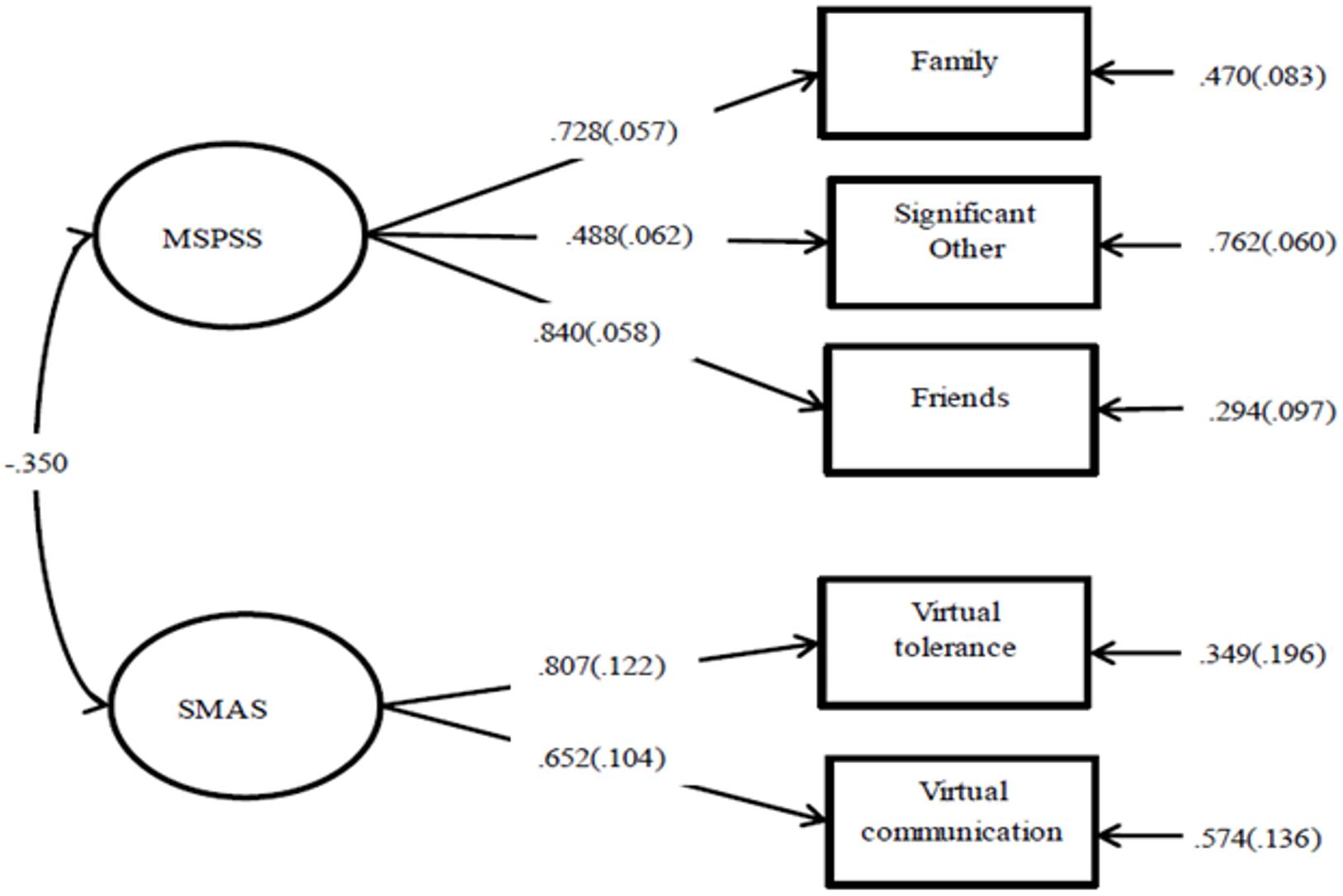
Goodness of fit values were found to be acceptable when the measurement model was tested: χ2 (4) = 5.608, p = 0.230, CFI = 0.993, TLI = 0.982, SRMR = .023 and RMSEA = 0.043 (90% CI [0.000 - 0.119]). The standardized factor loads obtained for the measurement model are shown in Figure 1.
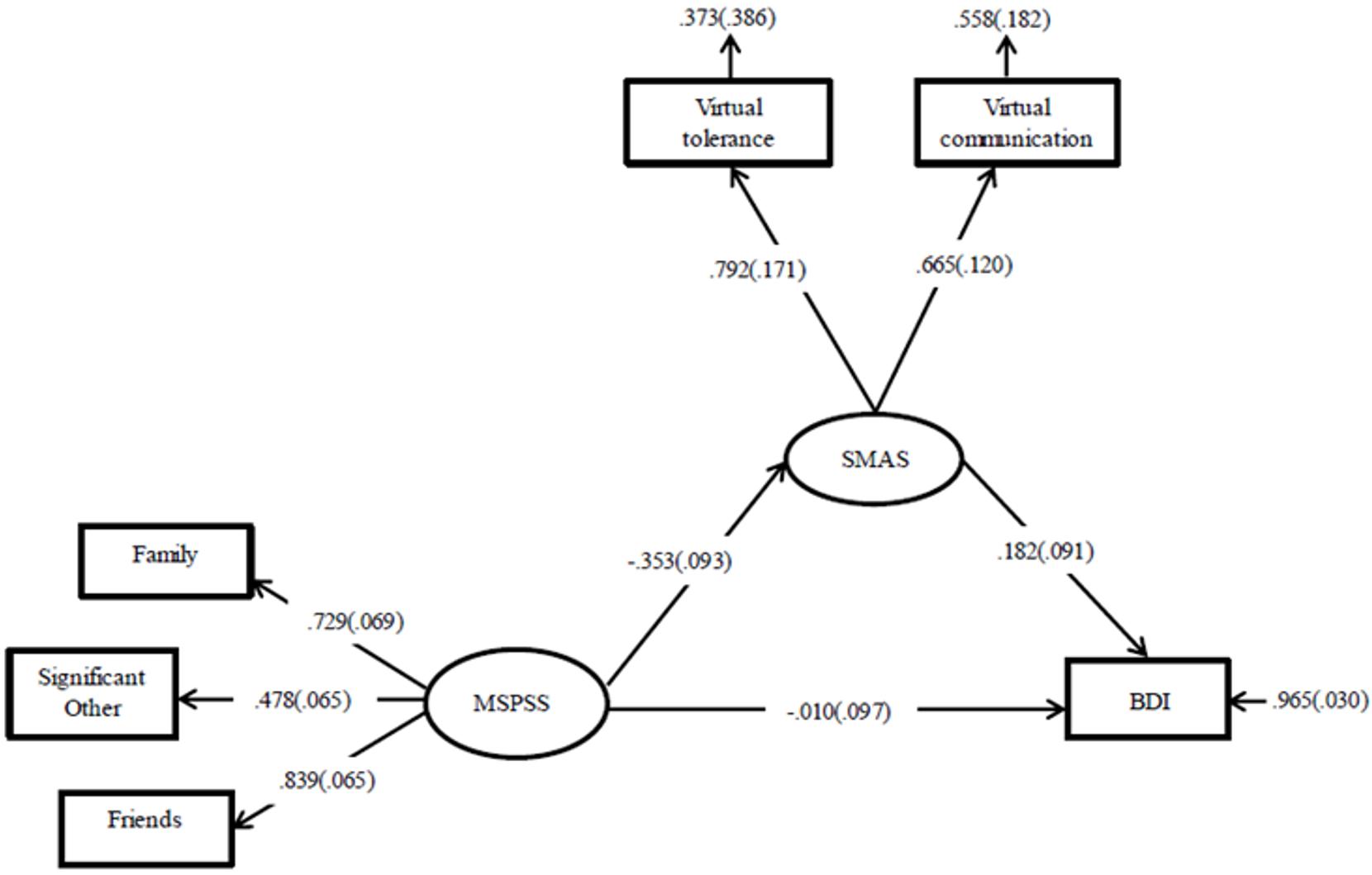
In the next step, the structural model was tested, and the goodness of fit values were found to be acceptable: χ2 (7) = 7.616, p = 0.368, CFI = 0.997, TLI = 0.994, SRMR = .024, and RMSEA = 0.020 (90% CI [0.000 - 0.088)]). As shown in Figure 2, multidimensional perceived social support significantly predicted social media addiction negatively (β = -0.35, p < .001), while social media addiction predicted depression significantly (β = 0.18, p). = 0.045). The mediating effect of social media addiction was investigated, and the direct path from multidimensional perceived social support to depression was not significant (β = -0.010, SE = 0.097, (90% CI [(-0.173) – (-0.149)]). On the other hand, when social media addiction was added to the path from multidimensional perceived social support to depression, the indirect path from multidimensional perceived social support to depression was found to be significant (β = -0.064, SE = 0.040, (90% CI [(-0.136) – (-0.007)]). In other words, social media addiction was a fully mediating variable between multidimensional perceived social support and depression.
Discussion
This study examined the mediating role of social media addiction in the relationship between perceived social support and depression. The findings revealed that social media addiction fully mediated this relationship. In other words, individuals with low levels of perceived social support tend to engage in problematic social media use, which in turn increases depressive symptoms. These results are consistent with an increasing number of studies highlighting the impact of digital behaviors on contemporary mental health (Andreassen et al., 2016; Holt-Lunstad et al., 2010; Meshi & Ellithorpe, 2021).
Previous research has demonstrated that both low perceived social support and excessive social media use are significantly associated with depression. The level of perceived social support is critically important for psychological resilience and mental health; lack of support has been linked to increased symptoms of depression and anxiety (Brailovskaia, & Margraf, 2020; Wang et al., 2019). On the other hand, intensive and problematic use of social media has been associated with adverse psychological outcomes such as depressive symptoms, social isolation, and low self-esteem (Marino et al., 2018; Meshi & Ellithorpe, 2021; Keles et al., 2020). When these two factors co-occur, especially among young adults, they may reinforce each other and significantly undermine mental well-being (Chen & Wang, 2021). However, how these variables interact and influence one another has been less frequently examined, particularly within mediation models. The results of this study support the idea that social media addiction serves as a psychological mechanism linking deficits in social support to increased depression risk. Simply put, individuals who do not receive sufficient support from family, friends, or romantic partners may turn to social media to fill this emotional void. Over time, this behavior may become addictive and exacerbate psychological distress. Recent longitudinal studies support this interpretation. For instance, Chen and Wang (2021) showed a reciprocal and reinforcing relationship between social media addiction and depressive symptoms, while Fumagalli et al. (2023) found that excessive social media use weakens the quality of face-to-face relationships, thereby reducing perceived support and increasing depressive symptoms.
These findings are also consistent with self-regulation and compensatory internet use theories. According to the compensatory internet use theory, individuals engage in excessive online activities to regulate negative emotions or fulfill unmet psychological needs (Kardefelt-Winther, 2014). Applied to our study, this theory suggests that low perceived social support may lead individuals to seek emotional closeness, approval, or attention through social media, thereby increasing their vulnerability to addiction.
It should be taken into consideration that this research was conducted during the COVID-19 pandemic, specifically between July and September 2021, a period when restrictions in Turkey had eased considerably compared to the strict lockdown of early 2021. During this time, vaccination campaigns were widespread, mobility had increased, and opportunities for face-to-face interactions had become more accessible, although some precautionary measures remained in place. This unique context may have influenced the dynamics among social support, social media use, and depressive symptoms. On one hand, relatively relaxed restrictions may have allowed participants to regain some access to in-person social networks. On the other hand, the residual effects of prolonged isolation and uncertainty might have amplified individuals’ reliance on digital platforms for emotional support. Prior evidence suggests that perceived social support played a protective role during the pandemic, buffering against mental health difficulties (Kaya et al., 2021). Other studies indicated that excessive social media use was linked to heightened depressive symptoms, particularly when offline support was limited (Çiçek et al., 2024; Güldal et al., 2022). International findings further reveal that patterns of social media consumption and depressive symptoms changed significantly between pre- and post-lockdown periods (Kim et al., 2023). Therefore, the timing of data collection constitutes a critical contextual factor when interpreting the present findings, suggesting that the interplay between social support and digital behavior may be particularly sensitive to broader social and environmental conditions.
In addition to perceived social support, personality traits, particularly neuroticism, have been shown to play a role in the development of social media addiction and depression. Highly neurotic individuals are more prone to negative social media use patterns, such as approval seeking, social comparison, and passive browsing, which have been found to increase depressive symptoms (Marino et al., 2021; Sindermann et al., 2020; Tang et al., 2016). Although such personality variables were not assessed in our study, future research should examine their mediating or moderating roles.
Sociodemographic factors may also shape these relationships. While previous studies have reported that women tend to score higher on social media addiction scales (Andreassen et al., 2016), our study did not find a significant gender difference, possibly due to the high proportion of female participants (approximately 78%) in the sample. However, educational level showed a significant difference: high school graduates scored higher on social media addiction compared to university graduates. This difference may be associated with digital literacy levels, critical thinking skills, or a greater tendency to fulfill social interaction and self-expression needs via social media among those with lower education (Aydin et al., 2021; Gökçek Özbek & Karaş, 2022). Some studies have also suggested that social media addiction may be higher among single individuals or those experiencing loneliness, as social media may serve as a means to fulfill social needs such as meeting potential partners (Andreassen et al., 2016; Gökçek Özbek & Karaş, 2022). However, our study did not find a significant relationship between marital status and social media addiction. This may be due to married individuals fulfilling their need for offline social support through their partners or preferring to spend time together rather than engaging with social media. Not only the amount, but also the source and quality of social support are important. Although social media increases the frequency of interactions, these interactions are often superficial and emotionally weak (Brailovskaia, & Margraf, 2020). Individuals may have hundreds of “friends” or “followers,” but these relationships often lack key elements of genuine social support, such as intimacy, empathy, and trust. Some studies have even suggested that seeking support online may replace face-to-face relationships, thereby reducing perceived overall support over time (Meshi & Ellithorpe, 2021; Oh & Syn, 2015).
At a neurocognitive level, social media platforms are designed to target the brain’s reward systems. Intermittent reinforcements such as likes, comments, and notifications may trigger addiction cycles similar to those seen in substance use or gambling disorders (Turel et al., 2014). For individuals with low perceived support or emotional vulnerability, such digital interactions may exacerbate addictive behaviors and emotional instability.
The findings of this study underscore the importance of incorporating strategies that enhance offline social support into interventions targeting individuals vulnerable to depression. Programs that promote face-to-face social connections, strengthen digital literacy, and offer psychoeducation to increase awareness of psychological needs underlying social media use may help reduce problematic online behaviors and prevent depressive symptoms. In this context, the development of integrative approaches that combine social support–based strategies with interventions targeting digital habits may provide an effective framework in clinical practice. Beyond its clinical relevance, the present study also makes important theoretical contributions by identifying social media addiction as a full mediator between perceived social support and depression. This advances the literature beyond simple bivariate associations and clarifies a key mechanism linking social and digital domains to mental health outcomes. These insights highlight the value of considering both social and technological contexts when explaining depressive symptomatology. Furthermore, the findings point to future directions, including longitudinal and cross-cultural studies and examinations of potential moderators, such as personality traits, loneliness, or cultural norms, that may shape these relationships. Such work may refine theoretical models and guide more targeted prevention and intervention strategies.
This study has certain limitations. Its cross-sectional design limits the ability to make causal inferences. The use of self-report scales may introduce social desirability bias and may not fully reflect actual behaviors. Although the sample size was sufficient for the analyses, the dominance of female participants may limit the generalizability of the findings. Furthermore, important variables such as the quality of online and offline support sources, loneliness, social comparison, and fear of missing out (FoMO) were not included in the study. Contextual factors such as personality traits and cultural norms were also not analyzed. Another limitation of this study is that the participants comprised a wide age range (19–54 years), covering early and middle adulthood. Although this age range was selected to achieve broader generalizability, the inability to control for age-related differences may hinder the interpretation of the findings. Therefore, future studies may benefit from examining a more homogeneous age group (e.g., only university students), which would contribute to more consistent and meaningful interpretations of the results.
In conclusion, the present study identifies social media addiction as a mediating pathway between low perceived social support and depressive symptoms, and this finding may open several avenues for future research. Subsequent studies may move beyond cross-sectional designs and employ longitudinal or experimental approaches to clarify the causal direction of these relationships. It might also be valuable to examine potential moderating variables such as personality traits, loneliness, fear of missing out, or social comparison orientation, as well as sociodemographic factors like age, gender, and educational background. Future research may additionally benefit from incorporating objective measures of digital behavior (e.g., usage logs, screen time data) alongside self-reports to capture a more accurate picture of online engagement. Furthermore, cross-cultural and cross-contextual replications may be needed to test the universality of the mediation model and to identify how cultural norms and social structures shape the interplay between support, digital use, and mental health. Taken together, these directions may refine theoretical models and generate more targeted strategies for prevention and intervention.
Acknowledgements
The authors would like to thank all the participants for their time and contribution to this study.
Ethical approval
This study was approved by the Sosyal ve Beşeri Bilimler Bilimsel Araştırma ve Yayın Etiği Kurulu (Date: February 22.2021, Decision/Protocol No: 833). Informed consent was obtained from all participants involved in this study.
Data availability statement
The data that support the findings of this study are available from the corresponding author upon reasonable request.
Conflict of interest
The authors declare that this study was conducted in the absence of any commercial or financial relationships that could be construed as a potential conflict of interest.
Funding
The authors declare that this study received no funding.
Generative AI statement
The authors declare that no generative AI or AI-assisted technologies were used in the writing or preparation of this study.
References
- Anderson, J. C., & Gerbing, D. W. (1988). Structural equation modeling in practice: A review and recommended two-step approach. Psychological Bulletin, 103(3), 411-423. https://doi.org/10.1037/0033-2909.103.3.411
- Anderson, M., & Perrin, A. (2018). Nearly one-in-five teens can’t always finish their homework because of the digital divide. Pew Research Center. https://internet.psych.wisc.edu/wp-content/uploads/532-Master/532-UnitPages/Unit-11/Anderson_Pew_2018.pdf
- Andreassen, C. S., Billieux, J., Griffiths, M. D., Kuss, D. J., Demetrovics, Z., Mazzoni, E., & Pallesen, S. (2016). The relationship between addictive use of social media and video games and symptoms of psychiatric disorders: A large-scale cross-sectional study. Psychology of Addictive Behaviors, 30(2), 252-262. https://doi.org/10.1037/adb0000160
- Aydin, S., Koçak, O., Shaw, T. A., Buber, B., Akpinar, E. Z., & Younis, M. Z. (2021). Investigation of the effect of social media addiction on adults with depression. Healthcare, 9(4), 450. https://doi.org/10.3390/HEALTHCARE9040450
- Beck, A. T., Ward, C. H., Mendelson, M., Mock, J., & Erbaugh, J. (1961). An Inventory for Measuring Depression. Archives of General Psychiatry, 4(6), 561-571. https://doi.org/10.1001/archpsyc.1961.01710120031004
- Bilgin, O., & Taş, İ. (2018). Effects of perceived social support and psychological resilience on social media addiction among university students. Universal Journal of Educational Research, 6(4), 751-758. https://doi.org/10.13189/ujer.2018.060418
- Brailovskaia, J., & Margraf, J. (2020). Relationship between depression symptoms, physical activity, and addictive social media use. Cyberpsychology, Behavior, and Social Networking, 23(12), 818-822. https://doi.org/10.1089/cyber.2020.0255
- Chen, J., & Wang, Y. (2021). Social media use for health purposes: Systematic review. Journal of Medical Internet Research, 23(5), e17917. https://doi.org/10.2196/17917
- Çiçek, I., Emin, Ş. M., Arslan, G., & Yıldırım, M. (2024). Problematic social media use, satisfaction with life, and levels of depressive symptoms in university students during the COVID-19 pandemic: Mediation role of social support. Psihologija, 57(2), 177-197. https://doi.org/10.2298/PSI220613009C
- Davila, J., Hershenberg, R., Feinstein, B. A., Gorman, K., Bhatia, V., & Starr, L. R. (2012). Frequency and quality of social networking among young adults: Associations with depressive symptoms, rumination, and corumination. Psychology of Popular Media Culture, 1(2), 72-86. https://doi.org/10.1037/A0027512
- Eker, D., Arkar, H., & Yaldız, H. (2001). Çok Boyutlu Algılanan Sosyal Destek Ölçeği’nin gözden geçirilmiş formunun faktör yapısı, geçerlik ve güvenirliği. Türk Psikiyatri Dergisi, 12(1), 17-25. https://www.turkpsikiyatri.com/PDF/C12S1/cokBoyutluAlgilanan.pdf
- Fumagalli, F., Muschalik, M., Kolpaczki, P., Hüllermeier, E., & Hammer, B. (2023). SHAP-IQ: Unified approximation of any-order shapley interactions. Advances in Neural Information Processing Systems, 36, 11515-11551. https://doi.org/10.48550/arXiv.2303.01179
- Gökçek Özbek, M., & Karaş, H. (2022). Associations of depressive symptoms and perceived social support with addictive use of social media among elderly people in Turkey. Psychogeriatrics, 22(1), 29-37. https://doi.org/10.1111/PSYG.12770
- Güldal, Ş., Kılıçoğlu, N. A., & Kasapoğlu, F. (2022). Psychological flexibility, coronavirus anxiety, humor and social media addiction during COVID-19 pandemic in Turkey. International Journal for the Advancement of Counselling, 44(2), 220-242. https://doi.org/10.1007/s10447-021-09461-x
- Hankin, B. L., Abramson, L. Y., Moffitt, T. E., Silva, P. A., McGee, R., & Angell, K. E. (1998). Development of depression from preadolescence to young adulthood: Emerging gender differences in a 10-year longitudinal study. Journal of Abnormal Psychology, 107(1), 128-140. https://doi.org/10.1037/0021-843X.107.1.128
- Hassan, T., Alam, M. M., Wahab, A., & Hawlader, M. D. (2020). Prevalence and associated factors of internet addiction among young adults in Bangladesh. Journal of the Egyptian Public Health Association, 95(3), 1-8. https://doi.org/10.1186/s42506-019-0032-7
- Hisli, N. (1989). Beck Depresyon Envanterinin üniversite ögrencileri için geçerliliği. Psikoloji Dergisi, 7(23), 3-13. https://psikolog.org.tr/tr/yayinlar/dergiler/1031828/tpd1300443319890000m000366.pdf?v=1703753150
- Holt-Lunstad, J., Smith, T. B., & Layton, J. B. (2010). Social relationships and mortality risk: A meta-analytic review. PLoS Medicine, 7(7), e1000316. https://doi.org/10.1371/journal.pmed.1000316
- Ioannou, M., Kassianos, A. P., & Symeou, M. (2019). Coping with depressive symptoms in young adults: Perceived social support protects against depressive symptoms only under moderate levels of stress. Frontiers in Psychology, 19, 2780. https://doi.org/10.3389/fpsyg.2018.02780
- Kardefelt-Winther, D. (2014). A conceptual and methodological critique of internet addiction research: Towards a model of compensatory internet use. Computers in Human Behavior, 31, 351-354. https://doi.org/10.1016/j.chb.2013.10.059
- Kaya, H., Ayık, B., Tasdelen, R., Ercis, M., & Ertekin, E. (2021). Social support promotes mental health during the COVID-19 outbreak: A cross-sectional study from Turkey. Psychiatria Danubina, 33(2), 217-224. https://doi.org/10.24869/psyd.2021.217
- Keles, B., McCrae, N., & Grealish, A. (2020). A systematic review: The influence of social media on depression, anxiety and psychological distress in adolescents. International Journal of Adolescence and Youth, 25(1), 79-93. https://doi.org/10.1080/02673843.2019.1590851
- Kim, A. C. H., Du, J., & Andrew, D. P. (2023). Social media consumption and depressive symptoms during the COVID-19 lockdown: The mediating effect of physical activity. Frontiers in Psychiatry, 14, 1120230. https://doi.org/10.3389/fpsyt.2023.1120230
- Kircaburun, K. (2016). Self-esteem, daily internet use and social media addiction as predictors of depression among Turkish adolescents. Journal of Education and Practice, 7(24), 64-72.
- Kline, R. B. (2015). Principles and practice of structural equation modeling. Guilford publications.
- Kross, E., Verduyn, P., Demiralp, E., Park, J., & Lee, D. S. (2013). Facebook use predicts declines in subjective well-being in young adults. PLoS ONE, 8(8), e69841. https://doi.org/10.1371/journal.pone.0069841
- Leung, H., Pakpour, A. H., Strong, C., Lin, Y. C., Tsai, M. C., Griffiths, M. D., Lin, C. Y., & Chen, I. H. (2020). Measurement invariance across young adults from Hong Kong and Taiwan among three internet-related addiction scales: Bergen Social Media Addiction Scale (BSMAS), Smartphone Application-Based Addiction Scale (SABAS), and Internet Gaming Disorder Scale-Short Form (IGDS-SF9) (Study Part A). Addictive Behaviors, 101, 105969. https://doi.org/10.1016/J.ADDBEH.2019.04.027
- Lin, Y. L., Sidani, J. E., Shensa, A., Radovic, A., Miller, E., Colditz, J. B., Hoffman, B. L., Giles, L. M., & Primack, B. A. (2016). Association between social media use and depression among US young adults. Wiley Online Library, 33(4), 323-331. https://doi.org/10.1002/da.22466
- Marengo, D., Poletti, I., & Settanni, M. (2020). The interplay between neuroticism, extraversion, and social media addiction in young adult Facebook users: Testing the mediating role of online activity using objective data. Addictive Behaviors, 102, 106150. https://doi.org/10.1016/j.addbeh.2019.106150
- Marino, C., Canale, N., Melodia, F., Spada, M. M., & Vieno, A. (2021). The overlap between problematic smartphone use and problematic social media use: A systematic review. Current Addiction Reports, 8, 469-480. https://doi.org/10.1007/s40429-021-00398-0
- Marino, C., Gini, G., Vieno, A., & Spada, M. M. (2018). A comprehensive meta-analysis on Problematic Facebook Use. Computers in Human Behavior, 83, 262-277. https://doi.org/10.1016/J.CHB.2018.02.009
- Meshi, D., & Ellithorpe, M. E. (2021). Problematic social media use and social support received in real-life versus on social media: Associations with depression, anxiety and social isolation. Addictive Behaviors, 119, 106949. https://doi.org/10.1016/j.addbeh.2021.106949
- Montag, C., Markowetz, A., Blaszkiewicz, K., Andone, I., Lachmann, B., Sariyska, R., Trendafilov, B., Eibes, M., Kolb, J., Reuter, M., Weber, B., & Markett, S. (2017). Facebook usage on smartphones and gray matter volume of the nucleus accumbens. Behavioural Brain Research, 329, 221-228. https://doi.org/10.1016/j.bbr.2017.04.035
- Myrick, J. G., Holton, A. E., Himelboim, I., & Love, B. (2016). Stupidcancer: Exploring a typology of social support and the role of emotional expression in a social media community. Health Communication, 31(5), 596-605. https://doi.org/10.1080/10410236.2014.981664
- Oh, S., & Syn, S. Y. (2015). Motivations for sharing information and social support in social media: A comparative analysis of Facebook, Twitter, Delicious, YouTube, and Flickr. Journal of the Association for Information Science and Technology, 66(10), 2045-2060. https://doi.org/10.1002/asi.23320
- Samra, A., Warburton, W. A., & Collins, A. M. (2022). Social comparisons: A potential mechanism linking problematic social media use with depression. Journal of Behavioral Addictions, 11(2), 607-614. https://doi.org/10.1556/2006.2022.00023
- Siedlecki, K. L., Salthouse, T. A., Oishi, S., & Jeswani, S. (2014). The relationship between social support and subjective well-being across age. Social Indicators Research, 117(2), 561-576. https://doi.org/10.1007/S11205-013-0361-4
- Sindermann, C., Elhai, J. D., & Montag, C. (2020). Predicting tendencies towards the disordered use of Facebook’s social media platforms: On the role of personality, impulsivity, and social anxiety. Psychiatry Research, 285, 112793. https://doi.org/10.1016/j.psychres.2020.112793
- Şahin, C., & Yağci, M. (2017). Sosyal Medya Bağımlılığı Ölçeği-yetişkin formu: Geçerlilik ve güvenirlik çalışması. Ahi Evran Üniversitesi Kırşehir Eğitim Fakültesi Dergisi, 18(1), 523-538. https://izlik.org/JA87TW45UC
- Tabachnick, B. G. (2014). Using multivariate statistics. Pearson New International Edition.
- Tang, J. H., Chen, M. C., Yang, C. Y., Chung, T. Y., & Lee, Y. A. (2016). Personality traits, interpersonal relationships, online social support, and Facebook addiction. Telematics and Informatics, 33(1), 102-108. https://doi.org/10.1016/J.TELE.2015.06.003
- Tariq, A., Beihai, T., Abbas, N., Ali, S., Yao, W., & Imran, M. (2020). Role of perceived social support on the association between physical disability and symptoms of depression in senior citizens of Pakistan. International Journal of Environmental Research and Public Health, 17(5), 1485. https://doi.org/10.3390/ijerph17051485
- Treem, J. W., Dailey, S. L., Pierce, C. S., & Biffl, D. (2016). What we are talking about when we talk about social media: A framework for study. Sociology Compass, 10(9), 768-784. https://doi.org/10.1111/soc4.12404
- Turel, O., He, Q., Xue, G., Xiao, L., & Bechara, A. (2014). Examination of neural systems sub-serving Facebook “addiction”. Psychological Reports, 115(3), 675-695. https://doi.org/10.2466/18.PR0.115c31z8
- Verduyn, P., Gugushvili, N., & Kross, E. (2021). The impact of social network sites on mental health: Distinguishing active from passive use. World Psychiatry, 20(1), 133-134. https://doi.org/10.1002/wps.20820
- Wang, P., Wang, X., Zhao, M., Wu, Y., Wang, Y., & Lei, L. (2019). Can social networking sites alleviate depression? The Relation between authentic online self-presentation and adolescent depression: A mediation model of perceived social support and rumination. Current Psychology, 38, 1512-1521. https://doi.org/10.1007/S12144-017-9711-8
- Zimet, G. D., Dahlem, N. W., Zimet, S. G., & Farley, G. K. (1988). The multidimensional scale of perceived social support. Journal of Personality Assessment, 52(1), 30-41. https://doi.org/10.1207/s15327752jpa5201_2
License
Copyright (c) 2026 The Author(s). This is an open access article distributed under the Creative Commons Attribution License (CC BY), which permits unrestricted use, distribution, and reproduction in any medium or format, provided the original work is properly cited.