


Abstract
This study aims to determine the COVID-19 infection and vaccination statuses of individuals with substance use disorders. In this cross-sectional study, the population consisted of individuals with substance use disorders who were interviewed in Sultanbeyli district. Data were collected through a structured interview form, which included demographic information about the individual and their family, medical history, and addiction history. The COVID-19 infection and vaccination statuses of the individuals were verified using the system records. Nearly all of the individuals were male (n=264, 96.7%). Among the participants, 24.7% (n=38) reported a history of COVID-19 infection. Regarding the uptake of the COVID-19 vaccine, 57.8% (n=115) had received at least one dose of the vaccine. The proportion of fully vaccinated participants was 42.2% (n=84). Educational status, marital status, employment status, substance use status in the family, treatment attempts for substance use, age, age of substance initiation, and number of used substances were not found to be significantly associated with either having a COVID-19 infection or being fully vaccinated (p>0.05) The low rate of vaccine uptake highlights the need for targeted interventions, as well as further studies to increase understanding of factors that may affect vaccine uptake.
Keywords: substance use disorders, COVID-19, vaccination, pandemics
Main Points
- The most common factors for substance use initiation included peer influence, family issues, social and work-related difficulties, and curiosity.
- The participants had low vaccination rates, with only 57.8% receiving at least one dose and 42.2% being fully vaccinated.
- Of the participants, 24.7% had a history of COVID-19 infection, and the proportion of fully vaccinated participants was 42.2%.
Introduction
Substance use disorder is defined according to the Diagnostic and Statistical Manual of Mental Disorders, Fifth Edition (DSM-5), which emphasizes the recurrent use of substances leading to clinically significant impairment or distress (American Psychiatric Association [APA], 2013). Substance use disorders are leading causes of mortality and morbidity (World Health Organization [WHO], 2024). According to the Centers for Disease Control and Prevention (CDC), 17.1% of individuals aged 12 and older in the United States were reported to have a substance use disorder (Centers for Disease Control and Prevention [CDC], 2025). For these reasons, substance use disorder is a significant public health concern.
COVID-19, which emerged in China in late 2019, evolved into a global pandemic, impacting the entire world by 2020 (Nandy et al., 2020). The COVID-19 pandemic has negatively affected many areas of life, such as health, the economy, and social life, by causing high mortality and morbidity (Chang et al., 2022; WHO, 2020). The first COVID-19 case in Türkiye was reported on March 11, 2020 (T.C. Ministry of Health, General Directorate of Public Health, 2020). Various measures have been implemented to contain the spread of COVID-19. These measures include closing schools, remote education, changing work conditions, and reducing face-to-face interactions through social distancing rules (Ayouni et al., 2021; Diab-Bahman & Al-Enzi, 2020). People are naturally accustomed to living together, but during the pandemic, social isolation measures led to psychosocial problems (Pietrabissa & Simpson, 2020). For these reasons, the negative effects of the COVID-19 pandemic could be observed more clearly in vulnerable groups. One of these vulnerable groups includes individuals with substance use disorders (Lauvrak & Juvet, 2020). Such individuals may face a higher risk of COVID-19 infection due to their socioeconomic and behavioral characteristics, as well as certain health comorbidities (Wei & Shah, 2020). In addition, those with substance use disorders may encounter difficulties accessing many basic health services, including vaccination services (Livingston, 2020; Price et al., 2024).
Vaccination plays a crucial role in disease prevention, benefiting both individual health and the establishment of herd immunity (Ndwandwe & Wiysonge, 2021). COVID-19 vaccination efforts began progressively in Türkiye, similar to other countries worldwide. Initially, healthcare workers, the elderly, and individuals with chronic illnesses were prioritized for vaccination. Subsequently, the program expanded to cover all age groups. By the end of June 2021, the Ministry of Health had made free vaccination accessible to all adults (Sezerol & Altaş, 2023).
COVID-19 vaccines have been one of the most critical tools for suppressing the adverse effects of the pandemic. However, achieving equitable access to healthcare and vaccination remains a challenge, particularly among disadvantaged groups. One such vulnerable population is individuals with substance use disorders. This study aims to assess the COVID-19 vaccination rates and SARS-CoV-2 infection statuses among individuals with substance use disorders attending the addiction counseling center in Sultanbeyli, Istanbul, and to identify associated factors.
Methods
Study Design, Type, Population
In addiction counseling units operating within District Health Directorates, individuals with substance use disorders or their relatives apply for counseling services. The addiction counseling unit aims to provide counseling services to individuals with substance use disorders and their families, guide them to appropriate treatment centers, and ensure follow-up of treatment processes. Expert psychologists offer guidance on addiction, treatment methods, and social support. Motivational interviews, information sharing, and support are provided to individuals with substance use disorders and their families before, during, and after treatment. Additionally, supporting social adaptation processes and collaborating with other institutions when necessary are among the primary objectives. A “substance user interview form” is completed for each new application. The study population consists of individuals with substance use disorders who were interviewed in the Sultanbeyli district from the beginning of 2018 to May 2022. Sultanbeyli is a district located on the Anatolian side of Istanbul, Türkiye, and has 360,702 residents (Türkiye İstatistik Kurumu, 2023). Sultanbeyli has the lowest socio-economic development index compared to other districts of Istanbul (Altaş & Sezerol, 2024).
In this cross-sectional study, no sampling method was employed; instead, the file records of all individuals who applied to the institution and had the interview form completed were included in the study. No direct contact was made with the individuals, and only their file records were utilized for the research.
Evaluation
The substance user interview form, from which the data were collected, includes information such as gender, age, marital status, educational background, application date, details about the parents, family history of substance use, substances used by the individual, reasons for starting substance use, name of the substance used, method of use, quantity and duration of use, age of initiation, whether the individual received treatment, and whether they were referred for treatment. Additionally, for individuals whose information was available in the system, the number of COVID-19 tests, the number of positive and negative results, and vaccination status were also examined. In the study, full vaccination status for COVID-19 was defined as a minimum of two doses of vaccination regardless of the type of vaccine (CDC, 2022).
Statistical Analysis
The statistical analysis of the study data was performed using the SPSS 24.0 software package. Descriptive data were presented as numbers and percentages for categorical variables, and as minimum value, maximum value, and median for continuous variables. Categorical variables were analyzed using Pearson’s chi square test and Fisher’s exact chi-square test. The normality of continuous variables was evaluated through histograms, probability plots, and analytical methods, including the Kolmogorov-Smirnov and Shapiro-Wilk tests. Continuous variables were evaluated with the Mann-Whitney U test for two independent groups if they did not meet the normal distribution criteria. Statistical significance was set at p<0.05.
Ethics
Ethics committee approval for the study was obtained from the Istanbul Medipol University Non-Interventional Clinical Research Ethics Committee under decision number 747 on 25/08/2022.
Results
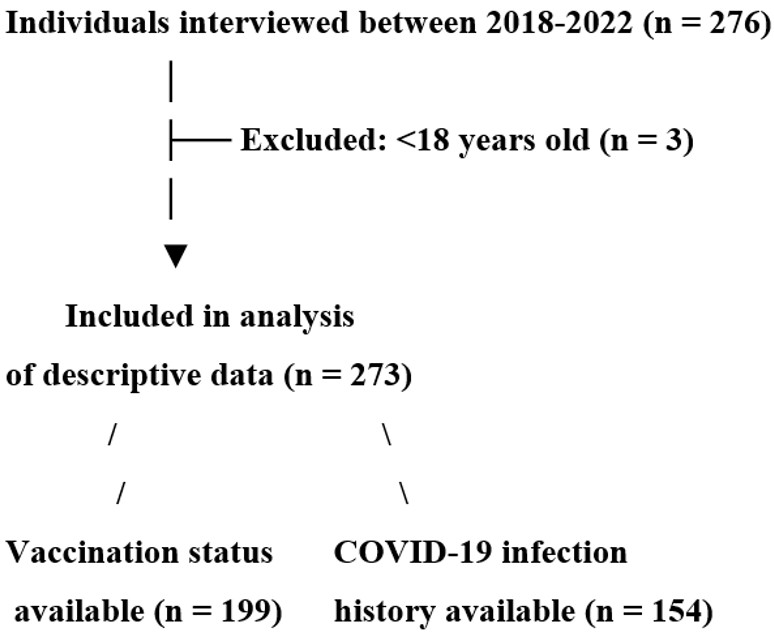
Over a five-year period, a total of 276 dependent individuals were interviewed. Three participants under the age of 18 were excluded from the analysis. Of the remaining 273, vaccination status was available for 199 and COVID-19 infection history was available for 154 (Figure 1). The substance use-related variables and sociodemographic characteristics were presented based on data from the 273 individuals included in the analysis.
The median age was 29, with a minimum age of 18 and a maximum age of 53. Nearly all individuals were male (n=264, 96.7%). The majority of participants were unemployed (n=191, 71.3%) and unmarried (n=175, 64.8%). Nearly half of the participants were middle school graduates (n=130, 49.1%). The percentages of participants whose mothers and fathers had passed away were 3.1% (n=6) and 11.0% (n=21), respectively (Table 1).
| Table 1. Sociodemographic features of the participants | ||
|
|
||
| Gender | Male |
|
| Female |
|
|
| Marital status | Married |
|
| Unmarried |
|
|
| Divorced |
|
|
| Educational status | Illiterate |
|
| Literate |
|
|
| Primary school |
|
|
| Secondary school |
|
|
| Highschool |
|
|
| University |
|
|
| Employment status | Not working |
|
| Working |
|
|
| Mother alive | No |
|
| Yes |
|
|
| Father alive | No |
|
| Yes |
|
|
The reason for substance use initiation was known for 72 participants. Advice from friends and the surrounding environment was the most common reason. Family issues, social life difficulties, work-related problems, and curiosity were the other reasons. The median age of initiation of substance use was 17.0 years (8.0–43.0). The median number of used substances was 2.0 (1.0-6.0). Of the participants, 77.5% (n=172) had attempted treatment for substance use. Among the participants, 16.5% (n=45) had a history of substance use in their family. Among these, the most common history was substance use by a sibling, while no participants reported substance use by their mother (Table 2).
| Table 2. Reasons for substance use initiation and history of use in close environment | ||
|
|
||
| Age of initiation of substance use |
|
|
| Number used substance |
|
|
|
|
||
| Reason for substance use initiation | Friends' advice / Environmental factors |
|
| Family issues |
|
|
| Social life difficulties, work-related problems |
|
|
| Curiosity |
|
|
| Treatment attempt | No |
|
| Yes |
|
|
| Substance use in family |
|
|
| Substance use of father |
|
|
| Substance use of sibling |
|
|
| Substance use of other relatives and close circle |
|
|
| Substance use of mother |
|
|
Among the participants, 24.7% (n=38) reported a history of COVID-19 infection. Regarding uptake of the COVID-19 vaccine, 57.8% (n=115) had received at least one dose of the vaccine. The proportion of fully vaccinated participants was 42.2% (n=84) (Table 3).
| Table 3. Information about COVID-19 vaccines and history of COVID-19 infection | ||
|
|
||
| History of COVID-19 infection | No |
|
| Yes |
|
|
| Uptake of COVID-19 vaccine | Unvaccinated |
|
| Vaccinated |
|
|
| COVID-19 vaccine doses | One dose |
|
| Two doses |
|
|
| Three doses |
|
|
| Four doses |
|
|
| Full vaccination | No |
|
| Yes |
|
|
Factors associated with participants’ COVID-19 infection status were evaluated. Educational status, marital status, employment status, family history of substance use, full vaccination status, treatment attempt, age, age of substance initiation, and number of used substances were not found to be significantly associated with having a COVID-19 infection (Table 4).
| Table 4. Factors associated with COVID-19 infection | ||||
|
|
|
|||
|
|
|
|||
|
|
|
|||
| Marital status | Married |
|
|
|
| Unmarried/Divorced |
|
|
||
| Educational status | Below high school |
|
|
|
| High school and above |
|
|
||
| Employment status | No |
|
|
|
| Yes |
|
|
||
| Family substance use | No |
|
|
|
| Yes |
|
|
||
| Treatment attempt | No |
|
|
|
| Yes |
|
|
||
| Full vaccination against COVID-19 | No |
|
|
|
| Yes |
|
|
||
| Age, median (min-max) |
|
|
|
|
| Age of initiation of substance use, median (min-max) |
|
|
|
|
| Number used substance, median (min-max) |
|
|
|
|
Factors associated with participants’ full vaccination status against COVID-19 were evaluated. Among those who had attempted substance use treatment, 45.8 % (n=60) were fully vaccinated against COVID-19, compared to 28.6 % (n=10) of those who had not attempted treatment (p=0.067). Educational status, marital status, employment status, family substance use, treatment attempt, age, age of initiation, and number of used substances showed no significant association with full vaccination (Table 5).
| Table 5. Factors associated with full vaccination against COVID-19 | ||||
|
|
|
|||
|
|
|
|||
|
|
|
|||
| Marital status | Married |
|
|
|
| Unmarried/Divorced |
|
|
||
| Educational status | Below high school |
|
|
|
| High school and above |
|
|
||
| Employment status | No |
|
|
|
| Yes |
|
|
||
| Family substance use | No |
|
|
|
| Yes |
|
|
||
| Treatment attempt | No |
|
|
|
| Yes |
|
|
||
| Age, median (min-max) |
|
|
|
|
| Age of initiation of substance use, median (min-max) |
|
|
|
|
| Number used substance, median (min-max) |
|
|
|
|
Discussion
Vaccine uptake is critically important for the control of infectious diseases (Excler et al., 2021). It is well-known that substance use disorders create significant barriers to accessing healthcare services (Motavalli et al., 2020; Ross et al., 2015). In this context, the study evaluated COVID-19 infection status, vaccination rates, and associated factors among individuals with substance use disorders.
In the study, nearly all the individuals were male (96.7%). Some studies in the literature have reported that hazardous alcohol consumption or heavy cannabis use is more prevalent in men than in women (Bosque-Prous et al., 2015; Colell et al., 2015; Mischley, 2016). Gender differences observed in substance use may stem from sociocultural structures, gender norms, and the varying societal roles and responsibilities attributed to women and men. In this study, the majority of participants were unemployed (71.3%). Nearly half of the participants were middle school graduates (49.1%). A population-based study reported that individuals with substance use disorders have lower levels of education compared to the general population (Amundsen et al., 2022). A study found that unemployment was associated with increased heavy cannabis use and hypnosedative use (Teixidó-Compañó et al., 2018). Unemployment can lead to financial hardship, challenges in maintaining daily life, and difficulties in living standards and social interactions. Individuals facing such challenges may experience increased stress, which can contribute to the adoption of unhealthy behaviors such as substance use.
In this study, friends’ advice and the surrounding environment were the most common reasons for the initiation of substance use. Family issues, social life difficulties, work-related problems, and curiosity were the other reasons. Similarly, the literature has reported that reasons for initiating substance use are associated with factors such as curiosity, peer influence, academic problems, economic difficulties, and easy access to addictive substances (Al‐Kandari et al., 2001; Wani & Ahmed, 2024). There is a need for multidisciplinary public health interventions to address the factors driving individuals toward substance use. Given that the median age of initiation was 17.0 years in this study, it is crucial to implement preventive interventions that support the development of young individuals, such as psychosocial support programs and structured educational initiatives.
Among the participants, 24.7% (n=38) reported a history of COVID-19 infection. The literature reports that individuals with substance use disorders are at an increased risk of COVID-19 infection (Wang et al., 2021). Moreover, it has been reported that COVID-19 patients with substance use disorders are at an increased risk for hospitalization and adverse outcomes (Baillargeon et al., 2021). This may be caused by the use of substances that negatively affect the cardiovascular and respiratory systems, as the users could be more vulnerable to respiratory complications of COVID-19 disease (Baillargeon et al., 2021). The increased vulnerability of individuals with substance use disorders to COVID-19 infection may also be attributed to the presence of comorbid conditions such as hepatitis C and HIV, as well as socioeconomic problems (Wei & Shah, 2020). In this study, educational status, marital status, employment status, family history of substance use, treatment attempts for substance use, age, age of substance initiation, and number of used substances were not found to be significantly associated with having a COVID-19 infection. The literature indicates that no significant age, gender, or ethnic disparities in breakthrough COVID-19 infections were observed among patients with substance use disorders after adjusting for other demographics, adverse socioeconomic determinants of health, comorbid medical conditions, and vaccine types, except in patients with cannabis use disorder (Wang et al., 2022).
In this study, the proportion of fully vaccinated participants (at least two doses) was 42.2%. In a study conducted in Türkiye, the rate of receiving two vaccine doses among individuals with substance use disorders was reported as 49.5% (Torun et al., 2025). According to data from the Turkish Ministry of Health, 85.7% of individuals aged 18 years and older received at least two doses of a COVID-19 vaccine ((T.C. Ministry of Health, n.d.). The COVID-19 vaccination rate among individuals with substance use disorders in the current study is significantly lower compared to the general population in Türkiye. Educational status, marital status, employment status, Family history of substance use, treatment attempts for substance use, age, age of substance initiation, and number of used substances were not found to be significantly associated with vaccine uptake. However, the proportion of fully vaccinated individuals was higher among those who had attempted treatment. Although this difference did not show statistical significance, the p value was close to the threshold, suggesting a potential relationship. This finding may indicate that individuals who have attempted treatment are also more likely to adhere to preventive measures such as vaccination. Further studies are needed in this regard. In Spain, 71% of individuals with opioid use disorder were vaccinated against COVID-19 (Vallecillo et al., 2022). In the same study, older age and the presence of comorbidities were found to be associated with vaccination. In another study, 20% of individuals with substance use disorders reported that they had not received the COVID-19 vaccine. The most common reasons cited were lack of trust in the vaccine and fear of side effects (Mondera et al., 2022). Another study conducted among youth aged 14–29 years reported that perceptions regarding vaccine safety and efficacy were the primary determinants influencing hesitant, uncertain, and acceptant vaccine attitudes (Everest et al., 2025). Thus, vaccine hesitancy and distrust, particularly prevalent in disadvantaged populations (Masson et al., 2021), may also have influenced uptake patterns observed in our study. In a review on COVID-19 vaccine hesitancy and under-vaccination among marginalized populations, some structural factors such as stigma, institutional mistrust, limited vaccine supply and availability, transportation barriers, and the absence of culturally and linguistically appropriate information were found to predominate (Newman et al., 2023). These findings underline the crucial role of structural barriers affecting vaccine uptake, particularly among disadvantaged populations. Qualitative studies could be conducted to explore the individual and environmental factors that facilitate vaccination or act as barriers to vaccine uptake. Larger and multicenter studies may also help to understand the underlying barriers to vaccine uptake among individuals with substance use disorders.
Limitations and Directions/Suggestions for Future Research
The study examined SARS-CoV-2 infection, vaccination status, and associated factors among individuals with substance use disorders during the pandemic. A limited number of studies have simultaneously evaluated SARS-CoV-2 infection, vaccination status, and substance use. This highlights the originality of our research. Furthermore, the study provides valuable insights to the literature, contributing to the improvement of health policies and interventions targeting this group.
However, reliance on self-reported data from participants poses a limitation, as social desirability bias may have influenced the responses. Additionally, since the data were collected from a single center, the generalizability of the findings is limited. Another limitation of this study is the lack of complete records regarding COVID-19 vaccination and infection history for the 273 individuals who applied to the counseling unit. Those with missing data may have differed from those with complete information, and the frequency estimates might therefore be subject to under- or overestimation. The proportion of men in our study was substantially higher. This may limit the generalizability of the findings to women. The underrepresentation of women may be related to barriers to accessing healthcare, cultural or social constraints, or differences in health-seeking behaviors. This imbalance should be considered when interpreting the results, as women’s perspectives and health needs may not have been adequately reflected. Another limitation is that the study did not fully address the environmental and socioeconomic factors affecting healthcare access for individuals with substance use disorders during the pandemic. Furthermore, as the vaccination dates of the participants were unknown, it remains unclear whether they were vaccinated before or after their COVID-19 infection. Consequently, the study does not provide data on vaccine efficacy within this population.
Future research should examine the underlying reasons for low vaccine uptake rates among people with substance use disorders, including psychosocial and cultural barriers. Moreover, interventional studies are needed to design and evaluate targeted programs, such as motivational interviewing or educational initiatives, to increase vaccine uptake in this population.
Conclusion
The study provides a unique contribution to the literature by examining SARS-CoV-2 infection, vaccination status, and associated factors among individuals with substance use disorders. Only 42.2% of participants were fully vaccinated against COVID-19, which is a relatively low rate. The findings highlight the challenges faced by this vulnerable group in accessing healthcare services and the disparities in vaccination rates. This information is crucial for improving health policies and developing interventions targeting individuals with substance use disorders. Targeted strategies, such as offering vaccination at substance use treatment centers, strengthening outreach programs for women who may face access barriers, and ensuring continuity of care, could be beneficial. In addition, mobile vaccination teams and telehealth-based vaccine reminders could further reduce barriers during public health crises. Broader and multicenter studies would be beneficial to better understand the socioeconomic and environmental factors associated with vaccine uptake, provide more data on vaccine efficacy, and enhance the generalizability of the findings.
Ethical approval
This study was approved by the Istanbul Medipol University Interventional Clinical Research Ethics Committee (Date: August 25, 2022, Decision/Protocol No: 747). Informed consent was obtained from all participants involved in this study.
Data availability statement
The data that support the findings of this study are available from the corresponding author upon reasonable request.
Conflict of interest
The authors declare that this study was conducted in the absence of any commercial or financial relationships that could be construed as a potential conflict of interest.
Funding
The authors declare that this study received no funding.
Generative AI statement
The authors declare that during the preparation of this study, the following AI-assisted technology was used: ChatGPT (OpenAI, version GPT-5.1) on December, 2025. Extent of Use: This study used the generative AI tool ChatGPT (OpenAI, version GPT-5.1) solely for language editing and improving the clarity of the manuscript. No content, interpretation, analysis, or scientific conclusions were generated by the AI. The authors confirm that they have critically reviewed and edited any AI-generated content and take full responsibility for the integrity, accuracy, and originality of the publication. The authors certify that the original human contribution is maintained and that AI-assisted tools are not listed or cited as authors.
References
- Al‐Kandari, F. H., Yacoub, K., & Omu, F. (2001). Initiation factors for substance abuse. Journal of Advanced Nursing, 34(1), 78-85. https://doi.org/10.1046/j.1365-2648.2001.3411731.x
- Altaş, Z. M., & Sezerol, M. A. (2024). Frequency of SARS-COV-2 infection and COVID-19 vaccine uptake and protection among Syrian refugees: COVID-19 vaccine among Syrian refugees. BMC Infectious Diseases, 24(1), 570. https://doi.org/10.1186/s12879-024-09460-4
- American Psychiatric Association. (2013). Diagnostic and statistical manual of mental disorders (5th ed.). American Psychiatric Publishing. https://doi.org/10.1176/appi.books.9780890425596
- Amundsen, E. J., Bretteville-Jensen, A. L., & Rossow, I. (2022). Patients admitted to treatment for substance use disorder in Norway: A population-based case-control study of socio-demographic correlates and comparative analyses across substance use disorders. BMC Public Health, 22(1), 792. https://doi.org/10.1186/s12889-022-13199-5
- Ayouni, I., Maatoug, J., Dhouib, W., Zammit, N., Fredj, S. B., Ghammam, R., & Ghannem, H. (2021). Effective public health measures to mitigate the spread of COVID-19: A systematic review. BMC Public Health, 21(1), 1015. https://doi.org/10.1186/s12889-021-11111-1
- Baillargeon, J., Polychronopoulou, E., Kuo, Y.-F., & Raji, M. A. (2021). The impact of substance use disorder on COVID-19 outcomes. Psychiatric Services, 72(5), 578-581. https://doi.org/10.1176/appi.ps.202000534
- Bosque-Prous, M., Espelt, A., Borrell, C., Bartroli, M., Guitart, A. M., Villalbí, J. R., & Brugal, M. T. (2015). Gender differences in hazardous drinking among middle-aged in Europe: The role of social context and women’s empowerment. European Journal of Public Health, 25(4), 698-705. https://doi.org/10.1093/eurpub/cku234
- Centers for Disease Control and Prevention. (2022). Requirement for proof of COVID-19 vaccination for air passengers. https://stacks.cdc.gov/view/cdc/116833
- Centers for Disease Control and Prevention. (2025). Substance use and substance use disorders in travelers. In CDC yellow book: Health information for international travel. https://www.cdc.gov/yellow-book/hcp/travelers-with-additional-considerations/substance-use.htm
- Chang, D., Chang, X., He, Y., & Tan, K. J. (2022). The determinants of COVID-19 morbidity and mortality across countries. Scientific Reports, 12(1), 5888. https://doi.org/10.1038/s41598-022-09783-9
- Colell, E., Sánchez‐Niubò, A., Delclos, G. L., Benavides, F. G., & Domingo‐Salvany, A. (2015). Economic crisis and changes in drug use in the Spanish economically-active population. Addiction, 110, 1129-1137. https://doi.org/10.1111/add.12923
- Diab-Bahman, R., & Al-Enzi, A. (2020). The impact of COVID-19 pandemic on conventional work settings. International Journal of Sociology and Social Policy, 40(9/10), 909-927. https://doi.org/10.1108/IJSSP-07-2020-0262
- Everest, L., Henderson, J., Ma, C., Prebeg, M., Relihan, J., & Hawke, L. D. (2025). Relationship between mental health and substance abuse on COVID-19 vaccine hesitancy in youth: A mixed methods longitudinal cohort study. PLoS ONE, 20(1), e0313157. https://doi.org/10.1371/journal.pone.0313157
- Excler, J. L., Saville, M., Berkley, S., & Kim, J. H. (2021). Vaccine development for emerging infectious diseases. Nature Medicine, 27(4), 591-600. https://doi.org/10.1038/s41591-021-01301-0
- Lauvrak, V., & Juvet, L. (2020). Social and economic vulnerable groups during the COVID-19 pandemic. Rapid review. Norwegian Institute of Public Health.
- Livingston, J. D. (2020). Structural stigma in health-care contexts for people with mental health and substance use issues: A literature review. Mental Health Commission of Canada.
- Masson, C. L., McCuistian, C., Straus, E., Elahi, S., Chen, M., Gruber, V. A., Le, T., & Guydish, J. (2021). COVID-19 vaccine trust among clients in a sample of California residential substance use treatment programs. Drug and Alcohol Dependence, 225, 108812. https://doi.org/10.1016/j.drugalcdep.2021.108812
- Mischley, L. K. (2016). Sex differences in cannabis use and effects: A cross-sectional survey of cannabis users. Cannabis and Cannabinoid Research, 1(1), 166-175. https://doi.org/10.1089/can.2016.0010
- Mondera, F., Direnzo, G. F. M., Cammalleri, V., Forestiero, F. M., Turatto, F., Baccolini, V., Marzuillo, C., Barra, M., & Villari, P. (2022). COVID-19 vaccination adherence and correlated factors in patients with substance use disorders. European Journal of Public Health, 32(Supplement_3), ckac131.351. https://doi.org/10.1093/eurpub/ckac131.351
- Motavalli, D., Taylor, J. L., Childs, E., Valente, P. K., Salhaney, P., Olson, J., Biancarelli, D. L., Edeza, A., Earlywine, J. J., Marshall, B. D. L., Drainoni, M.-L., Mimiaga, M. J., Biello, K. B., & Bazzi, A. R. (2020). “Health is on the back burner:” Multilevel barriers and facilitators to primary care among people who inject drugs. Journal of General Internal Medicine, 36, 129-137. https://doi.org/10.1007/s11606-020-06201-6
- Nandy, K., Salunke, A., Pathak, S. K., Pandey, A., Doctor, C., Puj, K., Sharma, M., Jain, A., & Warikoo, V. (2020). Coronavirus disease (COVID-19): A systematic review and meta-analysis to evaluate the impact of various comorbidities on serious events. Diabetes & Metabolic Syndrome, 14(5), 1017-1025. https://doi.org/10.1016/j.dsx.2020.06.064
- Ndwandwe, D., & Wiysonge, C. S. (2021). COVID-19 vaccines. Current Opinion in Immunology, 71, 111-116. https://doi.org/10.1016/j.coi.2021.07.003
- Newman, P. A., Dinh, D. A., Nyoni, T., Allan, K., Fantus, S., Williams, C. C., Tepjan, S., Reid, L., & Guta, A. (2023). COVID-19 vaccine hesitancy and under-vaccination among marginalized populations in the United States and Canada: A scoping review. Journal of Racial and Ethnic Health Disparities, 12(2), 413-434. https://doi.org/10.1007/s40615-023-01882-1
- Pietrabissa, G., & Simpson, S. G. (2020). Psychological consequences of social isolation during COVID-19 outbreak. Frontiers in Psychology, 11, 2201. https://doi.org/10.3389/fpsyg.2020.02201
- Price, O., Swanton, R., Grebely, J., Hajarizadeh, B., Webb, P., Peacock, A., Dore, G. J., Cowie, B. C., Vickerman, P., & Degenhardt, L. (2024). Vaccination coverage among people who inject drugs: A systematic review. International Journal of Drug Policy, 127, 104382. https://doi.org/10.1016/j.drugpo.2024.104382
- Ross, L. E., Vigod, S., Wishart, J., Waese, M., Spence, J. D., Oliver, J., Chambers, J., Anderson, S., & Shields, R. (2015). Barriers and facilitators to primary care for people with mental health and/or substance use issues: A qualitative study. BMC Family Practice, 16, 1-13. https://doi.org/10.1186/s12875-015-0353-3
- Sezerol, M. A., & Altaş, Z. M. (2023). Vaccine uptake and COVID-19 frequency in pregnant Syrian immigrant women. Vaccines, 11(2), 257. https://doi.org/10.3390/vaccines11020257
- T.C. Ministry of Health. (n.d.). COVID-19 vaccine information platform. Retrieved December 20, 2024, from https://covid19asi.saglik.gov.tr/
- T.C. Ministry of Health, General Directorate of Public Health. (2020). COVID-19 (SARS-CoV-2 enfeksiyonu) genel bilgiler, epidemioloji ve tanı. Sağlık Bakanlığı.
- Teixidó-Compañó, E., Espelt, A., Sordo, L., Bravo, M. J., Sarasa-Renedo, A., Indave, B. I., Bosque-Prous, M., & Brugal, M. T. (2018). Differences between men and women in substance use: The role of educational level and employment status. Gaceta Sanitaria, 32, 41-47. https://doi.org/10.1016/j.gaceta.2016.12.017
- Torun, H. O., Akdöner, B., & Keskinoğlu, P. (2025). Sociodemographic and clinical characteristics of vaccine hesitancy at an outpatient addiction treatment center. Addicta: The Turkish Journal on Addictions, 12(2), 120-126. https://doi.org/10.5152/ADDICTA.2025.24129
- Türkiye İstatistik Kurumu. (2023). Adrese dayalı nüfus kayıt sistemi sonuçları 2023. https://data.tuik.gov.tr/Bulten/Index?p=Adrese-Dayali-Nufus-Kayit-Sistemi-Sonuclari-2023-49684
- Vallecillo, G., Durán, X., Canosa, I., Roquer, A., Martinez, M. C., & Perelló, R. (2022). COVID‐19 vaccination coverage and vaccine hesitancy among people with opioid use disorder in Barcelona, Spain. Drug and Alcohol Review, 41(6), 1311-1318. https://doi.org/10.1111/dar.13502
- Wang, L., Wang, Q., Davis, P. B., Volkow, N. D., & Xu, R. (2022). Increased risk for COVID‐19 breakthrough infection in fully vaccinated patients with substance use disorders in the United States. World Psychiatry, 21(1), 124-132. https://doi.org/10.1002/wps.20921
- Wang, Q. Q., Kaelber, D. C., Xu, R., & Volkow, N. D. (2021). COVID-19 risk and outcomes in patients with substance use disorders: Analyses from electronic health records in the United States. Molecular Psychiatry, 26(1), 30-39. https://doi.org/10.1038/s41380-020-00880-7
- Wani, H. R., & Ahmed, A. (2024). A qualitative study of the initiation, causes, and consequences of drug addiction. Journal of Mental Health and Human Behaviour, 29(1), 10-15. https://doi.org/10.4103/jmhhb.jmhhb_249_23
- Wei, Y., & Shah, R. (2020). Substance use disorder in the COVID-19 pandemic: A systematic review of vulnerabilities and complications. Pharmaceuticals, 13(7), 155. https://doi.org/10.3390/ph13070155
- World Health Organization. (2020). Impact of COVID-19 on people’s livelihoods, their health and our food systems. https://www.who.int/news/item/13-10-2020-impact-of-covid-19-on-people’s-livelihoods-their-health-and-our-food-systems
- World Health Organization. (2024). Over 3 million annual deaths due to alcohol and drug use, majority among men. https://www.who.int/news/item/25-06-2024-over-3-million-annual-deaths-due-to-alcohol-and-drug-use-majority-among-men
License
Copyright (c) 2026 The Author(s). This is an open access article distributed under the Creative Commons Attribution License (CC BY), which permits unrestricted use, distribution, and reproduction in any medium or format, provided the original work is properly cited.