


Introduction
Human mobility has become one of the defining realities of the twenty-first century, reshaping societies, economies, identities, and public health systems across the globe. Forced displacement, labor migration, family reunification, and educational mobility increasingly influence not only demographic structures but also social cohesion, access to services, and patterns of vulnerability and resilience. According to international organizations, millions of people today live in conditions of displacement, uncertainty, and social precarity, while a significant proportion of these populations consist of children and young people. Migration therefore represents not merely a movement across borders, but also a complex social and psychological process that profoundly affects individuals’ everyday lives, well-being, and future opportunities.
Within this broader context, the relationship between migration and addiction has emerged as a critical yet still underexplored field of inquiry. Refugees and other groups of migrants frequently encounter multiple vulnerabilities before, during, and after migration, including trauma exposure, family separation, discrimination, poverty, legal insecurity, social exclusion, interrupted educational trajectories, and limited access to healthcare and psychosocial support systems. Such experiences may increase susceptibility to substance use and other addictive behaviors while simultaneously limiting access to preventive and therapeutic services. Particularly among young migrants and refugees, the intersection of identity formation, social belonging, uncertainty, and post-migration stress creates additional risks that require closer scholarly and policy attention.
At the same time, migration should not be viewed solely through a deficit-oriented lens. Migrant communities also demonstrate remarkable resilience, adaptive capacities, agency, and social solidarity despite difficult living conditions and structural barriers. Understanding addiction in migration contexts therefore requires a multidimensional and interdisciplinary perspective that considers not only risk factors and vulnerabilities, but also coping strategies, protective mechanisms, community support, social integration processes, and culturally sensitive interventions. Such an approach enables a more comprehensive understanding of migration-related addiction while also contributing to more inclusive, preventive, and evidence-based social policies and practices.
A Project and a Partnership of Three Countries
Today, migration constitutes one of the most significant social realities both globally and in Türkiye, with young people representing a substantial proportion of migrant populations. Migrant youth often encounter multiple challenges related to education, health, social inclusion, and access to support systems in the host societies. Particularly in cases of forced migration, experiences such as uncertainty, trauma, loneliness, displacement, discrimination, and socio-economic insecurity create important vulnerabilities for young people. These experiences, combined with cultural adaptation difficulties and mental health challenges, may increase susceptibility to substance use and other addictive behaviors. In Türkiye, which continues to host one of the world’s largest refugee populations, these issues become especially critical due to the large number of young refugees and migrants living in urban and socially disadvantaged settings.
Within this context, the Erasmus+ KA220 project titled “Developing a Prevention Model Against Addiction for Migrant Youth” (Project No. 2023-2-TR01-KA220-YOU-000180027), funded by European CommissionThe European Commission’s support for the production of this publication (the Supplementary Issue on Migration and Addictions) does not constitute an endorsement of the contents, which reflect the views only of the authors, and the Commission cannot be held responsible for any use which may be made of the information contained therein. , develops a preventive and resilience-oriented approach aimed at supporting migrant youth. Implemented through the collaboration of partner institutionsProject coordinator: Turkish Green Crescent Society (Türkiye). Project partners: Marmara University (Türkiye), Universitätsklinikum Hamburg-Eppendorf (Germany), Velferdsetaten Oslo Kommune (Norway). from Türkiye, Norway, and Germany, the project seeks to strengthen the social participation, well-being, and protective capacities of migrant young people while addressing trauma-related vulnerabilities and addiction risks. The project promotes culturally sensitive, youth-centered, and socially inclusive prevention strategies designed to enhance awareness, reduce risky behaviors, and support the reintegration and empowerment of disadvantaged youth.
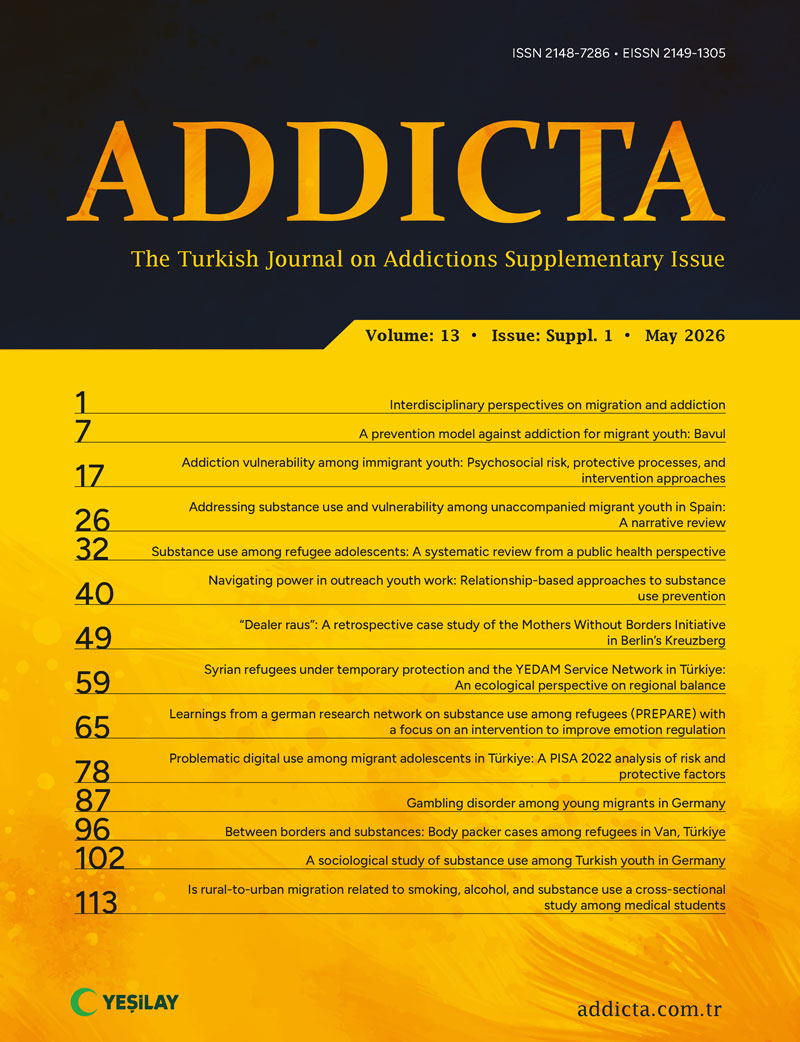
As one of the intellectual outputs of this international collaboration, this supplementary issue brings together interdisciplinary studies focusing on migration and addiction from diverse perspectives. The issue contributes to the growing literature by examining the structural, psychological, social, and cultural dimensions of addiction among migrant populations while also highlighting resilience, prevention, and community-based interventions. By disseminating open-access academic knowledge and comparative experiences, the supplementary issue contributes to evidence-based policymaking and supports national and international efforts aimed at protecting migrant youth and strengthening social cohesion.
The research landscape surrounding addiction among refugees and migrants is shaped by distinct national perspectives and traditions in each country. There is limited research in Norway concerning substance use and substance-related problems among refugees, asylum seekers, and individuals living in exile. Within the Norwegian context, research in this field remains relatively fragmented, with the primary focus historically directed toward trauma, mental health, and integration rather than the relationship between refugees’ mental health and their own substance use (Solberg et al., 2020, 2021).
It is well documented that refugees and asylum seekers constitute a particularly vulnerable group with regard to mental health due to potentially traumatic experiences prior to and during forced migration, as well as post-migratory stressors associated with establishing life in a new country, including limited knowledge of the host society and linguistic barriers (Solberg et al., 2020, 2021). By contrast, research is more extensive in relation to criminality, narcotics-related offences, and processes of social marginalization (Ryan et al., 2024).
The consequences of social marginalization, including participation in irregular labour markets or involvement in criminal activities, have occupied a more prominent position in both political discourse and academic research. This is not necessarily because crime rates or narcotics-related offences are generally higher among refugees and asylum seekers, but because migration policy and immigration law are increasingly employed as mechanisms through which individuals holding legal residence permits may nevertheless be expelled from the country.
For the individual concerned, substance use primarily represents a risk to health and a matter of concern for public health authorities. However, within the criminal justice system, possession and distribution of illicit substances directly affect opportunities for belonging, future prospects, and continued residence status. For this population, as for others involved in illicit substance use, drug-related practices constitute a nexus between health-related harms, social marginalization, and criminal prosecution. Yet for refugees and asylum seekers in particular, these consequences may additionally include the loss of the right to remain in the country.
Research on migration and addiction in Germany increasingly focuses on the mental health vulnerabilities, psychosocial stressors, and substance use risks experienced by asylum seekers and refugees. Since Germany has become one of the primary destinations for refugees in Europe following the 2015 refugee movements, scholars have paid growing attention to the relationship between forced migration, trauma, social exclusion, and addictive behaviors. Existing studies demonstrate that post-migration stressors such as uncertain legal status, discrimination, poor housing conditions, language barriers, and limited social integration significantly affect the psychological well-being of refugees and asylum seekers in Germany.
One of the major contributions in this field is the state-wide health monitoring study conducted by Biddle et al. (2019), which provides comprehensive data on the health conditions of asylum seekers and refugees in Germany. The study identifies high levels of chronic illness, depression, anxiety, and unmet healthcare needs among refugees, while also emphasizing structural barriers to healthcare access, particularly in collective accommodations and rural areas. Similarly, Hajak et al. (2021), through a systematic review, demonstrate that contextual post-migration factors play a crucial role in shaping refugees’ mental health. Their findings indicate that uncertain asylum procedures, separation from family members, discrimination, and social isolation increase psychological distress, whereas employment and social integration function as protective factors.
Research specifically focusing on substance use among refugees highlights the role of trauma and coping mechanisms. Lindert et al. (2021), in their qualitative study with Syrian male refugees in Germany, reveal that substance use is often perceived as a way of escaping traumatic past experiences and coping with psychosocial difficulties in the present. The study also shows that differences in social norms and the wider availability of substances in Germany influence refugees’ perceptions and behaviors regarding substance use. Likewise, Lorenz et al. (2023) examine professionals’ perspectives on substance use among refugees living in shared accommodations and emphasize the need for culturally sensitive addiction prevention and intervention programs.
Overall, the German literature demonstrates that addiction among refugees and migrants should be understood within broader socio-ecological and structural contexts rather than solely as an individual issue. Existing studies underline the importance of culturally appropriate prevention models, interdisciplinary cooperation, and trauma-informed mental health and addiction services for migrant populations in Germany.
Research on migration and addiction in Türkiye has increased in recent years; however, the literature remains relatively limited compared to the scale of migration experienced in the country. As Türkiye hosts one of the largest populations of migrants under temporary protection globally, the intersections of migration, mental health, social cohesion, and addiction have attracted growing scholarly attention. Existing studies emphasize that traumatic experiences, uncertainty, social exclusion, economic deprivation, and acculturation difficulties experienced by migrants constitute important risk factors for substance use and addictive behaviors (Güler & Demircan, 2022; Gülerce et al, 2022).
One of the most significant studies in the Turkish context is the qualitative research conducted by Taşdemir et al. (2020), which examines alcohol and substance addiction among Syrian migrants through the perspectives of addicted individuals, family members, and institutional actors. The study demonstrates that addiction among migrants cannot be understood solely at the individual level but must also be evaluated within broader environmental, social, and institutional contexts. The findings reveal that many migrants possess motivation to quit addiction but encounter major barriers in accessing support services and rehabilitation opportunities. Similarly, Demircan and Güler (2024) investigate smoking addiction and risky alcohol consumption among forcibly displaced Syrians and find that anxiety levels, psychological cohesion, and socio-cultural adaptation significantly predict addictive behaviors. Another important contribution is provided by Wanke et al. (2022), who focus on the stigmatization of drug addiction in South-East Türkiye. Their study reveals that substance use is heavily stigmatized within local communities and often concealed by families, making prevention efforts more difficult. This finding suggests that addiction interventions should address not only substance use itself but also the social stigma surrounding addiction. In a broader sociological context, Marufoğlu and Görür (2024) examine the relationship between migration, addiction, and crime rates, demonstrating a bidirectional relationship between migration and addiction-related social problems.
Overall, the literature in Türkiye primarily focuses on mental health vulnerabilities, social integration, and risk factors associated with migration, while relatively fewer studies address preventive and resilience-oriented models. This highlights the growing need for culturally sensitive, community-based, and youth-centered prevention approaches targeting migrant populations in Türkiye.
In conclusion, the experiences of Türkiye, Germany, and Norway demonstrate that migration and addiction are deeply interconnected phenomena shaped by trauma, social exclusion, structural inequalities, and post-migration challenges. At the same time, the literature from these countries also highlights the importance of resilience, social participation, and culturally sensitive prevention approaches in strengthening migrant well-being. Despite growing academic interest, significant gaps remain in prevention-oriented, youth-centered, and comparative research concerning addiction among migrant populations. This supplementary issue therefore seeks not only to contribute to the existing literature, but also to encourage stronger interdisciplinary collaboration, evidence-based policymaking, and community-based interventions across different national contexts. Ultimately, addressing addiction among migrant youth requires approaches that move beyond stigmatization and recognize migrants not merely as vulnerable populations, but also as individuals and communities with agency, resilience, and the capacity for social transformation.
Diverse Perspectives Across Europe
The articles brought together in this supplementary issue of Addicta contribute to this growing body of scholarship by examining migration and addiction through sociological, psychological, public health, ecological, and practice-oriented approaches.
A significant group of contributions in this issue focuses on migrant and refugee youth, emphasizing how migration-related vulnerabilities intersect with developmental processes, identity formation, and social belonging. The review article “Substance use among refugee adolescents: A systematic review from a public health perspective” (Akyol Güner, 2026) provides a comprehensive synthesis of empirical evidence regarding substance use among refugee adolescents across multiple national contexts. The article highlights the central role of trauma exposure, acculturative stress, family disruption, psychological distress, and socioeconomic disadvantage in shaping addiction vulnerability. Importantly, the review also identifies school connectedness, family support, and social networks as protective factors that can strengthen resilience among refugee youth.
Closely related to this discussion, “Addiction vulnerability among immigrant youth: Psychosocial risk, protective processes, and intervention approaches” (Özler Ervüz et al., 2026) conceptualizes addiction risk among migrant youth through the framework of Ecological Systems Theory. The study demonstrates how migration-related stressors operate simultaneously at individual, family, educational, and societal levels. By emphasizing the importance of social integration, cultural continuity, and belonging, the article expands current debates beyond clinical treatment models and argues for holistic prevention strategies.
Similarly, “Addressing substance use and vulnerability among unaccompanied migrant youth in Spain: A narrative review” (Mc-Gragh et al., 2026) examines one of the most vulnerable groups within migration processes: unaccompanied migrant minors. The article draws attention to the compounded effects of legal precarity, social isolation, housing insecurity, and interrupted caregiving structures on addiction vulnerability. Together, these three contributions collectively underline the urgent need for trauma-informed, culturally sensitive, and youth-centered prevention approaches that move beyond individualized understandings of addiction.
Building upon this preventive perspective, “A prevention model against addiction for migrant youth: Bavul” (Yaylacı et al., 2026) introduces the Bavul model, an innovative intervention framework developed specifically for migrant youth. Grounded in trauma-informed and strengths-based principles, the model combines experiential learning, resilience-building, identity development, and life skills education in a culturally sensitive format. The metaphor of the “Bavul” (suitcase) symbolically reflects the emotional, cultural, and experiential “bavul” carried by migrant youth throughout migration journeys. This contribution is particularly important because it translates theoretical discussions on vulnerability and resilience into a structured prevention model with practical applicability.
The supplementary issue also highlights the importance of community-based and outreach-oriented interventions. “Navigating power in outreach youth work: Relationship-based approaches to substance use prevention” (Chabchoub et al., 2026) emphasizes trust-building, relational engagement, and non-hierarchical communication in youth work practices. Rather than positioning young people merely as passive recipients of interventions, the article advocates participatory approaches that empower youth agency and social inclusion. In a similar vein, “‘Dealer raus’: A retrospective case study of the Mothers Without Borders initiative in Berlin’s Kreuzberg” (Ağca-Varoğlu, 2026) demonstrates how grassroots community initiatives in an immigrant neighborhood can mobilize collective action against drug-related harms through the instrumentalization of motherhood. By focusing on women’s activism, the study illustrates the importance of community engagement, both as a form of struggle against addiction and as a means of protecting the neighborhood from spatial stigmatization.
Several articles in this issue also examine migration and addiction through broader structural, institutional, and transnational lenses. “Syrian refugees under temporary protection and the YEDAM Service Network in Türkiye: An ecological perspective on regional balance” (Vuraloğlu, 2026) provides a valuable ecological analysis of the relationship between refugee population density and addiction service provision in Türkiye. The findings reveal important regional disparities and raise critical questions concerning equitable access to counseling and rehabilitation services. The article contributes to policy discussions by highlighting how migration-related demographic transformations require adaptive and regionally responsive public health infrastructures. The contribution titled “Learnings from a german research network on substance use among refugees (PREPARE) with a focus on an intervention to improve emotion regulation” (Milin et al., 2026) similarly focuses on intervention development and implementation. By presenting insights from the PREPARE research network in Germany, the article demonstrates the significance of interdisciplinary collaboration, evidence-based programming, and emotional regulation strategies in refugee-focused addiction prevention. These articles illustrate how institutional responses to addiction among migrants increasingly require coordinated approaches involving public health systems, academia, civil society, and local communities.
Another cluster of articles in this issue explores emerging and non-traditional forms of addiction and risk behaviors among migrant populations. “Problematic digital use among migrant adolescents in Türkiye: A PISA 2022 analysis of risk and protective factors” (Morgül, 2026) shifts attention toward digital dependency and problematic technology use among migrant adolescents. The article demonstrates how migration-related disadvantages may intersect with educational inequalities, psychosocial stressors, and digital environments, producing new forms of vulnerability that deserve greater scholarly attention. Likewise, “Gambling disorder among young migrants in Germany” (Şahinöz, 2026) expands the conceptual boundaries of addiction research by focusing on behavioral addictions among migrant youth. The article shows how social exclusion, economic insecurity, and identity struggles may shape gambling-related behaviors within migrant communities. Together, these two articles contribute to a broader understanding of addiction by moving beyond substance-centered perspectives and recognizing the growing importance of behavioral and digital addictions in migration contexts.
The issue also addresses migration and addiction through criminological and sociological perspectives. “Between borders and substances: Body packer cases among refugees in Van, Türkiye” (Tatlı & Sutaşır, 2026) investigates the intersection of irregular migration, trafficking routes, and substance transportation practices in a critical border region. By documenting body packer cases among refugees and irregular migrants, the study reveals the complex vulnerabilities that emerge at the intersection of migration governance, organized crime, and public health.
Meanwhile, “A sociological study of substance use among Turkish youth in Germany” (Yüksel & Hiçdurmaz, 2026) examines how migration histories, identity negotiations, discrimination, and transnational belonging influence substance use patterns among Turkish-origin youth in Germany. This contribution is particularly valuable because it situates addiction within broader sociological debates concerning diaspora experiences, social integration, and intergenerational transformation.
In a related manner, the article “Is rural-to-urban migration related to smoking, alcohol, and substance use a cross-sectional study among medical students” (Torun et al., 2026) focuses on internal migration and its relationship with smoking, alcohol use, and substance use among medical students. The study demonstrates that migration experiences within national borders may also constitute an important yet often overlooked determinant of addiction-related behaviors. By identifying associations between migration history, childhood trauma, mental health, residential environments, and substance-related risks, the article broadens the scope of migration and addiction research beyond refugee and international migration contexts. Importantly, the findings suggest that internal migration processes and social dislocation may interact with psychosocial vulnerabilities in shaping health-risk behaviors among young adults.
Taken together, the articles in this supplementary issue collectively demonstrate that addiction in migration contexts cannot be reduced to individual pathology alone. Instead, addiction emerges through the interaction of structural inequalities, displacement experiences, social exclusion, trauma exposure, policy environments, and community dynamics. The issue therefore calls for a multidimensional perspective that integrates public health, sociology, psychology, youth studies, migration studies, and social policy.
Conclusion
Migration and addiction emerge in this supplementary issue not as isolated or purely individual phenomena, but as deeply interconnected social, psychological, cultural, and structural processes. The studies brought together in this collection collectively demonstrate that experiences of forced displacement, uncertainty, trauma, discrimination, social exclusion, and disrupted social support systems significantly shape vulnerability to substance use and addictive behaviors among migrants and refugees. At the same time, the issue highlights that migrant communities are not defined solely by vulnerability; they also possess important capacities for resilience, adaptation, solidarity, and recovery.
One of the most important contributions of this supplementary issue lies in its multidimensional and comparative perspective. By bringing together research and experiences from Türkiye, Germany, Norway, Spain, and broader international contexts, the issue reveals both shared migration-related challenges and context-specific dynamics shaped by national policies, institutional structures, and social environments. The contributions consistently emphasize that addiction among migrant populations must be understood within broader socio-ecological frameworks that include trauma exposure, legal insecurity, social marginalization, poverty, discrimination, and barriers to healthcare and social participation.
Importantly, this collection also moves beyond problem-centered narratives by foregrounding prevention, resilience, and community-based responses. The studies underline the importance of culturally sensitive interventions, trauma-informed care, youth work, emotional regulation strategies, social cohesion, family support, and participatory approaches that strengthen migrant youths’ sense of belonging and agency. In this respect, the Erasmus+ project “Developing a Prevention Model Against Addiction for Migrant Youth,” implemented through the collaboration of institutions from Türkiye, Norway, and Germany, represents not only an academic partnership but also a practical effort to develop innovative and socially responsive prevention strategies for disadvantaged young people.
As migration continues to shape societies across Europe and beyond, understanding the intersections between migration and addiction becomes increasingly important for researchers, policymakers, practitioners, and civil society actors. This supplementary issue contributes to this growing field by encouraging interdisciplinary dialogue, comparative research, and evidence-based policymaking while also emphasizing the ethical responsibility to support migrant populations through inclusive, humane, and prevention-oriented approaches. Ultimately, the issue calls for a shift from reactive and stigmatizing perspectives toward holistic models that recognize both the vulnerabilities and the strengths of migrants and refugees in increasingly complex social realities.
Data availability statement
Data sharing is not applicable to this article as no new datasets were generated or analyzed during this study.
Conflict of interest
The author declares that this study was conducted in the absence of any commercial or financial relationships that could be construed as a potential conflict of interest.
Funding
This study received funding from the European Union under the Erasmus+ Youth Programme (Project No. 2023-2-TR01-KA220-YOU-000180027), Developing a Prevention Model Against Addiction for Migrant Youth.
Generative AI statement
The authors declare that no generative AI or AI-assisted technologies were used in the writing or preparation of this study.
- The European Commission’s support for the production of this publication (the Supplementary Issue on Migration and Addictions) does not constitute an endorsement of the contents, which reflect the views only of the authors, and the Commission cannot be held responsible for any use which may be made of the information contained therein. ↩
- Project coordinator: Turkish Green Crescent Society (Türkiye). Project partners: Marmara University (Türkiye), Universitätsklinikum Hamburg-Eppendorf (Germany), Velferdsetaten Oslo Kommune (Norway). ↩
References
- Ağca Varoğlu, F. G. (2026). “Dealer raus”: A retrospective case study of the Mothers Without Borders initiative in Berlin’s Kreuzberg. Addicta: The Turkish Journal on Addictions, 13(Suppl. 1), 49-58. https://doi.org/10.15805/addicta.2026.490
- Akyol Güner, T. (2026). Substance use among refugee adolescents: A systematic review from a public health perspective. Addicta: The Turkish Journal on Addictions, 13(Suppl. 1), 32-39. https://doi.org/10.15805/addicta.2026.486
- Biddle, L., Menold, N., Bentner, M., Nöst, S., Jahn, R., Ziegler, S., & Bozorgmehr, K. (2019). Health monitoring among asylum seekers and refugees: a state-wide, cross-sectional, population-based study in Germany. Emerging Themes in Epidemiology, 16, 3. https://doi.org/10.1186/s12982-019-0085-2
- Chabchoub, J., Jacobsen, C. S., & Haugstvedt, H. (2026). Navigating power in outreach youth work: Relationship-based approaches to substance use prevention. Addicta: The Turkish Journal on Addictions, 13(Suppl. 1), 40-48. https://doi.org/10.15805/addicta.2026.485
- Demircan, D., & Guler, M. (2024). Factors affecting risky alcohol consumption, smoking addiction in forced Syrian migrants. Addicta: The Turkish Journal on Addictions, 11(3), 338-346. https://doi.org/10.5152/ADDICTA.2024.23114
- Güler, M., & Demircan, D. (2022). Zorunlu göç: Bağımlılık açısından riskli bir süreç. İstanbul Aydın Üniversitesi Sosyal Bilimler Dergisi, 14(1), 1-14. https://doi.org/10.17932/IAU.IAUSBD.2021.021/iausbd_v14i1001
- Gülerce, H., Şahin, H., & Hadi, A. (2022). Migration and obstacles to social cohesion: The perception of young people in Turkey. HUMANITAS - Uluslararası Sosyal Bilimler Dergisi, 10(20), 206-225. https://doi.org/10.20304/humanitas.1058133
- Hajak, V. L., Sardana, S., Verdeli, H., & Grimm, S. (2021). A systematic review of factors affecting mental health and well-being of asylum seekers and refugees in Germany. Frontiers in Psychiatry, 12. https://doi.org/10.3389/fpsyt.2021.643704
- Lindert, J., Neuendorf, U., Natan, M., & Schäfer, I. (2021). Escaping the past and living in the present: a qualitative exploration of substance use among Syrian male refugees in Germany. Conflict and Health, 15, 26. https://doi.org/10.1186/s13031-021-00352-x
- Lorenz, M. H., Ensle, A., Taggert, J., Uricher, J., Heidenreich, T., & Laging, M. (2023). Professionals’ perspectives on substance use among refugees in shared accommodations: A qualitative study. Health & Social Work, 48(3), 188-197. https://doi.org/10.1093/hsw/hlad017
- Marufoğlu, M., & Görür, Ç. (2024). Sosyoekonomik faktörlerin suç oranlarına etkisi: Ekonomik büyüme, göç ve bağımlılık. R&S - Research Studies Anatolia Journal, 7(4), 427-445. https://doi.org/10.33723/rs.1531541
- Mc-Gragh, B., López Atanes, M., Rico, R., Bari, M., Millin, S., Behrendt, M., Schäfer, I., & Erkoreka, L. (2026). Addressing substance use and vulnerability among unaccompanied migrant youth in Spain: A narrative review. Addicta: The Turkish Journal on Addictions, 13(Suppl. 1), 26-31. https://doi.org/10.15805/addicta.2026.482
- Milin, S., Behrendt, M., Bari, M., López Atanes, M., Tekeli, M. R., Zurhold, H., Hiller, P., Lotzin, A., & Schäfer, I. (2026). Learnings from a german research network on substance use among refugees (PREPARE) with a focus on an intervention to improve emotion regulation. Addicta: The Turkish Journal on Addictions, 13(Suppl. 1), 65-77. https://doi.org/10.15805/addicta.2026.487
- Morgül, E. (2026). Problematic digital use among migrant adolescents in Türkiye: A PISA 2022 analysis of risk and protective factors. Addicta: The Turkish Journal on Addictions, 13(Suppl. 1), 78-86. https://doi.org/10.15805/addicta.2026.484
- Özler Ervüz, F., Ervüz, C., & Südüpak, Ş. (2026). Addiction vulnerability among immigrant youth: Psychosocial risk, protective processes, and intervention approaches. Addicta: The Turkish Journal on Addictions, 13(Suppl. 1), 17-25. https://doi.org/10.15805/addicta.2026.483
- PMM. (2026). Temporary protection. https://en.goc.gov.tr/temporary-protection27
- Europa, R. T., Eide, K., Hjern, A., Manhica, H., & Dunlavy, A. (2023). Narcotic offences and drug use disorders among young refugees in Norway. Scandinavian Journal of Public Health, 52(8), 942-950. https://doi.org/10.1177/14034948231201895
- Solberg, Ø., Nissen, A., Cauley, P., & Andersen, A. J. (2020). Mental health and quality of life among refugees from Syria after forced migration to Norway: Main findings from the REFUGE study. (Rapport 1/2020).
- Solberg, Ø., Sengoelge, M., Nissen, A., & Saboonchi, F. (2021). Coping in limbo? The moderating role of coping strategies in the relationship between post-migration stress and well-being during the asylum-seeking process. International Journal of Environmental Research and Public Health (IJERPH), 18(3), 1004. https://doi.org/10.3390/ijerph18031004
- Şahinöz, C. (2026). Gambling disorder among young migrants in Germany. Addicta: The Turkish Journal on Addictions, 13(Suppl. 1), 87-95. https://doi.org/10.15805/addicta.2026.491
- Taşdemir, M., Küçükali, H., Uçar, A., & Sur, H. (2020). Exploring alcohol and substance addiction among syrian migrants in Turkey: A qualitative study integrating perspectives of addicts, their relatives, local and national institutions. Addicta: The Turkish Journal on Addictions, 7(4), 253-276. https://doi.org/10.5152/ADDICTA.2020.20074
- Tatlı, M., & Sutaşır, M. N. (2026). Between borders and substances: Body packer cases among refugees in Van, Türkiye. Addicta: The Turkish Journal on Addictions, 13(Suppl. 1), 96-101. https://doi.org/10.15805/addicta.2026.489
- Torun, H. O., Akdöner, B., Işık, M., & Kırlı, U. (2026). Is rural-to-urban migration related to smoking, alcohol, and substance use a cross-sectional study among medical students. Addicta: The Turkish Journal on Addictions, 13(Suppl. 1), 113-122. https://doi.org/10.15805/addicta.2026.488
- Vuraloğlu, E. (2026). Syrian refugees under temporary protection and the YEDAM Service Network in Türkiye: An ecological perspective on regional balance. Addicta: The Turkish Journal on Addictions, 13(Suppl. 1), 59-64. https://doi.org/10.15805/addicta.2026.480
- Wanke, M., Macit, R., & Gülerce, H. (2022). The stigmatization of drug addiction in South-East Turkey the case of drug abuse prevention programme for youth project in Turkey. Addicta: The Turkish Journal on Addictions, 9(2), 137-141. https://doi.org/10.5152/ADDICTA.2022.22009
- Yaylacı, F. T., Gülerce, H., Nişancı, A., Gülerce, R., Akpınar, B., Fidan, M., Korkmaz, Z., Çelebi, A. S., & Turan, E. (2026). A prevention model against addiction for migrant youth: Bavul. Addicta: The Turkish Journal on Addictions, 13(Suppl. 1), 7-16. https://doi.org/10.15805/addicta.2026.479
- Yüksel, H., & Hiçdurmaz, Z. (2026). A sociological study of substance use among Turkish youth in Germany. Addicta: The Turkish Journal on Addictions, 13(Suppl. 1), 102-112. https://doi.org/10.15805/addicta.2026.481
License
Copyright (c) 2026 The Author(s). This is an open access article distributed under the Creative Commons Attribution License (CC BY), which permits unrestricted use, distribution, and reproduction in any medium or format, provided the original work is properly cited.