


Abstract
This study examined the demographic, social-behavioural, and psychosocial determinants of problematic digital use among migrant adolescents in Türkiye using data from the PISA 2022 migration subsample. The sample included 7,137 first- and second-generation migrant students. Problematic digital use was measured using students’ self-reports about their digital habits, while bullying experiences, perceptions of school safety, weekend digital activity, and levels of teacher support, family support, and emotional control were assessed through established background questionnaire scales. Analyses included t-tests, correlations, and hierarchical binary logistic regression.
Results showed that males and older students reported significantly higher levels of problematic digital use. Problematic use was positively associated with bullying, perceived lack of school safety, and intensive weekend digital activity, and negatively associated with teacher support, family support, and emotional control. The regression model explained 22.8% of the variance, with weekend digital use emerging as the strongest risk factor and emotional control as the strongest protective factor.
Overall, the study findings show that problematic digital engagement among migrant adolescents reflects an interplay of social stressors and self-regulatory resources. Interventions targeting both emotional regulation and supportive school-family environments may help promote healthier digital behaviours in this migrant population.
Keywords: problematic digital use, migrant adolescents, risk and protective factors, emotional regulation, school safety
Main Points
- Problematic digital use among migrant adolescents in Türkiye is shaped by both individual vulnerabilities (e.g., emotional control) and contextual stressors (e.g., bullying, unsafe school climate).
- Weekend digital activity, bullying exposure, and perceived school insecurity are the strongest risk factors associated with high problematic digital use.
- Teacher and family support, together with stronger emotional regulation, are associated with lower levels of problematic digital use.
- Gender and grade-level differences exist, with males and older students reporting higher problematic digital use.
- Findings highlight the need for prevention efforts that strengthen both emotional self-regulation and social connectedness in migrant youth.
Introduction
In recent years, digital technologies have become central to adolescents’ identity development, learning, and communication. While digital media can promote social connections and access to information, excessive or uncontrolled use of digital media can have negative psychological and behavioral effects, often conceptualized as problematic digital use (Boer et al., 2021; Kardefelt-Winther, 2014). Loss of control, obsessive checking, and disruption of daily functioning are characteristics of this type of problematic use (Fujita et al., 2022). Prior studies have linked problematic digital use to poorer academic performance, loneliness, anxiety, and sleep issues (Twenge, 2019).
Digital engagement can have special meanings and purposes for adolescent migrants. Language barriers, cultural identity formation, and preserving family ties are all frequently facilitated by digital environments (Mazzucato & van Geel, 2022). However, according to a systematic review, these online spaces can also serve as coping mechanisms for social isolation, discrimination, or acculturation stress (Mehjabeen et al., 2023). The likelihood of problematic use may rise when digital technology is used as the main tool for emotional control or escape. In order to understand how digital behaviors among migrant youth reflect both adaptation and vulnerability, it is imperative to examine problematic digital use within the migration context.
Differences in the digital behaviors of adolescents have been consistently associated with demographic factors, such as gender, age, and family background. According to data from international studies, such as PISA 2022, girls are more likely to engage in compulsive social media use, while boys are more likely to report problematic gaming and screen use (Kuss & Griffiths, 2017; OECD, 2023). Males engage with technology in a more performance-oriented way, while females use it more relationally, reflecting broader gendered motivations for technology use (Andreassen et al., 2017).
Age-related trends have also been noted; older teenagers are more likely to engage in problematic behavior because they frequently use technology more intensely and have less parental supervision (Kuss et al., 2021). Findings, however, are still inconsistent across cultural contexts. Due to emotional immaturity or a lack of self-regulation, younger students may also exhibit vulnerable behavior in certain situations (Livingstone & Sylwander, 2025). Re-examining demographic differences in problematic digital use within particular cultural and migration contexts is crucial in light of these discrepancies.
In addition to gender and age, adolescents’ familial background and socioeconomic status significantly influence their digital access, usage patterns, and vulnerability to problematic engagement. Young people from lower socioeconomic backgrounds may have less access to structured digital learning opportunities but more chances to engage in unmonitored online activities (OECD, 2023). For migrant adolescents, these disparities may be exacerbated by language barriers, insufficient parental knowledge of host-country technologies, and divergent cultural norms regarding device usage (Atalan Ergin & Essau, 2024; Mazzucato & van Geel, 2022). Consequently, this study examines problematic digital use among migrant adolescents in Türkiye while controlling for key demographic factors. This method establishes a contextual baseline for figuring out how psychosocial and behavioral factors add to the risks of digital engagement.
Migrant adolescents often face numerous stressors that can shape their technology usage. Experiences of social exclusion, peer victimization, and perceived insecurity in school settings are among the most commonly reported difficulties within this population (Verkuyten, 2018). These stressors may increase psychological susceptibility and lead to the use of digital technologies as a means of escapism or emotional compensation (Kardefelt-Winther, 2014).
Empirical evidence shows that adolescents subjected to bullying or unsafe school environments are more inclined to exhibit maladaptive or excessive online behaviors as a coping mechanism (Kırcaburun, 2019; Kowalski et al., 2014). Similarly, increased screen time during weekends has been associated with reduced self-regulation and poor psychosocial adjustment, reflecting a lack of routine and supervision characteristic of these periods (Boer et al., 2021; Twenge, 2019). In this context, the current study conceptualizes bullying exposure, perceived school safety, and weekend digital use as social and behavioral risk factors that may elevate the probability of problematic digital use among migrant adolescents in Türkiye.
Social support and emotional regulation are widely acknowledged as essential protective factors in the psychological adaptation of migrant adolescents. Support from family and teachers can help adolescents deal with acculturative stress, social exclusion, and discrimination by giving them a sense of belonging, stability, and guidance (Motti-Stefanidi et al., 2021; Suárez-Orozco et al., 2018). Supportive family relationships cultivate emotional security, whereas constructive teacher-student interactions enhance school engagement and resilience, both of which have been linked to diminished problematic technology use (Musetti et al., 2020).
Conversely, emotional control constitutes a vital self-regulatory skill that empowers adolescents to navigate stress and adverse emotions without engaging in maladaptive coping mechanisms, such as excessive digital involvement (Billieux et al., 2015; Elhai et al., 2017). Social support and emotional regulation together make up a dual protective system. For instance, social relationships offer external resources, whereas emotional regulation functions as an internal regulatory mechanism (Nozaki & Gross, 2025). This study investigates teacher support, family support, and emotional regulation as key protective factors associated with problematic digital use among migrant adolescents in Türkiye.
The present study is grounded in Bronfenbrenner’s Ecological Systems Theory (1992) and the Risk and Resilience Framework (Fergus & Zimmerman, 2005), which collectively emphasize the dynamic interaction of individual, social, and contextual factors in shaping adolescent development. From this perspective, problematic digital use may be regarded as the outcome of both vulnerability processes (such as exposure to social risks) and protective processes (such as family-teacher support and emotional regulation skills). These models underscore that digital behavior is shaped not only by access to technology but also by its integration within broader ecological systems, including familial, educational, and social contexts.
While these frameworks are relevant, empirical research assessing multi-level risk and protective models among migrant adolescents in Türkiye is scarce. International studies have explored the impact of psychosocial and behavioral factors on adolescents’ digital wellbeing; however, there is a scarcity of research examining these dynamics in migration contexts marked by social and cultural adaptation stress (Motti-Stefanidi et al., 2021; Suárez-Orozco et al., 2018)
The migration subsample of PISA 2022 provides a unique opportunity to analyze these associations at a national level using comprehensive, representative data. This study addresses a notable research gap by integrating demographic, social-behavioral, and psychosocial factors into a unified model, offering one of the first empirical investigations of problematic digital use among migrant adolescents in Türkiye through a multi-dimensional risk-protection framework.
The Current Study
Building on the risk-protection framework, the present study aimed to examine the demographic, social-behavioral, and psychosocial determinants of problematic digital use among migrant adolescents in Türkiye, using data from the PISA 2022 migration subsample. This nationally representative dataset provides a unique opportunity to explore how individual vulnerabilities and protective resources jointly shape adolescents’ digital engagement patterns within the Turkish migration context.
Gender, grade level, and socioeconomic background were included as control variables, consistent with prior international evidence linking these demographic factors to variation in technology use (OECD, 2023). The analytic model tested the combined effects of risk factors (experiences of bullying, perceptions of school safety, and intensity of weekend digital use) and protective factors (teacher support, family support, and emotional control).
Accordingly, the study aimed to address the following research questions:
- Are there significant differences in adolescents’ levels of problematic digital use across gender and grade levels?
- How are individual, social, and behavioral factors associated with problematic digital use?
- To what extent do demographic, social-behavioral, and psychosocial factors predict adolescents’ likelihood of high problematic digital use?
- Among all predictors, which factors emerge as the strongest risk and protective correlates of high problematic digital use?
Methods
Participant characteristics
Table 1 displays participant characteristics and descriptive statistics for the main study variables. Data were drawn from the migration subsample of the Turkish dataset in the PISA study, which included 7,137 adolescents. Based on the PISA migration status variable, this subsample consists of students who were classified as first- or second-generation immigrants. The gender distribution of the participants was roughly equal, with 49.3% of them being female (n = 3,520) and 50.7% being male (n = 3,617). The vast majority of participants were enrolled in Grade 10 (91.7%), with smaller proportions in Grade 9 (7.7%), Grade 11 (.4%), and only a few in other grades (<.1%). Participants’ socioeconomic status, measured by the Index of Economic, Social and Cultural Status (ESCS; M = -1.22, SD = 1.16), indicated that, on average, students came from below-average socioeconomic backgrounds relative to the OECD reference population. In this study, the ESCS z-score was used. When standardized (ESCS z-score), the mean was .00 (SD = 1.00), confirming the proper scaling of the index within the PISA framework.
|
a ESCS was standardized within the Turkish sample (ZESCS; M = 0, SD = 1). Original ESCS scores (OECD-scaled) ranged from -5.35 to 2.88 (M = -1.22, SD = 1.16). b Warm’s Mean Weighted Likelihood Estimates (WLE) were used for all PISA background indices. These indices are standardized across OECD countries, with a mean of approximately zero and a standard deviation of one. Higher scores indicate higher levels of the corresponding construct. c Negative values indicate below-average socioeconomic resources relative to the OECD average, whereas positive values reflect higher advantage. |
||
| Table 1. Participant characteristics and descriptive statistics for key variables | ||
| Variable |
|
|
| Gender | ||
| Female |
|
|
| Male |
|
|
| Grade level | ||
| Grade 7 |
|
|
| Grade 8 |
|
|
| Grade 9 |
|
|
| Grade 10 |
|
|
| Grade 11 |
|
|
| Grade 12 |
|
|
|
|
||
| Socioeconomic status (ESCS) a, c |
|
|
| Problematic digital use |
|
|
| Being bullied (WLE) b, c |
|
|
| School safety risks (WLE) |
|
|
| Weekend digital use (WLE) |
|
|
| Family support (WLE) |
|
|
| Teacher-student relationship quality (WLE) |
|
|
| Emotional control (WLE) |
|
|
The dependent variable, problematic digital use, ranged from 1 to 5 (M = 2.62, SD = .82), with higher scores indicating more problematic digital engagement. Among the predictor variables, being bullied, school safety risks, and weekend digital use were modeled as risk factors, whereas teacher support, family support, and emotional control were treated as protective factors. All predictors were used in their original PISA Warm’s Mean Weighted Likelihood Estimate (WLE) form, directly drawn from the PISA 2022 dataset. These indices (e.g., bullying, school safety risks, family support, teacher-student relationships, and emotional control) are standardized across OECD countries, with a mean of approximately zero and a standard deviation of one. Higher values reflect higher levels of the underlying construct, consistent with PISA scaling conventions (see Table 1).
Procedure
Data for this study were obtained from the Programme for International Student Assessment (PISA) 2022 Turkish dataset. The analysis focused on the migration subsample, which includes adolescents identified as first- or second-generation immigrants according to the PISA migration background variable. Data collection in PISA followed standardized international procedures coordinated by the OECD. Students filled out self-report questionnaires in schools while taking standardized tests. These questionnaires included information about the participants’ demographics, how they used digital technology, their school and family contexts, and psychological characteristics. All data were anonymized and accessible via the OECD database; therefore, no further ethical approval was necessary for secondary data analysis.
Measures
Demographics
Demographic information was obtained from the background questionnaire included in the PISA 2022 dataset. In line with OECD procedures, data on gender, grade level, and socioeconomic status were collected for all participants. Gender was recorded as male or female, and grade level reflected students’ current school grade (ranging from Grade 7 to Grade 12). Socioeconomic status was measured using the Index of Economic, Social and Cultural Status (ESCS), a composite indicator derived from parental education, occupational status, and household possessions. These demographic variables were used as control factors in the analyses, following standard practices in PISA-based research.
Risk Factors
Social and behavioral risk variables were taken from the PISA background indices, which were scaled using Warm’s Weighted Likelihood Estimates (WLE). For every construct in the Turkish sample, these standardized WLE scores offer reliable and psychometrically adjusted estimates. The following risk variables were used in this study: a. Being bullied (BULLIED) measured the frequency of peer victimization experiences. b. School safety risks (SCHRISK) reflected perceptions of insecurity or disorder at school. c. Weekend digital use (ICTWKEND) assessed the intensity of digital activity on weekends. Higher WLE scores indicate higher levels of the corresponding construct.
Protective Factors
Protective factors were taken from PISA background indices based on Warm’s Mean Weighted Likelihood Estimates (WLE). These standardized WLE scores give psychometrically adjusted estimates of protective constructs within the Turkish sample. The following protective variables were included in this study: a. Teacher-student relationship quality (RELATST) measured students’ perceived support and respect from teachers. b. Family support (FAMSUP) assessed perceived emotional and practical support from family. c. Emotional control (EMOCOAGR) measured students’ ability to regulate their emotional responses. Higher WLE scores indicated stronger perceived support and greater emotional regulation.
Problematic Digital Use
Problematic digital use was measured using PISA item set ST322 (e.g., “I keep my digital device near me to answer messages when I am home.”, “I feel nervous/anxious when I don’t have my digital device near me.”). Responses were rated on a five-point Likert scale ranging from 1 (never) to 5 (always), with higher scores indicating greater problematic use of digital technologies. Two items (ST322Q01JA and ST322Q02JA) were reverse-coded prior to computing the mean composite score to ensure that higher values consistently reflected more problematic use. One functional-use item (ST322Q04JA: “I have my digital device open in class so I can take notes or search for information”) was excluded from the calculation, as it represents purposeful rather than problematic device use. This exclusion aligns with prior research and OECD technical guidelines (Kastorff et al., 2025; OECD, 2023).
Due to the rotating design of student questionnaires, not all the students answered every question, which is in line with the PISA data structure and international reporting standards. A mean composite score was determined for students who had at least three valid answers on this scale in order to guarantee reliable measurement. This “mean of ≥3 valid items” approach follows OECD coding procedures for partially administered scales and has been used in previous PISA-based studies examining digital engagement and wellbeing (e.g., Bohnert & Gracia, 2022; OECD, 2023). Additionally, the selection of risk and protective variables was theory-driven and informed by prior literature, rather than data-driven or exploratory, and the study was not pre-registered.
Data Analysis
All analyses were conducted using IBM SPSS Statistics 29. Descriptive statistics were computed for all variables. Independent-samples t-tests examined gender and grade-level differences in problematic digital use. For this purpose, grade level was recoded into two categories: lower grades (Grades 7-9) and higher grades (Grades 10-12). Pearson correlations were conducted to assess associations between problematic digital use and continuous predictors. To identify the key predictors of high problematic digital use, a binary logistic regression was performed. The dependent variable was dichotomized at ±1 standard deviation (SD) from the mean (0 = low digital use, 1 = high digital use), a common approach in PISA-based studies to distinguish clearly high- and low-risk groups (e.g., Bohnert & Gracia, 2022; OECD, 2023).
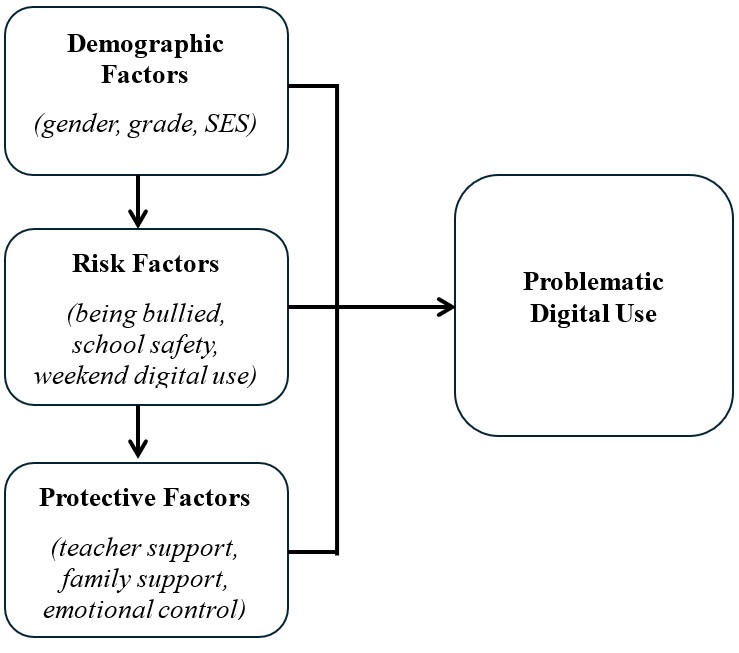
Predictors were entered in three blocks: (1) Demographics (gender, grade level, SES); (2) Risk factors (being bullied, school safety risks, weekend digital use); and (3) Protective factors (teacher support, family support, emotional control). To evaluate model fit, Nagelkerke R² and overall classification accuracy were used. All statistical tests were two-tailed, with p < .05 considered significant. The conceptual model of the hierarchical logistic regression analysis is presented in Figure 1.
Results
Gender and grade-level differences in problematic digital use
Independent-samples t-test results showed a significant difference between male and female students (t(6716) = 4.58, p < .001). Males (M = 2.67, SD = .83) reported significantly higher levels of problematic digital use than females (M = 2.58, SD = .80), with a small effect size (Cohen’s d = .11).
Additionally, students in lower grades (Grades 7-9) and higher grades (Grades 10-12) were compared on problematic digital use. Independent-samples t-test results indicated a significant difference between groups (t(6716) = 3.18, p = .001). Students in higher grades (M = 2.63, SD = .82) reported higher problematic digital use than those in lower grades (M = 2.51, SD = .84), with a small effect size (Cohen’s d = .14).
Associations between problematic digital use and study variables
Associations between problematic digital use and study variables are presented in Table 2. Pearson correlation results showed that socioeconomic status had a weak correlation with problematic digital use (r = .03, p < .05). Problematic digital use was positively correlated with being bullied (r = .13, p < .001), perceived school safety risks (r = .15, p < .001), and weekend ICT activity (r = .17, p < .001), indicating that higher levels of these risk factors were associated with greater problematic use. Conversely, problematic digital use was negatively correlated with teacher-student relationship quality (r = -.14, p < .001), family support (r = -.10, p < .001), and emotional control (r = -.16, p < .001), suggesting that stronger social and emotional resources were linked to lower levels of problematic use.
| p values are two-tailed; p < .05, p < .01, p < .001. | ||||||||
| Table 2. Correlations between problematic digital use and key study variables | ||||||||
| Variable |
|
|
|
|
|
|
|
|
| 1. Problematic digital use |
|
|||||||
| 2. Socioeconomic status |
|
|
||||||
| 3. Being bullied |
|
|
|
|||||
| 4. School safety risks |
|
|
|
|
||||
| 5. Weekend digital use |
|
|
|
|
|
|||
| 6. Teacher-student relationship quality |
|
|
|
|
|
|
||
| 7. Family support |
|
|
|
|
|
|
|
|
| 8. Emotional control |
|
|
|
|
|
|
|
|
Predictors of high problematic digital use
A hierarchical binary logistic regression analysis was conducted to identify the demographic, social-behavioral, and protective predictors of high problematic digital use among migrant adolescents. In the final model, all three blocks (demographics, risk factors, and protective factors) were included. Results are presented in Table 3.
| Warm’s Mean Weighted Likelihood Estimates (WLE) were used for all PISA background indices. These indices are standardized across OECD countries, with a mean of approximately zero and a standard deviation of one. Higher scores indicate higher levels of the corresponding construct; OR = Odds Ratio; CI = 95% Confidence Interval; p values are two-tailed. p < .05 considered statistically significant. Gender was coded as 0 = female (reference), 1 = male. |
||||
| Table 3. Binary logistic regression predicting high problematic digital use | ||||
| Predictor |
|
|
|
|
| Student International Grade (Derived) |
|
|
|
|
| Student (Standardized) Gender |
|
|
|
|
| Socioeconomic status (ESCS z-score) |
|
|
|
|
| Being bullied (WLE) |
|
|
|
|
| School safety risks (WLE) |
|
|
|
|
| Weekend digital use (WLE) |
|
|
|
|
| Teacher-student relationship quality (WLE) |
|
|
|
|
| Family support (WLE) |
|
|
|
|
| Emotional control (agreement; WLE) |
|
|
|
|
| Constant |
|
|
|
|
The overall model was statistically significant and demonstrated good fit, explaining approximately 22.8% of the variance in adolescents’ likelihood of belonging to the high-risk group for problematic digital use (Nagelkerke R² = .228). The model correctly classified 68.8% of cases, indicating a satisfactory level of predictive accuracy.
Findings showed that older adolescents and males were more likely to engage in problematic digital use compared to their younger and female peers. Among the risk-related variables, being bullied, feeling unsafe at school, and frequent digital use during weekends substantially increased the likelihood of high-risk digital use. Additionally, several protective factors were associated with a lower probability of problematic engagement. Adolescents who reported stronger teacher and family support and higher levels of emotional control were significantly less likely to fall into the high-risk group. Among all predictors, weekend digital activity emerged as the strongest risk factor, while emotional control appeared as the most robust protective factor.
Discussion
This study used data from the PISA 2022 migration subsample to examine problematic digital use among migrant adolescents in Türkiye. Three domains of influence were analyzed: psychosocial protective resources, social-behavioral risk factors, and demographic characteristics. The findings showed a significant association between sociodemographic characteristics and variations in digital engagement. Experiences of bullying, perceived lack of school safety, and excessive weekend digital use were identified as key risk factors associated with higher levels of problematic use. On the other hand, emotional control and teacher and family support served as significant protective factors associated with less problematic use. Overall, the findings revealed a complex pattern in which the digital engagement of migrant adolescents was influenced by both vulnerability and resilience factors.
This study showed that males and older migrant adolescents were more likely to report higher levels of problematic digital use, which is in line with previous research (Boer et al., 2020; Twenge & Martin, 2020). These patterns are consistent with broader gender and developmental trends, indicating that older adolescents typically have more autonomy and less parental supervision when it comes to technology use, while males may participate more intensely in digital activities related to gaming or performance (Isorna-Folgar et al., 2024; Kuss & Griffiths, 2017). Given that migrant families often experience intergenerational gaps in digital literacy and cultural adaptation, these differences may also be indicators of cultural norms and parental monitoring practices within the migration context (Moran, 2023; Suárez-Orozco et al., 2018).
The findings showed that among migrant adolescents, experiencing bullying, feeling unsafe at school, and engaging in a lot of digital activity on the weekends were all important risk factors for problematic digital use. This pattern supports the compensatory internet use framework, which suggests that adolescents may use digital spaces as a coping mechanism for stress, rejection, or unpleasant feelings (Kardefelt-Winther, 2014; Zhao et al., 2023). As digital spaces can provide short-term relief or social validation which may be limited in real social settings, peer victimization has been shown to predict higher engagement in maladaptive online behaviors, which is consistent with previous research (Kowalski et al., 2014).
According to Gültekin et al. (2024), students who feel unsafe in their school setting might turn to online interactions as a more secure and manageable way to connect. Given that weekends are less structured and have less oversight, increased weekend digital use serves to further reinforce this dynamic (Boer et al., 2021; Twenge, 2019). Weekend patterns may also reflect other contextual constraints, especially for migrant adolescents. According to earlier studies, opportunities for outdoor social activities may be restricted by language barriers, a sense of social exclusion, and a diminished sense of neighborhood belonging (Plenty & Jonsson, 2017; Schachner, 2017). On weekends, some migrant youth might therefore rely more on digital spaces as easily accessible places for social interaction, leisure, and emotional release (Moran, 2023). When combined, these results imply that social stressors might either directly or indirectly lead to increased digital overuse among young migrants.
The findings showed that emotional control and family and teacher support were important barriers to problematic digital use among adolescent migrants. These results are consistent with earlier studies that highlight the protective function of social support networks in adolescent adjustment and digital health (Musetti et al., 2020; Suárez-Orozco et al., 2018). While family support promotes communication and a sense of security, which can reduce the need for compensatory online behaviors, supportive teachers offer structure, belonging, and guidance, assisting students in managing academic and emotional stress (Motti-Stefanidi et al., 2021).
Similarly, emotional control is a crucial self-regulation ability that helps young people manage their stress and frustration without turning to excessive digital use (Billieux et al., 2015; Elhai et al., 2017). Within the migration context, these protective mechanisms may be particularly important, as social support networks can buffer migration-related stress, and emotional regulation capacities may strengthen adaptive coping in new challenging environments (Nozaki & Gross, 2025). All of these findings suggest that improving intrapersonal and interpersonal protective resources may be essential to lowering adolescent migrants’ excessive use of digital devices. This pattern further highlights the combined role of behavioral regulation and supportive environments in relation to problematic digital use.
The final model showed that both environmental and emotional factors uniquely contributed to the likelihood of high problematic digital use among immigrant youth when all demographic, social-behavioral, and psychosocial variables were considered. Weekend digital use was the most significant risk factor among all predictors, indicating that unstructured screen time on the weekends could be a major contributing factor to excessive use. This result is consistent with studies showing that when external structure, especially school routines, is absent, adolescents tend to show less self-regulation and more media exposure (Boer et al., 2021; Twenge, 2019).
The strongest protective factor, on the other hand, seemed to be emotional control, underscoring the critical role that self-regulation plays in reducing maladaptive digital behaviors. This confirms earlier findings that problematic internet or smartphone use is predicted by issues with emotion regulation (Elhai et al., 2017; Günaydın et al., 2022). Even after accounting for contextual supports (such as teacher and family relationships), the prominence of emotional control suggests that individual coping mechanisms may act as a risk buffer in a variety of social contexts.
The results of this study should be interpreted in light of its limitations. First, causal inferences about the direction of relationships between digital behaviors and psychosocial predictors cannot be made due to the study’s cross-sectional design. Future studies using longitudinal and cross-cultural designs could help clarify temporal relationships and provide stronger insight into potential causal pathways. Second, the study variables were obtained from self-report measures, which may have been influenced by adolescents’ self-perceptions about their technology use or by social desirability bias. Additionally, although gender, grade level, and socioeconomic status were included as demographic controls, other identity dimensions (e.g., country of origin, language spoken at home, time since migration, culture-related experiences) were not examined. Future research should take these factors into account, as they may offer a better understanding of the heterogeneity within migrant populations. Another limitation is that adolescents’ participation in sports and outdoor activities was not assessed. Engagement in such activities may be associated with lower problematic digital use, stronger emotion regulation, and greater social support. The absence of these variables may therefore limit the interpretation of the findings. Future research should incorporate indicators of physical and extracurricular engagement to provide a more comprehensive understanding of adolescents’ digital behaviors. Lastly, future research should also consider the concept of digital resilience (for example, the capacity to cope with online risks) as an important component of risk-protection models for migrant adolescents.
Implications
Several important implications emerged based on the risk-resilience framework (Fergus & Zimmerman, 2005) and ecological systems theory (Bronfenbrenner, 1992). First, educators and school psychologists should consider interventions to strengthen emotional regulation and supportive social networks among migrant youth. Since maladaptive digital coping is frequently associated with social isolation and cultural adaptation stress, it can be reduced by teacher-student relationship programs, mentorship networks, and family involvement. Similarly, training in emotional self-regulation, stress management, and mindful technology use should be part of preventive efforts in addition to traditional digital literacy programs. Promoting balanced and healthy digital use, especially for migrant adolescents, requires culturally sensitive strategies that consider migration-related difficulties (such as disrupted support systems and language barriers).
Conclusion
The current study highlights that problematic digital use among migrant adolescents in Türkiye is associated with both contextual stressors and individual vulnerabilities. Bullying experiences, feeling unsafe at school, and increased weekend digital use were identified as key factors associated with maladaptive engagement, whereas supportive teacher and family relationships, along with stronger emotional regulation, were linked to lower levels of problematic use.
This study emphasizes the unique digital challenges faced by immigrant youth by applying PISA 2022 data specifically to the migration context. The results suggest that problematic technology use reflects processes of social belonging, emotional adjustment, and ecological support, rather than being purely a matter of personal preference. Taken together, the findings highlight the importance of promoting self-control and a sense of belonging in order to support the digital wellbeing of migrant adolescents.
Ethical approval
Ethics committee approval and informed consent were not required for this study.
Data availability statement
The data supporting the findings of this study are openly available in OECD PISA 2022 Database at https://www.oecd.org/en/data/datasets/pisa-2022-database.html.
Conflict of interest
The author declares that this study was conducted in the absence of any commercial or financial relationships that could be construed as a potential conflict of interest.
Funding
The author declares that this study received no funding.
Generative AI statement
The author declares that no generative AI or AI-assisted technologies were used in the writing or preparation of this study.
References
- Andreassen, C. S., Pallesen, S., & Griffiths, M. D. (2017). The relationship between addictive use of social media, narcissism, and self-esteem: Findings from a large national survey. Addictive Behaviors, 64, 287-293. https://doi.org/10.1016/j.addbeh.2016.03.006
- Atalan Ergin, D., & Essau, C. A. (2024). Factors related to internet gaming disorder: Comparing reports of adolescents and their parents in Türkiye and the United Kingdom. European Journal of Developmental Psychology, 22(6), 852-874. https://doi.org/10.1080/17405629.2025.2547832
- Billieux, J., Philippot, P., Schmid, C., Maurage, P., De Mol, J., & Van der Linden, M. (2015). Is dysfunctional use of the mobile phone a behavioural addiction? Confronting symptom-based versus process-based approaches. Clinical Psychology & Psychotherapy, 22(5), 460-468. https://doi.org/10.1002/cpp.1910
- Boer, M., Stevens, G. W., Finkenauer, C., de Looze, M. E., & van den Eijnden, R. J. (2021). Social media use intensity, social media use problems, and mental health among adolescents: Investigating directionality and mediating processes. Computers in Human Behavior, 116, 106645. https://doi.org/10.1016/j.chb.2020.106645
- Boer, M., van den Eijnden, R. J. J. M., Boniel-Nissim, M., Wong, S. L., Inchley, J. C., Badura, P., & Stevens, G. W. J. M. (2020). Adolescents’ intense and problematic social media use and their well-being in 29 countries. Journal of Adolescent Health, 66(6), S89-S99. https://doi.org/10.1016/j.jadohealth.2020.02.014
- Bohnert, M., & Gracia, P. (2022). Digital engagement, social inequalities and adolescent well-being. SocArXiv. https://doi.org/10.31235/osf.io/ks3tj
- Bronfenbrenner, U. (1992). Ecological systems theory. In R. Vasta (Ed.), Six theories of child development: Revised formulations and current issues (pp. 187-249). Jessica Kingsley Publishers. https://doi.org/10.4236/jss.2025.136037
- Elhai, J. D., Levine, J. C., Dvorak, R. D., & Hall, B. J. (2017). Non-social features of smartphone use are most related to depression, anxiety, and problematic smartphone use. Computers in Human Behavior, 69, 75-82. https://doi.org/10.1016/j.chb.2016.12.023
- Fergus, S., & Zimmerman, M. A. (2005). Adolescent resilience: A framework for understanding healthy development in the face of risk. Annual Review of Public Health, 26(1), 399-419. https://doi.org/10.1146/annurev.publhealth.26.021304.144357
- Fujita, N., Sugimoto, T., Kuribayashi, K., & Yamamoto, M. (2022). Problematic internet use and daily difficulties among adolescents with school refusal behaviors. Medicine, 101(7), e28916. https://doi.org/10.1097/md.0000000000028916
- Gültekin, İ., Tapan, Ş., & Öztürk, N. (2024). Psychological factors associated with online friendship in adolescents: A systematic literature review. Cumhuriyet International Journal of Education, 13(2), 512-526. https://doi.org/10.30703/cije.1367211
- Günaydın, N., Arıcı, Y. K., Kutlu, F. Y., & Yançar Demir, E. (2022). The relationship between problematic Internet use in adolescents and emotion regulation difficulty and family Internet attitude. Journal of Community Psychology, 50(2), 1135-1154. https://doi.org/10.1002/jcop.22708
- Isorna-Folgar, M., Mateo-Orcajada, A., Failde-Garrido, J. M., Dapia-Conde, M. D., & Vaquero-Cristóbal, R. (2024). Influence of gender, parental control, academic performance and physical activity level on the characteristics of video game use and associated psychosocial problems in adolescents. Behavioral Sciences, 14(12), 1204. https://doi.org/10.3390/bs14121204
- Kardefelt-Winther, D. (2014). A conceptual and methodological critique of internet addiction research: Towards a model of compensatory internet use. Computers in Human Behavior, 31, 351-354. https://doi.org/10.1016/j.chb.2013.10.059
- Kastorff, T., Müller, M., & Greiff, S. (2025). Digital media use and availability can mitigate the digital divide: Meta-analytic insights from PISA 2022. Computers & Education, 238, 105409. https://doi.org/10.1016/j.compedu.2025.105409
- Kırcaburun, K., Kokkinos, C. M., Demetrovics, Z., & Griffiths, M. D. (2019). Problematic online behaviors among adolescents and emerging adults. International Journal of Mental Health and Addiction, 17, 891-908. https://doi.org/10.1007/s11469-018-9894-8
- Kowalski, R. M., Giumetti, G. W., Schroeder, A. N., & Lattanner, M. R. (2014). Bullying in the digital age: A critical review and meta-analysis of cyberbullying research among youth. Psychological Bulletin, 140(4), 1073-1137. https://doi.org/10.1037/a0035618
- Kuss, D. J., & Griffiths, M. D. (2017). Social networking sites and addiction: Ten lessons learned. International Journal of Environmental Research and Public Health, 14(3), 311. https://doi.org/10.3390/ijerph14030311
- Kuss, D. J., Kristensen, A. M., & Lopez-Fernandez, O. (2021). Internet addictions outside of Europe: A systematic literature review. Computers in Human Behavior, 115, 106621. https://doi.org/10.1016/j.chb.2020.106621
- Livingstone, S., & Sylwander, K. R. (2025). There is no right age! The search for age-appropriate ways to support children’s digital lives and rights. Journal of Children and Media, 19(1), 6-12. https://doi.org/10.1080/17482798.2024.2435015
- Mazzucato, V., & van Geel, J. (2022). Transnational young people: Growing up and being active in a transnational social field. In Handbook on transnationalism (pp. 198-210). https://doi.org/10.4337/9781789904017.00020
- Mehjabeen, D., Blignault, I., Taha, P. H., Reavley, N., & Slewa-Younan, S. (2023). A mixed methods systematic review of mental health self-care strategies for Arabic-speaking refugees and migrants. BMC Public Health, 23, 2544. https://doi.org/10.1186/s12889-023-17395-9
- Moran, C. (2023). The ‘connected migrant’: A scoping review. Convergence, 29(2), 288-307. https://doi.org/10.1177/13548565221090480
- Motti‐Stefanidi, F., Pavlopoulos, V., & He, J. (2021). Immigrant youth resilience: Theoretical considerations, empirical developments, and future directions. Journal of Research on Adolescence, 31(4), 966-988. https://doi.org/10.1111/jora.12656
- Musetti, A., Corsano, P., Boursier, V., & Schimmenti, A. (2020). Problematic internet use in lonely adolescents: The mediating role of detachment from parents. Clinical Neuropsychiatry, 17(1), 3-10. https://doi.org/10.36131/clinicalnpsych20200101
- Nozaki, Y., & Gross, J. J. (2025). Bridging supportive communication and interpersonal emotion regulation: An integrative review. Journal of Social and Personal Relationships, 42(8), 2231-2262. https://doi.org/10.1177/02654075251335816
- OECD. (2023). PISA 2022 results (volume I): The state of learning and equity in education. OECD Publishing. https://doi.org/10.1787/53f23881-en
- Plenty, S., & Jonsson, J. O. (2017). Social exclusion among peers: The role of immigrant status and classroom immigrant density. Journal of Youth and Adolescence, 46(6), 1275-1288. https://doi.org/10.1007/s10964-016-0564-5
- Schachner, M. K. (2017). From equality and inclusion to cultural pluralism - Evolution of school acculturation research. In P. Schnabel & R. Powell (Eds.), Intercultural relations in education (pp. 45-66). Routledge. https://doi.org/10.1080/17405629.2017.1326378
- Suárez-Orozco, C., Motti-Stefanidi, F., Marks, A. K., & Katsiaficas, D. (2018). An integrative risk and resilience model for immigrant-origin youth. American Psychologist, 73(6), 781-796. https://doi.org/10.1037/amp0000265
- Twenge, J. M. (2019). More time on technology, less happiness? Current Directions in Psychological Science, 28(4), 372-379. https://doi.org/10.1177/0963721419838244
- Twenge, J. M., & Martin, G. N. (2020). Gender differences in associations between digital media use and psychological well-being. Journal of Adolescence, 79, 91-102. https://doi.org/10.1016/j.adolescence.2019.12.018
- Verkuyten, M. (2018). The social psychology of ethnic identity (2nd ed.). Routledge. https://doi.org/10.4324/9781315109527
- Zhao, B., Liu, J., & Li, J. (2023). Peer relationships and adolescent internet addiction. Computers in Human Behavior, 149, 109884. https://doi.org/10.1016/j.childyouth.2023.107243
License
Copyright (c) 2026 The Author(s). This is an open access article distributed under the Creative Commons Attribution License (CC BY), which permits unrestricted use, distribution, and reproduction in any medium or format, provided the original work is properly cited.