


Abstract
The integration of mobile phones into everyday life has become unavoidable, shifting lifestyles across generations. Most likely, emerging adults suffer from repercussions caused by their dependence on smartphones and exposure to social networking sites, potentially associated with adverse outcomes for their mental health. This study investigated the mediating roles of social network sites addiction and doomscrolling within the interaction between nomophobia and the psychological well-being of emerging adults, utilizing a theoretical model grounded in the transactional model of stress. A cross-sectional study was conducted with 399 college students aged 18–24 in Tamil Nadu, India. The data analysis involved the Pearson correlation coefficient and structural equation modeling to examine the mediating roles of social network sites addiction and doomscrolling. It was observed that there was a positive link between nomophobia, social network sites addiction, and doomscrolling and a negative correlation between these factors and psychological well-being. Moreover, the results revealed that social network sites addiction and doomscrolling fully mediated the relationship between nomophobia and psychological well-being. The study recommends that college administrators, teachers, behaviorists, and researchers employ acceptance commitment therapy, cognitive behavioral therapy, and mindfulness to help individuals manage smartphone use, reduce nomophobia, and adopt healthier online habits for better well-being.
Keywords: doomscrolling, nomophobia, psychological well-being, social network sites addiction
Main Points
- With the continuous increase in the penetration of smartphones in India, there is indeed a dearth of literature available on the psychological effects of nomophobia (NMP) and maladaptive online behaviors in emerging adults.
- The results showed that the individuals with higher levels of NMP exhibited more significant social network sites addiction and doomscrolling, which negatively impacted their psychological well-being.
- Applying the transactional model of stress and coping, social network sites addiction and doomscroll-ing moderate the relationship between NMP and well-being.
- These findings highlight the need for interventions aimed at educators, mental health professionals, and college administrators to address smartphone dependency and foster healthier online habits.
- Findings may guide efforts in developing programs such as Mindfulness-Based Interventions and Cognitive Behavioral Therapy to address NMP and its impact on well-being.
Introduction
New technologies have changed the way people live, work, and communicate with each other, and mobile gadgets have become essential instruments in the modern world. In this context, it is always important to evaluate how technology has changed society (Nawaz, 2023). As a result of the enhanced adoption of mobile devices as a habit, people spend part of their time on smartphones (Kim et al., 2024). Projections in 2023 revealed that the rate of smartphone dependency in India was more than one billion and would rise to 1.55 billion in 2040. Moreover, globally, the estimated smartphone user population is expected to reach approximately 7.7 billion by 2027 (Statista, 2023). Smartphone ownership remains notably high among the 18-29 age group, primarily consisting of students (Amez & Baert, 2020). However, the escalating use of these devices can fuel anxiety, known as “nomophobia” (NMP), where individuals fear being without their phones (Yildirim & Correia, 2015), resulting in discomfort and nervousness when detached from the device due to intermittent reception or a drained battery. It was ascertained that 66% of smartphone users are afflicted with NMP (Yildirim & Correia, 2015).
Although King et al. (2010) initially explored NMP, characterizing it as a hallmark ailment of the 21st century, it has only recently emerged as a central focus of intense research scrutiny, leading Humood et al. (2021) to conduct a landmark meta-analysis, revealing that approximately 21% of adults experience severe NMP. In addition, Tuco et al. (2023), in their in-depth review of 28 cross-sectional studies in nine countries, concluded that NMP is highly prevalent in university students. Their studies confirmed that 25% of the patients had mild NMP, more than 50% moderate NMP, and less than 20% severe NMP. Subsequently, Jahrami et al. (2023) conducted a meta-analysis with 20 articles from 10 countries from 2008 to 2022. The study showed that NMP leads to enhanced anxiety, depression, sleep disorders, poor academic performance, attention deficits, and impaired coping strategies in these vulnerable populations. Furthermore, an Indian study among students aged 20-23 showed that 15.5% suffered from mild NMP, 67.2% faced moderate NMP, and 17.3% suffered from severe NMP (Bartwal & Nath, 2020). Given its ubiquitous presence in modern life, it is crucial to understand how it impacts individuals’ psychological well-being (PWB).
Psychological well-being is described by Diener et al. (2010) as a multi-factorial concept that encompasses aspects such as purpose in life, autonomy, mastery, and self-acceptance. This state leads to better and happier health and quality of human lives. The PWB is important among emerging adults because this stage is characterized by high anxiety and low PWB resulting from adaptation to new learning environments and increased academic demands (Canero Perez, 2019). Though a strong PWB enhances resilience, fosters personal growth, and contributes to a fulfilling college experience (Ryff, 1989), students vulnerable to NMP experience a decline in their PWB and an increase in academic stress (Bülbüloğlu et al., 2020). Although previous studies have consistently reported a negative correlation between NMP and PWB (Bülbüloğlu et al., 2020; Wibowo & Safaria, 2025), limited attention has been given to the mediating factors that may explain this relationship, highlighting a critical gap in the literature. This gap is particularly concerning, as college students heavily engaged with digital technology (Amez & Baert, 2020) are increasingly at risk of maladaptive behaviors (Tuco et al., 2023). The present study examines the role of negative coping strategies, specifically social network sites addiction (SNSA) and doomscrolling, as potential mediators between NMP and PWB among emerging adults.
Social networking sites, as virtual communities, can lead to addiction through user interactions and connections. Studies indicated that excessive SNSA causes different negative impacts on mood status, such as anxiety, stress, and depression (Hussain & Griffiths, 2018), as well as a higher risk of insomnia (Lin et al., 2021). Further, doomscrolling, described as the habit of repeatedly scrolling through distressing or negative digital news or online news websites, has been identified by research as often leading to increased anxiety, stress, and harm to mental well-being (Sharma et al., 2022). The previous studies have individually explored relationships between different aspects of NMP and PWB (Bülbüloğlu et al., 2020), as well as the links between doomscrolling and PWB (Satici et al., 2022; Shabahang et al., 2023; Sharma et al., 2022; Taskin et al., 2024), social network sites use and PWB (Dolapoğlu et al., 2025). The findings consistently display a negative correlation between these variables, indicating that increased engagement in these activities is linked to lower levels of PWB. Hylkilä et al. (2024) undertook a recent in-depth review of 21 studies showing an inverse relationship between problematic social networking site use and various aspects of social well-being, including social relationships, parasocial relationships, and social media anxiety, underscoring the potential negative outcomes of excessive social networking on young adults. In addition, SNSA mediates the relationship between social and technology overload and PWB (Choi & Lim, 2016). Research has established a positive relationship between social media addiction and doomscrolling (Turk-Kurtça, 2025), indicating that social media addiction findings could help explain SNSA, given shared social networking elements between websites. Research has established independent relationships between SNSA and doomscrolling and enhanced psychological distress. However, few studies have examined how NMP interacts with SNSA in greater depth (Al-Mamun et al., 2022; Maftei & Pătrăușanu, 2024). A clear research gap remains in understanding how NMP, SNSA, and doomscrolling collectively influence PWB. Although these factors have been studied separately, little is known about how they interact to affect the PWB of emerging adults. To develop a deeper insight into digital dependence, it is essential to examine the role of NMP and the potential mediating roles of SNSA and doomscrolling on PWB. Examining NMP at various points helps explain its multidimensional nature while determining the interventions that could minimize its adverse effects on human existence. As this is a relatively new area of research, the existing empirical evidence lacks a strong foundation for establishing mediation effects. While prior studies have identified associations among the variables examined, there is currently no research specifically investigating the mediating roles of SNSA and doomscrolling in the relationship between NMP and PWB. The present study explores these mediating mechanisms to address this gap, thereby contributing to a deeper understanding of how NMP may influence PWB through SNSA and doomscrolling.
Theoretical Background
Turel and Serenko (2012) proposed three models, the cognitive-behavioral model, the social skills model, and the socio-cognitive model, to explain how maladaptive social network site use develops, mainly when individuals use social media to manage distress, especially those with limited offline social skills (Xu & Tan, 2012). Further, Choi and Lim (2016) employed cognitive load theory, the theory of information overload, and human interruption theory to explain how overload from digital environments can lead to mental fatigue, reduced focus, and impaired well-being. While these theories illuminate the mechanics of overload and its effects, they fail to address how individuals appraise and cope with such stressors.
To address this limitation, the transactional model of stress and coping developed by Lazarus and Folkman (1984) is adopted as the central framework in this study. The transactional model of stress and coping focuses on the depth of distress encountered with a primary and secondary appraisal of the stimulus (Lazarus & Folkman, 1984). Primary appraisal comprises the initial assessment of the stressor, whereas secondary appraisal is the ability to manage the stressor. Distress occurs when stressor demands exceed coping resources, but is reduced when resources surpass the stressor’s impact (Lazarus & Folkman, 1984). Unlike other theories, the transactional model of stress and coping is particularly suitable for this study because it accounts for the subjective nature of stress appraisal, making it highly relevant to understand how individuals perceive and react to smartphone-related stressors such as NMP.
Nomophobia and Psychological Well-Being
Nomophobia represents a significant primary stressor in the transactional model of stress and coping. As individuals experience high levels of NMP, they perceive their environment as increasingly threatening, negatively impacting their PWB. Previous research supports this relationship, demonstrating that increased NMP is associated with reduced PWB (Bülbüloğlu et al., 2020). Additionally, Wibowo and Safaria (2025) empirically established that NMP is a significant predictor of PWB. To confirm the result, the following hypothesis is suggested:
Hypothesis 1: NMP is negatively associated with PWB of emerging adults.
Nomophobia, Social Network Sites Addiction, and Doomscrolling
Individuals with a high degree of NMP may fall back on excessive engagement with social networking sites as a way to alleviate their anxiety and stress. It causes more severe addiction to social media platforms since people want to run away from the problems they face in their daily lives (Can & Kaya, 2016). Empirical studies have shown that NMP positively correlates with SNSA (Al-Mamun et al., 2023; Maftei & Pătrăușanu, 2024; Dolapoğlu et al., 2025). The main elements of NMP include stress and anxiety (Yildirim & Correia, 2015), which drive people to use ineffective coping behaviors like prolonged smartphone use along with information-seeking habits (Davey & Davey, 2014). Research reveals that individuals with problematic social media habits and those who consume news excessively show signs of compulsive online activity because anxiety makes them seek reassurance (Satici et al., 2023; Sharma et al., 2022), revealing the presence of doomscrolling. Although no direct studies have linked NMP and doomscrolling, it is plausible that individuals with high levels of NMP may engage in doomscrolling as a coping mechanism for distress, potentially worsening its impact on PWB. Furthermore, while NMP and SNSA are positively correlated (Al-Mamun et al., 2022; Dolapoğlu et al., 2025; Maftei & Pătrăușanu, 2024), no predictive relationship has been established. In light of the reviewed studies on NMP, SNSA, and doomscrolling, the following hypotheses are articulated:
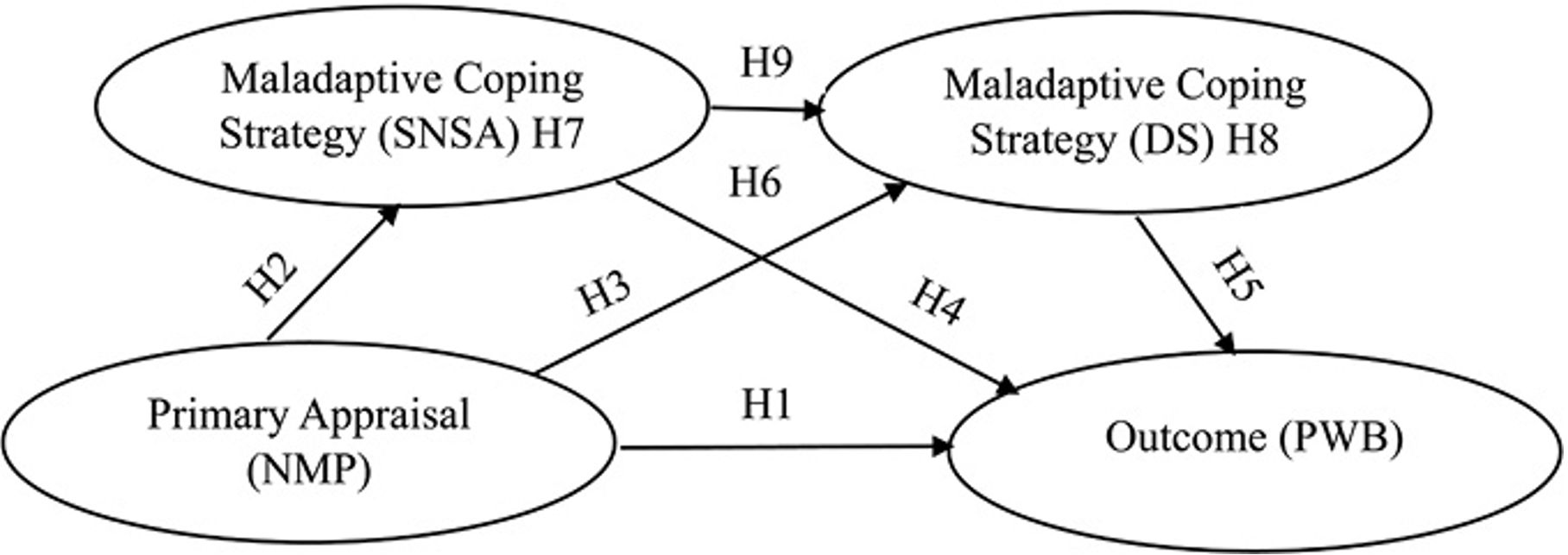
Hypothesis 2: NMP is positively associated with SNSA among emerging adults.
Hypothesis 3: NMP is positively associated with doomscrolling among emerging adults.
Social Network Sites Addiction, Doomscrolling, and Psychological Well-Being
Individuals engaged constantly in social media may experience a decline in PWB due to the negative impact of constant online engagement, such as social comparison and feelings of inadequacy. This addiction may also diminish meaningful face-to-face communication, leaving individuals feeling more worried and isolated from real life. Studies revealed that social media addiction diminishes PWB (Choi & Lim, 2016; Hylkilä et al., 2024; Kuss & Griffiths, 2011; Utz & Breuer, 2017). Similarly, due to constant exposure to unpleasant information, doomscrolling can reduce PWB among individuals. Continuous contact with adverse news and information can intensify depressive feelings and anxiety, which, in turn, reduce PWB (Satici et al., 2022). Evidence suggests that doomscrolling is a negative predictor of PWB (Satici et al., 2023; Taskin et al., 2024). Kuss and Griffiths (2011) highlight that SNSA is associated with negative consequences, including reduced social participation, poor academic performance, and relationship issues, which can predict a decline in PWB. Given these attributes, the following hypotheses are proposed:
Hypothesis 4: SNSA is negatively associated with PWB of emerging adults.
Hypothesis 5: Doomscrolling is negatively associated with PWB of emerging adults.
Social Network Sites Addiction and Doomscrolling
Social network sites addiction can also influence doomscrolling behaviors. As individuals become increasingly addicted to social media, they may spend more time engaging with distressing content online, leading to heightened doomscrolling. Prior research suggests that individuals with high SNSA levels demonstrate compulsive engagement with distressing online content, which may contribute to heightened emotional exhaustion and psychological distress (Satici et al., 2023). Although studies (Satici et al., 2023; Turk-Kurtça, 2025) have explored the relationship between SNSA and doomscrolling, they have not examined whether one predicts the other. Considering these findings, the following hypothesis is proposed:
Hypothesis 6: SNSA is positively associated with doomscrolling among emerging adults.
The Mediating and Chain Mediating Roles of Social Network Sites Addiction and Doomscrolling
Drawing from the transactional model of stress and coping (Lazarus & Folkman, 1984), NMP can be understood as a psychological stressor that triggers maladaptive coping strategies such as SNSA and doomscrolling. While these behaviors may initially appear to reduce anxiety or maintain social connection, they often contribute to a decline in PWB. Additionally, the Compensatory Internet Use Theory (Kardefelt-Winther, 2014) and the Uses and Gratifications Theory (Katz et al., 1973) offer further insight by framing SNSA and doomscrolling as coping mechanisms that individuals turn to when trying to manage the emotional discomfort brought on by NMP. These theoretical frameworks collectively support that SNSA and doomscrolling may serve as mediators, both individually and sequentially, in the relationship between NMP and PWB among emerging adults.
In this context, SNSA is proposed to act as a mediator through which the adverse effects of NMP are transferred, ultimately leading to reduced PWB. Individuals with high levels of NMP may increase their engagement with social networking platforms, which can escalate into addictive patterns and impair PWB (Choi & Lim, 2016). Similarly, doomscrolling is expected to mediate the link between NMP and PWB, as people with high NMP may turn to constant scrolling through negative online content, which worsens their PWB. These coping behaviors, SNSA and doomscrolling, can also work together in a sequence. That is, high NMP may lead to SNSA, which then increases the likelihood of doomscrolling, further raising emotional distress and reducing PWB. The mediating role of SNSA, doomscrolling, or their combined effect as chain mediators in the relationship between NMP and PWB has not been tested previously. Based on this framework, the following hypotheses are proposed:
Hypothesis 7: SNSA mediates the relationship between NMP and PWB of emerging adults.
Hypothesis 8: Doomscrolling mediates the relationship between NMP and PWB of emerging adults.
Hypothesis 9: SNSA and doomscrolling act as a chain mediator in the connection between NMP and PWB of emerging adults.
Within the transactional model of stress and coping framework, high NMP can increase stress due to heightened sensitivity to stressors and limited coping resources. The SNSA and doomscrolling may further exacerbate this by intensifying the perception of resource depletion, negatively impacting PWB. This study aims to explore how NMP affects well-being through the chain mediating effects of SNSA and doomscrolling in emerging adults. Figure 1 displays the conceptual framework anchored in the study’s hypotheses.
Material and Methods
Participants/Sample
Participants were selected based on their enrollment in college, their age between 18 and 24 years, and their smartphone ownership. A total of 423 questionnaires were administered to college students (both undergraduate and postgraduate) over about three weeks. The final analysis encompassed 399 respondents whose data were deemed complete and suitable for inclusion after the exclusion of cases with missing values.
Ethical Committee Approval
Ethics Committee of University of Periyar approved the research proposal No. PUIEC/010/2024, presented on October 25, 2024. The study adhered to the Declaration of Helsinki, with ethical approval obtained (Approval Number: PU/001/IECRHS/2024-11; Date: November 8, 2024).
Sampling and Sample Procedures
A cross-sectional study was utilized to gather data via a questionnaire-based survey. A convenience sampling method was used, taking advantage of the accessibility and proximity of these institutions. Preliminary information regarding the study was effectively disseminated to the principal, faculty members, and students, and consent was meticulously secured from every participant. A good rapport was established with the students, and clear instructions were provided on how to complete the questionnaires. Students were assured that their responses would be kept confidential and would not affect their academic standing. Questionnaires were administered individually in 20- to 30-minute sessions, with groups of 30-40 students at a time.
Instruments
This study utilized four self-administered questionnaires to assess NMP, SNSA, doomscrolling, and PWB. The NMP questionnaire, devised by Yildirim and Correia (2015), comprises 20 items, such as “I would feel uncomfortable without constant access to information through my smartphone,” and measures four dimensions: inability to communicate, loss of connectedness, inability to access information, and surrendering convenience. Participants rated each item on a 7-point Likert scale, with scores ranging from 20 to 140. Higher scores indicated more severe NMP, categorized as absent (20), mild (21-60), moderate (61-100), or severe (≥100). The internal consistency of the scale in the research, as shown by Cronbach’s α, was 0.934.
The SNSA scale, adapted from Koc and Gulyagci (2013) and modified by Choi and Lim (2016), consisted of six items such as “I have difficulties in focusing on my study or work due to social network sites use” and “I lose sleep over spending more time on these social network sites.” Respondents evaluated each statement using a scale ranging from 1 to 7. Higher scores indicated higher levels of SNSA. The SNSA scale demonstrated strong internal consistency with a Cronbach’s α of 0.869.
The doomscrolling questionnaire, developed by Sharma et al. (2022), comprised 15 items, such as “I lose track of time when I read bad news on social media.” Respondents evaluated items on a 7-point Likert scale, where higher scores signified greater doomscrolling. A Cronbach’s α of 0.944 indicated strong internal consistency for the scale.
Diener et al.’s (2010) Flourishing Scale (FS) measures PWB using eight items, including “I lead a purposeful and meaningful life.” Each item was rated by participants on a 7-point Likert scale, with higher scores representing greater PWB. The FS exhibited high internal consistency in the sample, evidenced by a Cronbach’s α of 0.909.
Data Analysis
Prior to analysis, rigorous data checks were conducted to assess normality, identify outliers, and manage any missing values. These preliminary steps were executed using Statistical Package for the Social Sciences (SPSS) version 21.0 (IBM SPSS Corp.; Armonk, NY, USA). After data preparation, Pearson correlation coefficients were computed to identify potential relationships among variables. Moreover, SEM was used to test the mediating effects of SNSA and doomscrolling on the link between NMP and PW. This analytical approach was implemented using Amos version 23.0.
Results
Preliminary Analysis
This study employed Harman’s single-factor test (Collier, 2020) in SPSS to assess potential common method bias (CMB). The results revealed that a single factor explained 31.821% of the total variance, falling short of the 40% threshold (Podsakoff et al., 2003), suggesting minimal CMB concerns. A collinearity test was also performed with PWB as the outcome variable and NMP, SNSA, and doomscrolling as the predictors. The variance inflation factors values were 2.137, 2.310, and 1.270, indicating no significant issues with multicollinearity. Furthermore, the normality test and bivariate correlations were calculated for all variables under analysis. The data’s adherence to normality was assessed by calculating skewness and kurtosis values. The results in Table 1 displayed that both skewness and kurtosis fell within the acceptable limits of −2 to +2 and −7 to +7, respectively, indicating normal distribution (Hair et al., 2023). Added to that, the Pearson correlation coefficients denoted a significant negative link between NMP and PWB (r = −0.243, p = .001), SNSA and PWB (r = −0.365, p = .001), as well as doomscrolling and PWB (r = −0.524, p = .001). Additionally, a positive correlation existed between NMP and SNSA (r = 0.727, p = .001), NMP and doomscrolling (r = 0.379, p = .001), and between SNSA and doomscrolling (r = 0.456, p = .001).
|
N = 399. Note: DS = Doomscrolling; Ku = Kurtosis; M = Mean; NMP = Nomophobia; PWB = Psychological well-being; SD = Standard deviation; Sk = Skewness; SNSA = Social network sites addiction. ***p < .001. |
||||||||
| Table 1. Mean, standard deviation, skewness-kurtosis, and correlation values of the research variables | ||||||||
| Variables |
|
|
|
|
|
|
|
|
| 1. NMP |
|
|
|
|
|
|
|
|
| 2. SNSA |
|
|
|
|
|
|
|
|
| 3. DS |
|
|
|
|
|
|
|
|
| 4. PWB |
|
|
|
|
|
|
|
|
Reliability and Validity
Confirmatory factor analysis (CFA) was conducted for each scale. Table 2 presents the results, including convergent and discriminant validity, reliability, model fit indices, and factor loadings. The CFA was executed to examine the scale’s structure. Fit indices were scrutinized to investigate the CFA model’s adequacy. The results showed a satisfactory fit: X2 = 1.442 (df = 1106, p = .001), CFI = 0.957, TLI = 0.954, SRMR = 0.0383, and RMSEA = 0.033 (Kline, 2016; Hair et al., 2023). Factor loadings ranged from 0.617 to 0.846, demonstrating strong item relationships with their respective factors. Convergent validity was evaluated using factor analysis, composite reliability (CR), and average variance extracted (AVE). As depicted in Table 2, all latent variables exceeded the recommended thresholds: CR ≥ 0.7 and AVE ≥ 0.5 (Fornell & Larcker, 1981; Hair et al., 2023). These findings establish adequate convergent validity for the scale’s items. In addition to that, the discriminant validity of all items in this investigation was analyzed using the square root of the AVE value and the correlation coefficients between different factors. As illustrated in Table 2, all correlation coefficients between latent variables were below the square root of AVE, indicating strong discriminant validity (Fornell & Larcker, 1981). Ultimately, the constructs and scales demonstrated reliable and valid measures. Furthermore, this study employed Cronbach’s alpha to assess item reliability. The Cronbach’s α values for each variable ranged from 0.732 to 0.944, all well above the 0.80 threshold, thus meeting the satisfactory statistical cutoff value of 0.70 (Nunnally & Bernstein, 1994). Thus, the reliability and internal consistency of the instruments used in this analysis had satisfactory statistical reliability.
|
α = Cronbach’s alpha; X2 = Chi-square; AVE = Average variance extracted; CFI = Comparative fit index; CR = Composite reliability; DS = Doomscrolling; Factor I = Not being able to access information; Factor II = Giving up convenience; Factor III = Not being able to communicate; Factor IV = Loss of connection; NMP = Nomophobia; PWB = Psychological well-being; RMSEA = Root mean square error of approximation; SNSA = Social network sites addiction; SRMR = Standardized root mean square residual; TLI = Tucker-Lewis index. ***p < .001. |
||||||||||||||||||||
| Table 2. Summary of measurement model evaluation for each construct | ||||||||||||||||||||
| Construct |
|
|
|
|
|
|
|
|
|
|||||||||||
|
|
|
|
|
|
|
|
||||||||||||||
| NMP four factors (F) |
|
|
|
|
|
|||||||||||||||
| 1. FI |
|
|
|
|
||||||||||||||||
| 2. FII |
|
|
|
|
|
|||||||||||||||
| 3. FIII |
|
|
|
|
|
|
||||||||||||||
| 4. FIV |
|
|
|
|
|
|
|
|||||||||||||
| 5. SNSA |
|
|
|
|
|
|
|
|
|
|
|
|
|
|||||||
| 6. DS |
|
|
|
|
|
|
|
|
|
|
|
|
|
|
||||||
| 7. PWB |
|
|
|
|
|
|
|
|
|
|
|
|
|
|
|
|||||
| Item loadings | ||||||||||||||||||||
| Construct |
|
|
|
|
|
|
|
|
|
|
|
|
|
|
|
|
|
|
|
|
| NMP FI |
|
|
|
|
||||||||||||||||
| NMP FII |
|
|
|
|
|
|||||||||||||||
| NMP FIII |
|
|
|
|
|
|
||||||||||||||
| NMP FIV |
|
|
|
|
|
|||||||||||||||
| SNSA |
|
|
|
|
|
|
||||||||||||||
| DS |
|
|
|
|
|
|
|
|
|
|
|
|
|
|
|
|||||
| PWB |
|
|
|
|
|
|
|
|
||||||||||||
Mediation Model
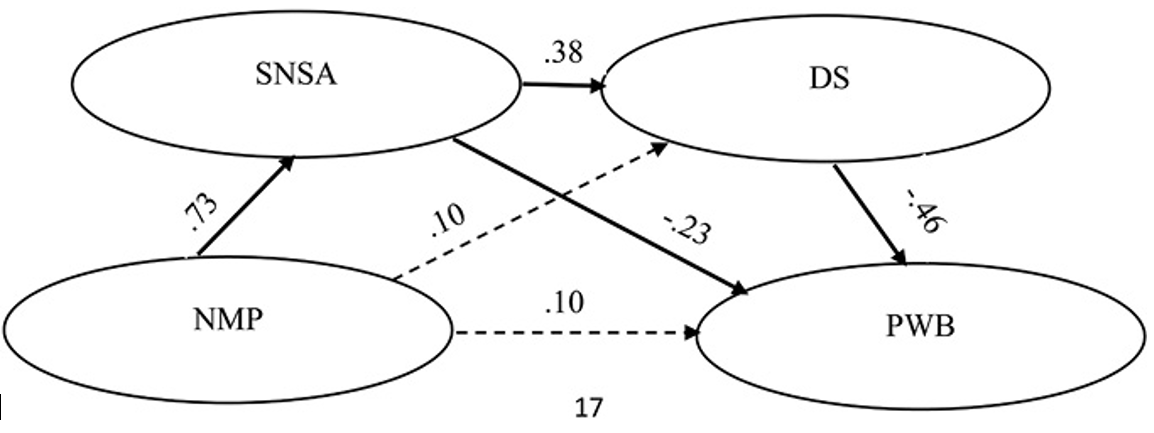
A structural model was established which produced good fit indices X2 = 2.399 (df = 1, p = .121), RMSEA = 0.059, NFI = 0.996, CFI = 0.997, SRMR = 0.0141, and TLI = 0.984 (Kline, 2016; Hair et al., 2023). Prior to performing the mediation analyses, the link between NMP and PWB was examined. The outcome indicated that the direct influence of NMP on PWB, with mediators present, was not statistically significant (β = 0.095, p = .192), thereby not supporting H1. NMP positively influenced SNSA (β = 0.727, p = .001), which confirms H2. In contrast, the direct effect of NMP on doomscrolling was not significant (β = 0.101, p = .117), thus not supporting H3. However, SNSA negatively predicted PWB (β = −0.226, p = .004), confirming H4. Likewise, doomscrolling negatively influenced PWB (β = −0.457, p = .001), providing support for H5. Additionally, a significant positive link between SNSA and doomscrolling (β = 0.382, p = .001) was observed, verifying H6. To examine the mediating effects of SNSA and doomscrolling, a bootstrapping analysis using a sample of 5000 was conducted. The results showed that SNSA fully mediated the relationship between NMP and PWB (β = −0.036, p = .002), supporting H7. On the other hand, the mediating role of doomscrolling in the relationship between NMP and PWB was not significant (β = −0.014, p = .108), indicating that H8 was not supported. Notably, NMP’s impact on PWB was completely chain-mediated by SNSA and doomscrolling (β = −0.039, p = .001), thus supporting H9. All path coefficients were significant in this model, as demonstrated in Figure 2. Detailed effect sizes of direct and indirect paths are outlined in Table 3.
| Note: DS = Doomscrolling; LCL = Lower confidence limit; NMP = Nomophobia; PWB = Psychological well-being; SE = Standard error; SNSA = Social network sites addiction; UCL = Upper confidence limit. | |||||||
| Table 3. The standardized estimates of the SEM and hypothesis testing | |||||||
| Paths |
|
|
|
|
|
Result | Hypotheses |
| Standardized direct effects | |||||||
| NMP → PWB |
|
|
|
|
|
Not significant | H1 not supported |
| NMP → SNSA |
|
|
|
|
|
Significant | H2 supported |
| NMP → Doomscrolling |
|
|
|
|
|
Not significant | H3 not supported |
| SNSA → PWB |
|
|
|
|
|
Significant | H4 supported |
| Doomscrolling → PWB |
|
|
|
|
|
Significant | H5 supported |
| SNSA → Doomscrolling |
|
|
|
|
|
Significant | H6 supported |
| Standardized indirect effects | |||||||
| NMP → SNSA → PWB |
|
|
|
|
|
Full mediation | H7 supported |
| NMP → Doomscrolling → PWB |
|
|
|
|
|
Not significant | H8 not supported |
| NMP → SNSA → Doomscrolling → PWB |
|
|
|
|
|
Chain mediation | H9 supported |
Discussion
This study explored the complex relationships between NMP, SNSA, doomscrolling, and PWB in emerging adults, grounded in the transactional model of stress and coping. As hypothesized, significant correlations were found: NMP negatively correlated with PWB, but positively correlated with SNSA and doomscrolling. Additionally, SNSA and doomscrolling were positively correlated, reinforcing their interconnectedness.
The SEM analysis revealed that the direct path from NMP to PWB was not statistically significant when SNSA and doomscrolling were included in the model, suggesting that NMP influences PWB indirectly through these maladaptive coping behaviors. This reinforces the need to explore SNSA and doomscrolling as key mediators in the relationship between NMP and PWB. Specifically, the relationship between NMP and PWB received validation in previous research (Lee et al., 2018; Tuco et al., 2023). This study presents distinct research outcomes because it shows that NMP affects well-being through dysfunctional behavioral patterns. The NMP exists with compulsive social media behavior and exposure to negative content, which together produce detrimental impacts on well-being. The structural model also demonstrated that NMP significantly predicted SNSA, aligning with the idea that those with high levels of NMP are more likely to engage in compulsive social media use (Oraison & Wilson, 2024). This confirms that SNSA serves as a maladaptive coping mechanism for managing disconnection-related anxiety (Seo & Ray, 2019). However, NMP did not predict doomscrolling directly, suggesting that other psychological or contextual factors influence doomscrolling. This distinction warrants further investigation into the contextual triggers of doomscrolling, which may not be solely driven by NMP but could include factors like personality traits or media exposure.
Interestingly, both SNSA and doomscrolling contributed significantly to lower PWB, emphasizing the harmful effects of excessive online engagement and consuming distressing content. These behaviors can disrupt real-life interactions and elevate psychological distress (Blease, 2015; Choi & Lim, 2016; Satici et al., 2023). Moreover, SNSA significantly predicted doomscrolling, suggesting a pathway where increased social media use encourages doomscrolling. The transformation of doomscrolling from a purposeful behavior to a habitual, stress-reinforcing activity may help explain its negative effects on well-being (Sharma et al., 2022; Satici et al., 2023).
The mediational analysis indicated that SNSA completely mediated the relationship between NMP and PWB. This finding suggests that individuals with severe NMP may excessively rely on mobile phones to stay connected, which can lead to SNSA and poorer PWB. This result aligns with Choi and Lim (2016), Bevan et al. (2012), and Blease (2015), who found that SNSA mediates the relationship between social media overload and well-being. However, doomscrolling did not independently mediate the NMP-PWB relationship when SNSA was accounted for, reinforcing the idea that SNSA encompasses behaviors that may include doomscrolling, thus overshadowing its unique contribution (Gonzalez & MacKinnon, 2021).
The study also revealed a full-chain mediating effect of SNSA and doomscrolling in the link between NMP and PWB, eliminating the direct association between NMP and PWB. This chain mediation underscores the importance of SNSA and doomscrolling as intermediaries in this relationship. These external distractions serve as temporary coping mechanisms, which may fail to address the underlying sources of stress. This is consistent with Sriwilai and Charoensukmongkol’s (2015) argument that such distractions can provide short-term relief but are ultimately maladaptive. While SNSA and doomscrolling may offer temporary relief from anxiety, they perpetuate a cycle of dependency on digital devices for emotional regulation, undermining PWB in the long run (Satici et al., 2023; Güme, 2024). This highlights the need for adaptive coping strategies that promote emotional resilience without relying on harmful digital behaviors.
The findings should be considered within India’s socio-cultural context, where collectivism, high academic expectations, and close family involvement significantly shape student behavior (Chadda & Deb, 2013). The increase in mobile usage among Indian students after COVID likely intensified their feelings of NMP because SNSA is a key factor that bridges NMP to psychological distress in this study. The SNSA drives people into doomscrolling, which worsens their emotional state while compromising their well-being. This growing digital dependence creates a conflict with India’s cultural values that prioritize mindful living and social connectedness (Kanchibhotla et al., 2024), and in doing so, potentially undermines core socio-cultural pillars such as collectivism, high academic expectations, and close family involvement. Evidence suggests that both mindfulness and social connectedness are declining among students (Alvarado-García et al., 2025; Chhajer & Hira, 2024; Varghese & Mathew, 2023) by impairing attention and emotional regulation (Singh et al., 2022) while fostering loneliness and social isolation (Engti et al., 2022; Singh et al., 2022), ultimately affecting students’ well-being (Ganguly et al., 2022). Therefore, addressing SNSA is essential, as it serves as the main pathway through which NMP and doomscrolling disrupt psychological health.
The boundary conditions of this study offer further interpretive depth. During emerging adulthood, when individuals actively explore their identities and engage in intensified social comparison (Gyberg & Frisén, 2017), NMP may be more likely to trigger behavioral consequences (Baig & Rajini, 2024; Shabahang et al., 2023). The relationships between NMP and related outcomes may be influenced by emotion regulation, resilience, and access to social support. Individuals with strong offline social networks tend to exhibit better psychological regulation and may prefer adaptive coping strategies over SNSA or doomscrolling. Further empirical investigation is needed to examine these potential moderating factors, which were not included in the current study. Strengthening psychological resources in emerging adults may help transform digital engagement from a reactive escape into a conscious, regulated choice, thereby buffering the negative effects of NMP on well-being.
Importantly, these findings reinforce the transactional model of stress and coping framework’s proposition that maladaptive coping arises when individuals perceive a stressor as overwhelming and lack appropriate coping resources (Lazarus & Folkman, 1984). Here, NMP is likely appraised as a threat to social inclusion, prompting avoidant strategies such as compulsive digital engagement. While such behaviors may offer short-term relief, they eventually lead to increased rumination, anxiety, sleep disturbances, and diminished well-being (Jennett et al., 2008; Sharma et al., 2022). This maladaptive feedback loop mirrors patterns found in substance addiction, providing comfort while worsening underlying distress (Yildirim & Correia, 2015).
Limitations
Acknowledging the study’s limitations, including the inability to infer causality due to its cross-sectional nature and potential biases in participant self-reports, is essential. While this study focused on NMP, SNSA, doomscrolling, and PWB, there may be additional variables that may contribute to or moderate these relationships. Future research may explore other relevant factors, such as personality traits, emotion regulation, resilience, and social support, to enhance the understanding of technology-related mental health outcomes. Further studies, preferably using longitudinal or experimental designs, are needed to confirm the causal pathways. Despite these limitations, addressing NMP, SNSA, and doomscrolling through targeted interventions and educational initiatives holds promise for promoting healthier technology usage and enhancing overall well-being among emerging adults.
Implications
This study confirms that NMP negatively impacts PWB, with SNSA fully mediating this effect. When SNSA is considered, the role of doomscrolling as a mediator is less significant. The study underscores the chain mediation of SNSA and doomscrolling in the NMP-PWB relationship and emphasizes the need for adaptive coping strategies. It bridges educational psychology, clinical psychology, behavioral sciences, and digital well-being by advocating for Cognitive Behavioral Therapy, Acceptance and Commitment Therapy, and Mindfulness-Based Interventions. The transactional model of stress and coping framework also highlights the role of educational institutions in implementing targeted interventions and awareness campaigns, ultimately contributing to healthier digital habits and improved psychological resilience in emerging adults.
This research emphasizes the intricate interplay between NMP, SNSA, doomscrolling, and PWB, highlighting the critical role of SNSA in shaping well-being among emerging adults. The study reveals that SNSA not only mediates the relationship between NMP and PWB but also acts as a chain mediator that exacerbates the effects of NMP through doomscrolling behavior. These findings emphasize the urgent need for tailored mental health interventions that target SNSA and digital coping strategies, such as Acceptance and Commitment Therapy, Cognitive Behavioral Therapy, and Mindfulness-Based Interventions, to reduce the negative psychological impact of smartphone dependency. Addressing these behaviors in an increasingly digital world is crucial for improving well-being and promoting healthier interactions with technology.
Acknowledgements
The author acknowledges the study participants for their time and cooperation, and the institutions that provided permission for data collection.
Ethical approval
This study was approved by the Institutional Ethics Committee of Periyar University (Date: November 8, 2024, Decision/Protocol No: PU/001/IECRHS/2024-11). Informed consent was obtained from all participants involved in this study.
Data availability statement
The data that support the findings of this study are available from the corresponding author upon reasonable request.
Conflict of interest
The authors declare that this study was conducted in the absence of any commercial or financial relationships that could be construed as a potential conflict of interest.
Funding
The authors declare that this study received no funding.
Generative AI statement
The authors declare that during the preparation of this study, the following AI-assisted technology was used: During the preparation of this work, we used AI language tools from November 25 to 30, 2024, for English language polishing of translated content. After using these tools, we reviewed and edited the content as needed and took full responsibility for the content of the publication.
References
- Al-Mamun, A. F., Başpınar, M. M., & Basat, O. (2022). The relationship of job satisfaction with nomophobia and social media addiction in healthcare professionals: A cross-sectional study. Bagcilar Medical Bulletin, 7(4), 311-318. https://doi.org/10.4274/BMB.galenos.2022.2022-06-052
- Al-Mamun, F., Mamun, M. A., Prodhan, M. S., Muktarul, M., Griffiths, M. D., Muhit, M., & Sikder, M. T. (2023). Nomophobia among university students: Prevalence, correlates, and the mediating role of smartphone use between facebook addiction and nomophobia. Heliyon, 9(3), e14284. https://doi.org/10.1016/j.heliyon.2023.e14284
- Alvarado-García, P. A. A., Soto-Vásquez, M. R., Infantes Gomez, F. M., Guzman Rodriguez, N. M., & Castro-Paniagua, W. G. (2025). Effect of a mindfulness program on stress, anxiety, depression, sleep quality, social support, and life satisfaction: A quasi-experimental study in college students. Frontiers in Psychology, 16, 1508934. https://doi.org/10.3389/fpsyg.2025.1508934
- Amez, S., & Baert, S. (2020). Smartphone use and academic performance: A literature review. International Journal of Educational Research, 103, 101618. https://doi.org/10.1016/j.ijer.2020.101618
- Baig, M. G., & Rajini, T. (2024). The influence of smartphone addiction and nomophobia on lifestyle and mental health: Behavioural disruptions and intervention strategies. International Journal of Indian Psychology, 12(4), 677-679. https://doi.org/10.25215/1204.063
- Bartwal, J., & Nath, B. (2020). Evaluation of nomophobia among medical students using smartphones in North India. Medical Journal, Armed Forces India, 76(4), 451-455. https://doi.org/10.1016/j.mjafi.2019.03.001
- Bevan, J. L., Pfyl, J., & Barclay, B. (2012). Negative emotional and cognitive responses to being unfriended on Facebook: An exploratory study. Computers in Human Behavior, 28(4), 1458-1464. https://doi.org/10.1016/j.chb.2012.03.008
- Blease, C. R. (2015). Too many ‘friends,’ too few ‘likes’? Evolutionary psychology and ‘Facebook depression’. Review of General Psychology, 19(1), 1-13. https://doi.org/10.1037/gpr0000030
- Bülbüloğlu, S., Özdemir, A., Kapıkıran, G., & Sarıtaş, S. (2020). The effect of nomophobia behavior of nurses working at surgical clinics on time management and psychological well-being. Journal of Substance Use, 25(3), 318-323. https://doi.org/10.1080/14659891.2019.1692926
- Can, L., & Kaya, N. (2016). Social networking sites addiction and the effect of attitude towards social network advertising. Procedia-Social and Behavioral Sciences, 235, 484-492. https://doi.org/10.1016/j.sbspro.2016.11.059
- Canero Perez, M., Mónaco Gerónimo, E., & Montoya Castilla, I. (2019). Emotional intelligence and empathy as predictors of subjective well-being in university students. European Journal of Investigation in Health, Psychology and Education, 9(1), 19-29. https://doi.org/10.30552/ejihpe
- Chadda, R. K., & Deb, K. S. (2013). Indian family systems, a collectivistic society, and psychotherapy. Indian Journal of Psychiatry, 55(Suppl. 2), S299-S309. https://doi.org/10.4103/0019-5545.105555
- Chhajer, R., & Hira, N. (2024). Exploring positive psychology intervention and mindfulness-based intervention in nature: Impact on well-being of school students in India. Frontiers in Public Health, 12, 1297610. https://doi.org/10.3389/fpubh.2024.1297610
- Choi, S. B., & Lim, M. S. (2016). Effects of social and technology overload on psychological well-being in young South Korean adults: The mediatory role of social network service addiction. Computers in Human Behavior, 61, 245-254. https://doi.org/10.1016/j.chb.2016.03.032
- Collier, J. (2020). Applied structural equation modeling using AMOS: Basic to advanced techniques. (1st ed.). Routledge. https://doi.org/10.4324/9781003018414
- Davey, S., & Davey, A. (2014). Assessment of smartphone addiction in Indian adolescents: A mixed-method study by systematic review and meta-analysis approach. International Journal of Preventive Medicine, 5(12), 1500-1511.
- Diener, E., Wirtz, D., Tov, W., Kim-Prieto, C., Choi, D. W., Oishi, S., & Biswas-Diener, R. (2010). New well-being measures: Short scales to assess flourishing and positive and negative feelings. Social Indicators Research, 97(2), 143-156. https://doi.org/10.1007/s11205-009-9493-y
- Dolapoğlu, N., Türk, E., Yürür, E. K., Can, M. Ş., Alçı, D., Tulacı, R. G., Baykan, H., & Karlıdere, T. (2025). Never without my mobile phone: The relationship between nomophobia, social media addiction and emotion regulation difficulties. Bağımlılık Dergisi, 26(1), 59-67. https://doi.org/10.51982/bagimli.1511840
- Engti, R., Momin, M. H., & Vyas, S. N. (2022). Social media addiction and its impact among the school students during Covid-19 lockdown in an urban area of Western India: A cross-sectional study. International Journal of Research in Medical Sciences, 10(12), 2870. https://doi.org/10.18203/2320-6012.ijrms20223090
- Fornell, C., & Larcker, D. F. (1981). Evaluating structural equation models with unobservable variables and measurement error. Journal of Marketing Research, 18(1), 39-50. https://doi.org/10.1177/002224378101800104
- Ganguly, A., Mukherjee, T., & Chowdhury, S. (2022). Social media addiction, fear of missing out and social competence of adolescents: An exploratory study. Indian Journal of Clinical Psychology, 49(3).
- Gonzalez, O., & MacKinnon, D. P. (2021). The measurement of the mediator and its influence on statistical mediation conclusions. Psychological Methods, 26(1), 1-17. https://doi.org/10.1037/met0000263
- Güme, S. (2024). Doomscrolling: A review. Psikiyatride Güncel Yaklaşımlar, 16(4), 595-603. https://doi.org/10.18863/pgy.1416316
- Gyberg, F., & Frisén, A. (2017). Identity status, gender, and social comparison among young adults. Identity, 17(4), 239-252. https://doi.org/10.1080/15283488.2017.1379905
- Hair, J., Hair Jr., J. F., Sarstedt, M., Ringle, C. M., & Gudergan, S. P. (2023). Advanced issues in partial least squares structural equation modeling. Sage Publications.
- Humood, A., Altooq, N., Altamimi, A., Almoosawi, H., Alzafiri, M., Bragazzi, N. L., Husni, M., & Jahrami, H. (2021). The prevalence of nomophobia by population and by research tool: A systematic review, meta-analysis, and meta-regression. Psych, 3(2), 249-258. https://doi.org/10.3390/psych3020019
- Hussain, Z., & Griffiths, M. D. (2018). Problematic social networking site use and comorbid psychiatric disorders: A systematic review of recent large-scale studies. Frontiers in Psychiatry, 9, 686. https://doi.org/10.3389/fpsyt.2018.00686
- Hylkilä, K., Männikkö, N., Peltonen, A., Castrén, S., Mustonen, T., Konttila, J., Männistö, M., & Kääriäinen, M. (2024). Association between problematic social networking site use and social well-being among young adults: A systematic review. Journal of Affective Disorders Reports, 16, 100775. https://doi.org/10.1016/j.jadr.2024.100775
- Jahrami, H., Fekih Romdhane, F., Pandi-Perumal, S. R., BaHammam, A. S., & Vitiello, M. V. (2023). Global research evidence on nomophobia during 2008-2022: A bibliometric analysis and review. Psychology, Health and Medicine, 1-16.
- Jennett, C., Cox, A. L., Cairns, P., Dhoparee, S., Epps, A., Tijs, T., & Walton, A. (2008). Measuring and defining the experience of immersion in games. International Journal of Human-Computer Studies, 66(9), 641-661. https://doi.org/10.1016/j.ijhcs.2008.04.004
- Kanchibhotla, D., Harsora, P., & Subramanian, S. (2024). Influence of yogic breathing in increasing social connectedness among Indian adults. Acta Psychologica, 243, 104164. https://doi.org/10.1016/j.actpsy.2024.104164
- Kardefelt-Winther, D. (2014). A conceptual and methodological critique of internet addiction research: Towards a model of compensatory internet use. Computers in Human Behavior, 31, 351-354. https://doi.org/10.1016/j.chb.2013.10.059
- Katz, E., Blumler, J. G., & Gurevitch, M. (1973). Uses and gratifications research. Public Opinion Quarterly, 37(4), 509-523. https://doi.org/10.1086/268109
- Kim, E., Song, D., Park, D., Kim, H., & Shin, G. (2024). Effect of smartphone use on cervical spine stability. Journal of Biomechanics, 166, 112053. https://doi.org/10.1016/j.jbiomech.2024.112053
- King, A. L. S., Valença, A. M., & Nardi, A. E. (2010). Nomophobia: The mobile phone in panic disorder with agoraphobia: Reducing phobias or worsening of dependence?. Cognitive and Behavioral Neurology: Official Journal of the Society for Behavioral and Cognitive Neurology, 23(1), 52-54. https://doi.org/10.1097/WNN.0b013e3181b7eabc
- Kline, R. B. (2016). Principles and practice of structural equation modeling (3rd ed.). Guilford Press.
- Koc, M., & Gulyagci, S. (2013). Facebook addiction among Turkish college students: The role of psychological health, demographic, and usage characteristics. Cyberpsychology, Behavior and Social Networking, 16(4), 279-284. https://doi.org/10.1089/cyber.2012.0249
- Kuss, D. J., & Griffiths, M. D. (2011). Online social networking and addiction-a review of the psychological literature. International Journal of Environmental Research and Public Health, 8(9), 3528-3552. https://doi.org/10.3390/ijerph8093528
- Lazarus, R. S., & Folkman, S. (1984). Stress, appraisal, and coping. Springer.
- Lee, S., Kim, M., Mendoza, J. S., & McDonough, I. M. (2018). Addicted to cell phones: Exploring the psychometric properties between the nomophobia questionnaire and obsessiveness in college students. Heliyon, 4(11), 2018.e00895. https://doi.org/10.1016/j.heliyon
- Lin, C. Y., Potenza, M. N., Ulander, M., Broström, A., Ohayon, M. M., Chattu, V. K., & Pakpour, A. H. (2021). Longitudinal relationships between nomophobia, addictive use of social media, and insomnia in adolescents. Healthcare, 9(9), 1201. https://doi.org/10.3390/healthcare9091201
- Maftei, A., & Pătrăușanu, A. M. (2024). Digital reflections: Narcissism, stress, social media addiction, and nomophobia. Journal of Psychology, 158(2), 147-160. https://doi.org/10.1080/00223980.2023.2256453
- Nawaz, S. (2023). Rethinking classifications and metrics for problematic smartphone use and dependence: Addressing the call for reassessment. Computers in Human Behavior Reports, 12, 100327. https://doi.org/10.1016/j.chbr.2023.100327
- Nunnally, J., & Bernstein, I. (1994). Psychometric theory (3rd ed.). MacGraw-Hill.
- Oraison, H., & Wilson, B. (2024). The relationship between nomophobia, addiction, and distraction. Journal of Technology in Behavioral Science, 9(4), 745-751. https://doi.org/10.1007/s41347-024-00392-z
- Podsakoff, P. M., MacKenzie, S. B., Lee, J.-Y., & Podsakoff, N. P. (2003). Common method biases in behavioral research: A critical review of the literature and recommended remedies. Journal of Applied Psychology, 88(5), 879-903. https://doi.org/10.1037/0021-9010.88.5.879
- Ryff, C. D. (1989). Happiness is everything, or is it? Explorations on the meaning of psychological well-being. Journal of Personality and Social Psychology, 57(6), 1069-1081. https://doi.org/10.1037/0022-3514.57.6.1069
- Satici, S. A., Gocet Tekin, E., Deniz, M. E., & Satici, B. (2023). Doomscrolling scale: Its association with personality traits, psychological distress, social media use, and well-being. Applied Research in Quality of Life, 18(2), 833-847. https://doi.org/10.1007/s11482-022-10110-7
- Seo, D., & Ray, S. (2019). Habit and addiction in the use of social networking sites: Their nature, antecedents, and consequences. Computers in Human Behavior, 99, 109-125. https://doi.org/10.1016/j.chb.2019.05.018
- Shabahang, R., Kim, S., Hosseinkhanzadeh, A. A., Aruguete, M. S., & Kakabaraee, K. (2023). Give your thumb a break. Media Psychology, 26(4), 460-479. https://doi.org/10.1080/15213269.2022.2157287
- Sharma, B., Lee, S. S., & Johnson, B. K. (2022). Supplemental material for the dark at the end of the tunnel: Doomscrolling on social media newsfeeds. Technology, Mind, and Behavior, 3(1), 144-156. https://doi.org/10.1037/tmb0000059.supp
- Singh, S., Singh, S., & Sharma, M. (2022). A study on mental health of students addicted to social networking sites. International Journal of Indian Psychology, 10(1), 565-571. https://doi.org/10.25215/1001.056
- Sriwilai, K., & Charoensukmongkol, P. (2015). Face it, do not Facebook it: Impacts of social media addiction on mindfulness, coping strategies, and the consequences on emotional exhaustion. Stress and Health, 32(4), 427-434. https://doi.org/10.1002/smi.2637
- Statista (2023). The number of smartphone users in India from 2010 to 2023, with estimates for 2040 (in millions). Statista. https://www.statista.com/statistics/467163/forecast-of-smartphone-users-in-india/
- Taskin, S., Yildirim Kurtulus, H., Satici, S. A., & Deniz, M. E. (2024). Doomscrolling and mental well-being in social media users: A serial mediation through mindfulness and secondary traumatic stress. Journal of Community Psychology, 52(3), 512-524. https://doi.org/10.1002/jcop.23111
- Tuco, K. G., Castro-Diaz, S. D., Soriano-Moreno, D. R., & Benites-Zapata, V. A. (2023). Prevalence of nomophobia in university students: A systematic review and meta-analysis. Healthcare Informatics Research, 29(1), 40-53. https://doi.org/10.4258/hir.2023.29.1.40
- Turel, O., & Serenko, A. (2012). The benefits and dangers of enjoyment with social networking websites. European Journal of Information Systems, 21(5), 512-528. https://doi.org/10.1057/ejis.2012.1
- Turk-Kurtça, T. (2025). Generalized anxiety disorder and social media addiction relationships: The role of psychological resilience, doomscrolling, and cyberchondria severity. Psihologija, 58(3), 319-342. https://doi.org/10.2298/PSI230921004T
- Utz, S., & Breuer, J. (2017). The relationship between the use of social network sites, online social support, and well-being. Journal of Media Psychology, 29(3), 115-125. https://doi.org/10.1027/1864-1105/a000222
- Varghese, M. S. M., & Mathew, M. A. M. (2023). Social connectedness, academic self-efficacy, and life satisfaction among international and domestic college students from India. International Journal of Indian Psychology, 11(3), 682-690. https://doi.org/10.25215/1103.064
- Wibowo, A., & Safaria, T. (2025). The role of FOMO on psychological well-being with nomophobia as a mediator among college students. Current Psychology, 44(7), 6092-6101. https://doi.org/10.1007/s12144-025-07636-y
- Xu, H., & Tan, B. C. (2012). Why do I keep checking Facebook: Effects of message characteristics on the formation of social network services addiction. ICIS 2012 Proceedings.
- Yildirim, C., & Correia, A. P. (2015). Exploring the dimensions of nomophobia: Development and validation of a self-reported questionnaire. Computers in Human Behavior, 49, 130-137. https://doi.org/10.1016/j.chb.2015.02.059
License
Copyright (c) 2026 The Author(s). This is an open access article distributed under the Creative Commons Attribution License (CC BY), which permits unrestricted use, distribution, and reproduction in any medium or format, provided the original work is properly cited.